The Window of Formation

AI help isn't the problem. Timing is.
By Jim Germer
Introduction:
Read This Before You Let Your Kid Ask AI Another Homework Question.
Somewhere in your house tonight, a kid is going to open an AI chatbot to help with homework. Nothing dramatic will happen. No alarm will sound. The essay will get written, the math problem will get solved, and everyone will move on with their evening. This page is not about stopping that. It is about a question almost nobody is asking while it happens.
The public conversation about AI and children has settled into a familiar shape. One side warns that AI is making kids dumber, lazier, and less able to think. The other side points out that every generation panics about a new technology, and every generation turns out fine. Both sides are arguing about whether AI is good or bad. That is the wrong argument, and this page is built to make the case for a different one.
The real question is not whether a child uses AI. It is when, relative to whether the underlying capacity has already been built. The same AI tool, doing the exact same thing, can help one learner and quietly cost another. The difference is not the tool. It is whether the person using it already knows how to do the thing the tool is doing for them.
This distinction is not a guess, and it is not a metaphor borrowed from an unrelated field. It comes from a randomized study of adult professionals learning a new technical skill, published in early 2026, and it is backed by decades of research on how people learn under different kinds of assistance. Every specific number that appears on this page has been checked against its original source before being written down. Where a claim is solid, it will be stated plainly, without unnecessary hedging. Where a claim is a reasonable extension of solid evidence but not yet proven, it will be labeled that way. Where something is genuinely unknown, this page will say so directly, rather than filling the gap with a confident-sounding guess.
That distinction matters more than it might seem. A great deal of what gets written about AI and children blurs the line between what researchers have actually shown and what sounds plausible enough to repeat. This page tries not to do that. If a claim cannot be traced to something real and checkable, it will not appear here dressed up as fact.
By the end of this page, the goal is not for you to feel afraid of AI, and it is not for you to feel reassured that everything is fine. The goal is for you to understand one specific, testable idea clearly enough to apply it in your own home or classroom: that timing, not access, is the variable that actually matters. What follows is the evidence for that claim, the argument that stands even if part of the evidence turns out to be incomplete, and a plain answer to the question every parent eventually asks — what, exactly, am I supposed to do about it?
Executive Summary

Read This If You've Got Five Minutes Instead of Twenty.
Here's the thing nobody's saying clearly enough: this isn't actually an argument about whether AI is good or bad for your kid's brain. That question doesn't have a real answer, because it's the wrong question. The real one is simpler and a lot more useful — does the help show up before your kid has learned to do the thing, or after? Same AI, same homework, same fifteen minutes at the kitchen table. Whether it helps or quietly costs them depends entirely on that one variable. Nothing else.
That's also the "window" in this page's title, by the way. Not a fixed age, not a door that slams shut on some birthday. Just the possibility that the order help arrives in matters on its own, separately from how much practice someone eventually gets. That's the whole idea this page is built to investigate, and it's worth saying upfront that "investigate" is the right word, not "prove." More on that in a minute.
We didn't just assert any of this and move on. We checked and sorted everything we found into three honest piles: things that are actually proven, things that are a reasonable bet based on real evidence, and things that are still just open questions. Most writing on this subject blurs those three together. This page tries hard not to.
Start with the one piece of hard evidence in the first pile, the proven one. Fifty-two adult professionals, a real study, published by researchers at Anthropic in January 2026, learning a coding skill from scratch. Half got AI help. Half didn't. Afterward, everyone took a quiz on whether they actually understood what they'd just done. The AI group scored seventeen points lower, roughly two letter grades. Not because they were lazy. They finished the task fine. What happened is quieter than that: the group without AI hit a wall, three separate times on average, and had to climb over it themselves. The AI group hit that wall once. AI wasn't just helping. It was removing the exact experience that builds the skill in the first place.
That's not a guess. That's measured.
There's a distinction underneath that finding worth naming, because it explains something that would otherwise look like a contradiction. Some research finds AI genuinely helps people learn faster. Other research finds it leaves people worse off. Both can be true at once, because they're not measuring the same thing. Help that supports someone while they do the thinking themselves is different from help that just does the thinking instead. The first is what a good tutor does. The second is what happens when the answer arrives before the struggle does. Same word, "help," pointing at two completely different things, and that difference, not whether AI got used at all, is what actually predicted who learned something and who didn't.
From there, this page splits the argument into two pieces, deliberately, because they don't need each other to be true. One piece is about what happens inside a single kid's head, the distinction above. The other piece is bigger than any one learner. It's about something every profession has quietly relied on for generations: junior work has always produced two things at once, the finished task and a slightly more capable person. Nobody had to manage that second part on purpose. It just happened, as a side effect of grinding through boring entry-level work under some supervision. AI can now produce the finished task without producing the person. That's not a theory. It's already showing up in hiring data, three separate research teams, three different datasets, all finding the same pattern: workers in their early twenties, in the jobs AI touches most, are getting hired into entry-level roles noticeably less often than before. Not laid off. Just never let onto the ladder in the first place. Nobody's fully ruled out other explanations yet, and this page says so directly. But three independent teams landing in the same place is worth taking seriously.
Here's the part worth sitting with for a second: even if every developmental claim on this page eventually turned out to be wrong, that second argument, the one about junior work and who trains the next generation, would still stand entirely on its own. It doesn't need a brain science finding to be true. It just needs three plain facts nobody really disputes: expertise gets built through experience, AI is increasingly doing the work that experience used to come from, and no company is required by any law of economics to replace what it's no longer providing automatically. That's a real problem whether or not anything else on this page holds up.
Now, here's where we get honest about the part that isn't proven yet, the piece still sitting in the "open question" pile, because a page that only tells you what confirms its own title isn't worth trusting. The specific claim in this page's name, that timing itself, independent of everything else, changes a person's outcome for good, nobody has actually run that experiment. Not for coding, not for writing, not for anything. We say so, directly, because the alternative is pretending a hunch is a finding, and that's exactly the move this page refuses to make. What we do have is everything pointing in the same direction, hard enough that ignoring it seems like the riskier bet, not the safer one.
Since nobody knows yet, we laid out the three honest ways this could go, rather than picking the one that makes the best headline. It's possible the gap closes on its own with a little ordinary practice, more like a debt that pays itself down than a permanent loss. It's possible it closes, but only with real, deliberate effort, more expensive than getting it right the first time. And it's possible, in the worst case, that it doesn't close at all, even with real effort, meaning the order in which things happened actually mattered permanently. We don't know which of those three is true. Nobody does yet. But they're not equally serious, and that difference in stakes, not a guess about which one is real, is the actual argument for taking this seriously now rather than waiting.
So what do you actually do with all that, tonight, without waiting for a study that might be years away?
Not much, honestly. That's kind of the point. The single biggest thing costs nothing: ask to see the attempt before the AI gets involved. Messy first try, on paper, in their own words, before the chat window opens. That's it. That's the whole household rule. It protects the moment this page has argued matters most, without turning you into someone who tracks screen time or interrogates every homework session.
Every so often, ask your kid to do something similar without the AI, just to see. Not a trap. Just information. If it goes fine, great, the skill's really there. If it falls apart, you just found out something worth knowing now, while there's still time to do something about it, instead of years from now.
Schools have a version of this too. Chasing down AI-written essays after the fact turns every student into a suspect. A better instinct is making sure some real chunk of graded work still happens the old way, in the room, unaided, with real mistakes in it, not because AI is banned, but because that's the only way anyone can actually tell whether a skill got built or just skipped.
Here's the part that makes all of this worth doing regardless of how the bigger question eventually resolves: if this page turns out to be wrong, these same habits still produce better learning. Struggling with something before getting help is good practice, no matter what the research eventually shows about timing specifically. And if this page turns out to be right, those same small habits become the thing that actually mattered. Either way, nothing about doing this costs you anything or requires betting on an outcome nobody can predict yet.
And because a claim that can't be checked isn't really a claim, this page ends by putting a stake in the ground, publicly, with a date attached, which is the kind of thing very little writing on this topic ever actually does. If this mechanism is real, the gap between what someone can do with AI's help and what they can do without it should visibly widen, sometime between 2029 and 2031, among people starting their careers right now, specifically in the tasks where AI is doing the work instead of supporting the person doing it. If that gap never shows up, or closes quickly once people get real unaided practice, that's evidence this page had it wrong, and we're saying so now, in advance, rather than deciding later that whatever happened was the outcome we expected all along. Come back in a few years and check. That's not a hedge. That's the whole point of saying something in public that could turn out to be wrong.
You don't need to be afraid of AI, and you don't need to pretend everything's fine either. You don't need to remember every study on this page. You only need to remember one question: who's doing the thinking?
Part One: The Window of Formation
AI help isn't the problem. Timing is.
The name of this page was not chosen quickly. Before settling on it, the phrase was checked against existing use in petroleum engineering, materials science, and even a video game interface, to make sure it wasn't accidentally borrowing a meaning that belongs to something else entirely. It was also tested directly against a more precise alternative, in front of a general reader, to see which one actually worked as a title. The precise version lost. A title has a different job than a scientific term, and this page's name was chosen for the job it actually has to do.
The word "formation" is used the way a teacher, a coach, or an apprentice-trade supervisor would use it — the process of building a skill or capacity, not creating a fixed thing that either exists or doesn't. The word "window" is used descriptively, to point at a stretch of time during which practice matters most for building that particular capacity. It is not meant to suggest a door that slams shut at a specific age, after which nothing can be learned. That claim would go well beyond what the evidence in this piece actually supports, and this page will say so again, directly, in the section that follows.
The idea itself is older than AI. A gymnastics coach who lets a young athlete attempt a skill unaided before offering a correction is applying the same principle as a teacher who waits before giving a struggling student the answer. What has changed is not the principle. It is the scale, speed, and completeness with which a new kind of tool can now perform the thinking the learner was supposed to be doing for themselves — and how easily that can happen without anyone noticing what was skipped.
That is the whole argument in miniature: AI help isn't the problem. Timing is.
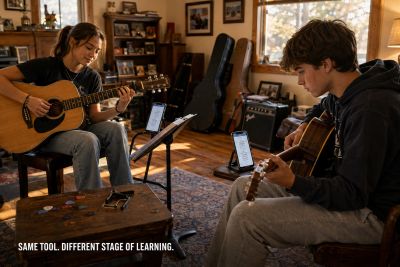
Part Two: The Question Every Parent Is Asking Wrong
Ask most parents what worries them about AI and their kids, and you'll get some version of the same answer: they're worried their child is using it too much. That's a reasonable instinct, and it's also the wrong question, or at least an incomplete one. This page is not going to try to answer whether a child should use AI. That question, framed that way, doesn't have a useful answer, because the answer depends entirely on something else — something the "should they use it" framing skips right past.
The actual question is this: does the help arrive before the child has learned to do the thing themselves, or after?
That distinction sounds small. It isn't. Picture two students, the same age, both using the exact same AI tool, working on the exact same kind of assignment. One of them already knows how to construct an argument — has done it dozens of times, has a feel for how evidence supports a claim, has made the mistakes that taught her what a weak argument looks like from the inside. She uses the AI to check her thinking, catch a gap in her reasoning, or tighten a paragraph that isn't landing. The tool is doing something real for her, but it isn't doing the thing she already knows how to do.
Now picture the second student. He has not yet built an argument on his own — never had to sit with an unclear thesis and slowly work it into something coherent, never had to notice for himself that a piece of evidence doesn't actually support the point he's making. When he uses the same AI tool for the same assignment, it isn't checking his thinking. It's replacing the thinking he was supposed to be doing in the first place.
Same tool. Same assignment. Same fifteen minutes at the kitchen table. Two completely different things are happening, and the difference has nothing to do with the technology. It has to do with whether the underlying skill — building an argument — has already formed in that particular learner.
This is why the broader argument about whether AI helps or hurts thinking tends to go in circles. Both sides are usually right, just about different learners. A person who has already built a capacity generally uses assistance to extend or refine it. A person who hasn't yet built that capacity risks having the assistance quietly stand in for it. Treating those as the same situation — as one undifferentiated question of "AI use" — makes the debate unresolvable, because the honest answer keeps changing depending on who's being asked about.
There's a practical reason to prefer this narrower question over the broader one, beyond just accuracy. "Is AI good or bad for how kids think?" isn't a question you can test. It's too vague to design a study around, too dependent on which kid, which subject, which week. "Does the outcome change depending on whether assistance arrives before or after a skill has formed?" is a real question, and it's one researchers have actually started to test directly, with real people, under real conditions, with results that can be checked against the original data rather than taken on faith. The next several sections of this page walk through exactly that evidence.
Everything that follows on this page exists to answer this one question as precisely as the evidence currently allows. Not every part of it is settled. Some of what follows is well established, backed by a randomized study with a real, statistically meaningful result. Some of it is a reasonable extension of that evidence, but still short of proof. And some of it is a genuinely open question that hasn't been tested yet, no matter how often it gets treated as settled in the broader conversation about AI and children. Each section will say plainly which category it falls into, because the distinction between what's known and what's merely plausible is the entire point of building this page carefully rather than quickly.
So set aside, for now, the question of whether AI is good or bad. That question was never going to have a stable answer. The question worth asking is narrower, more useful, and — as it turns out — testable: when the help arrives, relative to whether the skill it's replacing has already been built.

Part Three: Nobody's Brain Is Melting. That's Not the Danger.
If you've spent any time around the conversation about AI and kids, you've probably seen the imagery. A brain draining into a phone. A skull with a funnel where the top of the head should be. Headlines that use words like "shrink" and "drain" and "lose" — the vocabulary of damage, the same vocabulary you'd use for something that already existed and got hurt. It's dramatic. It's memorable. And it's aimed at the wrong mechanism.
Damage is the wrong model here, and the difference matters more than it might first appear. Something that gets damaged was there, and now it's diminished. A muscle that atrophies from disuse was built once and is now weaker than it used to be. That's a real phenomenon, and it happens to adults who let a skill go unused for long enough. But it isn't what's most at stake for a child who grows up with AI doing large parts of the cognitive work before that child has ever done it independently.
What's at stake for that child isn't damage. It's absence. A capacity that was never built in the first place isn't the same as one that got hurt. Nothing was there to lose. The problem isn't that something got worse. It's that something never arrived.
This distinction isn't just semantic housekeeping. It changes how a worried parent should understand the situation, and more importantly, what they should actually do. Damage implies something has already gone wrong, and the natural response to something already wrong is alarm, maybe even a sense that the harm can't be undone. Absence implies something hasn't happened yet, and the natural response to something that hasn't happened yet is different: you can still make it happen. One framing puts a parent in a defensive crouch, waiting to see how bad the damage turns out to be. The other framing puts a parent in an active position, with something concrete to do.
Consider what this looks like in an actual household. A ten-year-old who has never had to sit with a confusing math word problem, because an AI tool will restate it clearly and walk through the steps the moment she asks, hasn't had anything damaged. Nothing in her has been worn down. She simply hasn't yet had the experience of sitting with confusion long enough to work through it herself, because the tool has been quietly available to remove that experience before it could happen. That's not an injury. That's an opportunity that keeps getting skipped, homework assignment by homework assignment, without anyone deciding to skip it on purpose.
This reframing isn't meant to talk anyone out of being concerned. The underlying worry that led to those tabloid images in the first place is not wrong. Something real is at stake in how children build the capacity to think through hard problems on their own. But aiming that concern at the wrong mechanism leads to the wrong response. A parent convinced their child's brain is being damaged might reach for prohibition, keeping AI away entirely, treating it as something to be minimized or hidden from. A parent who understands the actual issue as absence, not injury, reaches for something more useful: making sure the child still gets the experience of struggling with a problem before the tool steps in to resolve it.
That's a small shift in words with a large shift in what follows from them. The rest of this page will spend most of its time on the evidence for exactly this mechanism — why an unused capacity fails to form, what that looks like in a real study, and what a parent can actually do about it in an ordinary household on an ordinary evening. But it begins here, with getting the metaphor right. The real risk was never a brain being fried. It's a skill that never got the chance to form in the first place, and every day that chance isn't taken is a day it can still be.

PART FOUR: They Said the Same Thing About Calculators. Here's Why They're Wrong.
There's a comeback that shows up almost every time this conversation happens, and it's worth taking seriously instead of brushing past it. People said the same thing about the calculator. They said the same thing about spell-check. They said the same thing about looking things up on a phone instead of memorizing them. Every generation panics about the tool that's replacing something the last generation had to do the hard way, and every time, it turns out fine. Civilization survived the calculator. It'll survive this too.
That argument deserves a real answer, not a dismissal, because it's built on something true. New tools really have offloaded mental work throughout history, and most of those handoffs really did turn out fine. The question worth asking isn't whether that pattern has ever held. It's whether this is the same kind of handoff.
It isn't, and the difference is specific enough to explain in one sentence: a calculator, a spell-checker, or a search engine assists a mental operation the person still has to start and steer. You have to know there's a problem to solve before you can hand the arithmetic to a calculator. You have to have already formed a sentence before spell-check can catch what's wrong with it. You have to know what you're looking for before a search engine can help you find it. In every one of those cases, the tool takes over one bounded piece of the work, but the person is still the one who initiates the task, decides what problem is being solved, and judges whether the result makes sense.
Generative AI can do something none of those tools could. It can originate the thinking itself. It can produce the idea, the plan, the first sentence, the argument's structure, before the person has attempted any of it. That's not a faster calculator. That's a different kind of tool doing a different kind of work, earlier in the thinking process, closer to the part of thinking that calculators and spell-checkers were never built to touch.
This isn't just a reasonable-sounding distinction. It shows up in real research, and it shows up in a way none of the earlier technology panics ever had backing them. A randomized controlled trial by Bastani and colleagues, published in the Proceedings of the National Academy of Sciences in 2025, found that high school students given unrestricted access to an AI tutor while practicing math performed better on their practice problems, but performed worse than a control group once the AI was taken away and they had to solve similar problems unaided. A separate study by Goldberg and Magen, published in Scientific Reports in 2026, found that children's own internal encoding of information dropped when they expected an external source of information to remain available to them, even before they'd actually used it. And Anthropic's own analysis of over half a million real conversations found that when students used AI for schoolwork, the most common activity wasn't checking a calculation or verifying a fact. It was AI doing the creating and the analyzing directly, the two activities that the calculator generation was never handed in the first place.
No previous technology panic had this kind of evidence to back it up. Nobody ran a randomized trial during the calculator era showing that calculator use degraded unaided arithmetic once the calculator was removed, because that isn't what a calculator does. It couldn't produce that finding, because it was never capable of doing the part of the work that would have needed protecting.
None of this means AI is simply bad, any more than the earlier sections of this page argue that AI use is simply bad. It means the "we survived the calculator" argument, while fair to raise, doesn't settle anything, because it's answering a different question than the one this page is asking. The calculator took over a bounded task and left the thinking around it intact. This is a difference in kind, not just in degree, and pretending otherwise means comparing two things that only look alike from a distance.
So the next time that comparison comes up, and it will, the honest response isn't to dismiss it as an easy panic to wave off. It's to say plainly that the comparison doesn't hold, and to be ready to explain exactly why: because for the first time, there's a tool capable of doing the part of the thinking that was never on offer before, and there's now real evidence showing what happens when it does.

Part Five: What We're NOT Telling You to Panic About
Before this page goes any further, it's worth being just as clear about what it isn't arguing as what it is. A title like "The Window of Formation" can suggest a stronger claim than this page actually makes if a reader isn't told plainly where the claim stops. So here's exactly where it stops.
This page is not arguing that there's a fixed age at which the ability to build a particular skill closes forever, the way a door might shut and lock. That's a real thing in some parts of biology — certain aspects of vision, for instance, depend on specific experience arriving during a narrow developmental stretch, or the underlying wiring doesn't form the same way later. But that kind of hard, biologically fixed cutoff is a different and much stronger claim than anything this page is making about thinking, writing, or professional judgment. When researchers have gone looking for that kind of fixed window in complex human capacities, what they generally find instead is more forgiving than a slammed door. Adults who never learned to read can still gain real reading skills and show measurable changes in how their brains process language after just a few months of instruction. Older adults can meaningfully improve memory skills through structured training, with benefits that last for years. None of that looks like a door that's already closed. This page isn't claiming children have a ticking clock that runs out at a specific birthday.
This page is also not arguing that AI is inherently harmful or that any use of it puts a child's thinking at risk. Most of what a person does with AI in a given day probably has nothing to do with the mechanism this page is describing. Asking it what time a store closes doesn't touch any capacity a person is in the middle of building. The concern here is narrower and more specific than "AI use is dangerous." It's about what happens when AI performs the particular thinking a person hasn't yet learned to do for themselves, not about AI as a category of technology.
This page is also not claiming that professional judgment, writing ability, or emotional regulation have been proven to depend on some special developmental window, the way a plant depends on a season. That would be an overstatement, and it's worth saying so directly rather than letting the title imply more certainty than the evidence supports. When this question has been examined in the research literature and tested through sustained, adversarial questioning of an AI system, the honest answer has consistently been the same: there's no controlled study showing that professional judgment has to form during some particular life stage or not at all. What does hold up is something narrower and better supported — that assistance which helps a beginner can become useless or even counterproductive once someone has already built real expertise in that specific area, a pattern researchers call the expertise-reversal effect, documented across dozens of studies going back decades. That's a real and well-established finding. It is not the same as proving a fixed formation window exists for judgment, or for writing, or for the ability to manage a difficult emotion.
The word "window" itself deserves a direct explanation, since it's doing a lot of work in the title of this whole page. It's being used the way a builder might use it, to describe a period during which a particular kind of practice does more to build a capacity than the same practice would do at another time. It is not being used the way a biologist uses it to describe a hard developmental cutoff, and it's not meant to suggest that once a certain age has passed, a skill can never be built at all. If that stronger meaning were what the evidence actually supported, this page would say so plainly, the same way it says plainly what the evidence does support elsewhere. It doesn't, so it won't.
Spelling all of this out here, before the rest of the page makes its case, is deliberate rather than defensive. A title carries an implicit promise about how strong the argument behind it is going to be, and a reader deserves to know upfront exactly how far that promise extends and where it stops. The claim this page is prepared to defend is specific: that timing relative to whether a skill has already formed changes what assistance does to a learner, and that this matters enough to think about carefully. That claim does not require a hard biological deadline, a blanket judgment against AI, or proof that every human capacity works this way. It only requires what the following sections are about to lay out plainly, one piece of evidence at a time.

Part Six: 52 People Learned One Thing. Half Barely Learned It At All.
Everything on this page so far has been building toward a single piece of evidence. It's time to actually look at it. In January 2026, two researchers at Anthropic, Judy Hanwen Shen and Alex Tamkin, working through the Anthropic Fellows Program, ran a study designed to answer a very specific question: when adults use AI to help them learn a new technical skill, do they actually learn it, or do they just produce work that looks like they learned it? The study is titled 'How AI Impacts Skill Formation' (arXiv:2601.20245), and it is available to read in full. It's worth naming directly that the researchers work at Anthropic, an AI company with its own commercial interest in AI adoption. What cuts against reading that as bias here is the direction of the finding: it runs against AI use rather than for it, and the AI system tested wasn't even Anthropic's own product, but a competitor's, built on GPT-4o.
The design was simple and carefully controlled. Fifty-two professional and freelance software developers were given a coding task using Python's Trio library, something most of them had never used before. Half were randomly assigned to complete the task with access to an AI coding assistant built on GPT-4o. The other half completed it without any AI help at all. Afterward, everyone took the same quiz, testing whether they actually understood the concepts behind the code they'd just written, not just whether the code worked.
The result: the group that used AI scored seventeen percent lower on the quiz than the group that worked without it, a gap the researchers describe as roughly equivalent to two letter grades. This wasn't a small, statistically shaky difference. The effect size, reported using a measure called Cohen's d, came out to 0.738, with a p-value of 0.01, meaning there's only a one-in-a-hundred chance a result this large happened purely by accident. In plain terms, this is one of the clearer findings in the entire study. It's also worth noting what didn't happen: the AI-assisted group wasn't faster either. The study found no significant speed advantage for AI users, so this wasn't a simple tradeoff of speed for understanding. They didn't gain time, and they lost learning.
Here's what makes this result matter for this page specifically, rather than just being an interesting fact about software developers. The AI-assisted group didn't get worse at everything equally. The gap was largest in one specific skill: debugging, the ability to look at broken code, figure out what's wrong, and fix it. That's not a coincidence, and the researchers found a plausible reason for it buried in their own data. The group working without AI encountered a median of three errors per task, actual mistakes they had to notice and resolve themselves before moving on. The group working with AI encountered a median of just one. The AI wasn't only providing help. It was quietly removing the very experience of hitting a wall and having to climb over it that builds the skill of debugging in the first place. That skill matters for a reason beyond the task itself. Someone eventually has to catch AI's mistakes, not just accept its output, and catching a mistake requires the same skill that gets skipped when AI fixes the mistake first. The people least practiced at debugging are, by this same mechanism, the people least equipped to notice when the AI got something wrong.
This is worth sitting with for a moment, because it's the clearest real-world demonstration of the exact mechanism this page has been describing since Part Two. The AI-assisted developers weren't lazy, and they weren't careless. They completed their assigned task successfully, on schedule, with working code. From the outside, nothing looked wrong. But the struggle that would have taught them how to recognize and fix an error on their own had been quietly skipped, task after task, exactly the distinction Part Three drew between a skill that never formed and one that was damaged.
One more detail is worth being precise about, because earlier drafts and early conversations about this study circulated a specific pair of numbers, sixty-seven percent for the unaided group and fifty percent for the AI-assisted group, as if those were the study's own reported figures. They aren't. The paper itself reports the difference as seventeen percentage points, or two letter grades on a twenty-seven-point quiz. The sixty-seven and fifty percent figures appear to have come from a secondary summary of the study, not from the original research paper, and this page is not going to repeat them as if they were the primary source's own numbers. The seventeen-point gap, backed directly by the paper's own statistics, is the number worth remembering.
It's also worth being fair to what this study doesn't show. Fifty-two people is not a massive sample, and this is one study of one specific skill, coding, learned over one relatively short task. It doesn't prove that every kind of AI assistance harms every kind of learning, and the researchers themselves don't claim that. What it does show, clearly and with real statistical weight behind it, is that AI assistance can measurably interfere with skill formation when it removes the specific experience, in this case, encountering and fixing errors, that the skill actually depends on. That's not a sweeping claim about AI and human intelligence. It's a precise, tested finding about one mechanism, in one setting, that happens to be exactly the mechanism this page has been describing in the abstract since Part Two.
The next section looks more closely at what separated the developers who used AI and still learned the material from the ones who didn't, because the study found something there too, and it turns out engagement, not access, was the variable that mattered most.

Part Seven: The People Who Struggled Beat the People Who Didn't Have To
The developers in the Shen and Tamkin study weren't struggling with something exotic. They were doing what almost anyone does when they're learning something new and something goes wrong: staring at an error, trying to figure out what went wrong, trying something else, getting it wrong again, and eventually understanding why. That process feels like friction in the moment. It's also, as it turns out, the actual mechanism by which the skill gets built. The group that used AI encountered that friction a third as often. The group that worked without it hit the wall, again and again, and had to climb over it themselves.
This isn't a strange or technical phenomenon limited to software developers. It's the same thing that happens anywhere a person is learning to do something they can't yet do reliably.
Think about learning to parallel park. The first several attempts are usually bad. You misjudge the angle, you cut the wheel too early, you end up too far from the curb or too close to the car behind you, and you have to pull out and try again. It's uncomfortable, and it would be easy to have someone else just park the car for you every time until you eventually got your license anyway. But if someone parked it for you single time you were learning, you wouldn't actually learn to parallel park. You'd learn to be a passenger while someone else does it. The discomfort of getting it wrong, sitting there re-angling the wheel and trying again, is not a flaw in the learning process. It is the learning process.
Or think about a new employee learning a company's internal software for the first time. The employee who gets stuck, has to click around, tries the wrong menu, eventually finds the right one, and remembers where it was next time, is building something; the employee who has a coworker walk them through every step is not building. Both of them finish the task. Only one of them will remember how to do it alone next week.
Cooking without a recipe works the same way. The first few times someone tries to season a dish by taste instead of by following exact measurements, they'll probably get it wrong; too salty, not enough acid, something a little off. That's not a failure. That's the specific experience that eventually produces the ability to taste something and know what it needs. A person who always follows someone else's exact instructions can produce a good dish every time, but they're not building the judgment that lets them improvise later, when there's no recipe to follow at all.
This is why the Shen and Tamkin result matters beyond the specific case of software developers learning a Python library. The pattern it captured—less struggle in the moment, less skill afterward—may extend well beyond coding. It shows up anywhere a task can be completed successfully without the person doing it actually having to develop the ability behind it. A student can turn in a well-written essay that AI helped structure without ever developing the ability to structure an argument alone. A new manager can send a well-handled difficult email that AI helped draft without ever building the judgment to handle the next hard conversation without help. In every one of these cases, the finished product looks the same from the outside whether or not the underlying skill actually got built. That is exactly what makes this hard to notice while it's happening, and exactly why unaided performance eventually has to be checked.
None of this means struggle is good for its own sake, or that a person should refuse help out of some sense that suffering builds character. Nobody benefits from being handed an impossible problem with no path through it, and there's a real, well-documented pattern in learning research, called the expertise-reversal effect, showing that the exact same kind of help that's essential for a beginner can actually get in the way once someone already has real skill in an area. Help isn't the problem here. The question this page keeps returning to is narrower than that: whether the specific struggle that builds a specific skill is still happening, or whether it's being quietly and consistently removed before the person ever gets the chance to work through it themselves.
That's what happened, measurably, to half the people in the Shen and Tamkin study. It's also likely happening in ordinary households and workplaces every day, in situations that will never show up in a research paper, simply because nobody's checking.

Part Eight: Two People Used AI the Exact Same Amount. Only One Learned Very Much.
The seventeen-point gap in Part Six tells you something happened. It doesn't tell you why some people in the AI-assisted group came out fine while others came out worse. That's the more useful question, and Shen and Tamkin actually answered it.
Everyone in the AI-assisted group had access to the same tool. Nobody was blocked from using it, and nobody was forced to use it a specific way. But when the researchers looked closely at how each person actually used the assistant, moment to moment, six distinct patterns emerged, and those patterns predicted quiz scores far better than simply belonging to the AI group or the no-AI group did.
Three of those patterns produced strong results. People using what the researchers labeled Conceptual Inquiry, mostly asking the AI questions to understand ideas rather than asking it to write code, scored well. People using Generation-Then-Comprehension, letting AI produce code and then working to understand it afterward rather than just accepting it, also scored well. So did people using Hybrid Code-Explanation, asking for both the code and the reasoning behind it together. Across these three patterns, quiz scores ranged from sixty-five to eighty-six percent, well within the range of what the no-AI group achieved on its own. It's worth being clear about what this means: even the highest-scoring AI-assisted group was still using AI to generate code. The difference wasn't whether AI wrote anything. It was what the person did with what it wrote. It's worth being direct about a limitation here: each of these six patterns represents a small slice of an already modest study, sometimes as few as two or three participants. That's not enough people to draw firm conclusions about any single pattern in isolation.
The other three patterns told a very different story. People using AI Delegation, handing over the task and accepting what came back with little scrutiny, scored the worst. So did people using Progressive AI Reliance, leaning on the tool more and more as the task went on rather than less. Iterative AI Debugging, letting the AI find and fix errors rather than working through them personally, also scored poorly. Across these three patterns, quiz scores ranged from twenty-four to thirty-nine percent, roughly half of what the strongest AI-assisted patterns achieved.
That gap is worth noting carefully, with the sample-size caveat above in mind. The gap between the best and worst AI-assisted patterns was substantial, though it's a comparison across small subgroups rather than the two full, evenly split groups behind the headline seventeen-point finding, so it should be read as suggestive rather than as conclusive on its own. Two people can spend the same amount of time with the same tool doing the same task, and one of them ends up having learned far less while the other ends up performing about as well as someone who never touched the AI in the first place. The variable that actually mattered wasn't whether AI was involved. It was what the person was doing with it while it was involved.
[Chart: Quiz score by interaction pattern, six subgroups within N=52. High-engagement patterns, Conceptual Inquiry, Generation-Then-Comprehension, Hybrid Code-Explanation, 65 to 86 percent. Low-engagement patterns, AI Delegation, Progressive AI Reliance, Iterative AI Debugging, 24 to 39 percent. Note: individual subgroup sizes are small; treat as suggestive, not independently conclusive. Source: Shen and Tamkin, How AI Impacts Skill Formation, arXiv:2601.20245.]
This is worth translating out of the language of a research study and into something closer to ordinary life, because the same six patterns show up outside of coding, even if nobody's naming them that carefully in the moment. A student asking an AI tool to explain why an essay's argument is weak and then rewriting it herself is doing something closer to Conceptual Inquiry. A student pasting the assignment into the tool and turning in whatever comes back is doing something closer to AI Delegation. Both students technically "used AI" on their homework. Only one of them was doing anything that resembled learning.
This also adds a little more to the calculator comparison from Part Four. A calculator doesn't really offer six different modes of engagement, some of which build skill and some of which quietly erode it. It performs one bounded function regardless of how you approach it. AI apparently isn't like that. The same tool, used two different ways by two different people, can produce results that look identical on the surface, a finished task, a submitted assignment, a working piece of code, while doing almost opposite things underneath.
None of this means every low-engagement use of AI is a disaster, or that every high-engagement use guarantees learning. Fifty-two people, split across six smaller patterns, is a modest sample even before it's divided that finely, and this is one study of one task.
But the overall pattern is specific enough, and the gap between the best and worst patterns is large enough, to say something with real confidence: the question this page keeps returning to, whether assistance performs the thinking or supports the person doing the thinking, isn't just a theoretical distinction. It's something that shows up directly in how people score when they're tested afterward, and it shows up whether or not anyone involved was thinking about it in those terms at the time.

Part Nine: Here's the Whole Argument in One Sentence
Eight sections in, it's worth stopping and saying the whole thing plainly, in case any of it got lost in the studies and the statistics and the parking-lot analogies.
It is not AI versus no AI.
It is whether AI performs the thinking a person needs to practice, or leaves that thinking for the person to do.
That's the entire argument. Everything before this section was building the case for it. Everything after this section will apply it, first to what "leaving the thinking for the person to do" actually looks like in practice, then to what it means for a professional, a teenager, and a child, and then to what a parent or a workplace can actually do about it. But the sentence itself doesn't get more complicated than that, and it's worth being suspicious of any version of this argument that tries to make it more complicated than it needs to be.
Later in this page, this same idea gets stated a different way, as a question of timing rather than operation, because timing is often the easier version to notice in the moment, before a task is even finished. But it's the same underlying claim, described from two angles. AI performing the thinking before someone has learned to do it, and assistance arriving before the capacity it substitutes for has formed, are two ways of describing the same event. This section states the version that's easiest to test against evidence. The later version states the one that's easier to remember at the kitchen table.
This is why the question from Part Two, whether AI use is good or bad, has never had a stable answer. It was never a question with one answer, because it was really two different situations wearing the same description. A person using AI to check work they already know how to do is in a completely different situation from a person using AI to produce work they don't yet know how to do. Both of them can be described, accurately, as "using AI." The word doesn't distinguish between them, even though the two situations produce opposite outcomes.
The Shen and Tamkin study is the clearest evidence for this because it isolated the variable directly. Everyone in the study had access to the same AI tool. The people who used it to ask questions and check their own understanding came out of the task about as capable as the people who never touched it. The people who let it handle the parts of the task they didn't already know how to do came out of it measurably less capable, even though, from the outside, both groups finished the same assignment successfully. Access to AI wasn't the variable that mattered. What the AI was being allowed to do, on the person's behalf, was.
This sentence is short on purpose because it needs to survive being repeated by someone who only half-remembers where they heard it. A parent explaining this to a spouse at dinner, a teacher explaining it to a colleague in the hallway, a manager explaining it to someone on their team, none of them are going to recite a study's statistics from memory. What they might remember, if it's stated clearly enough the first time, is the actual distinction: not whether the tool was used, but what it was used for.
It's worth being honest about what this sentence doesn't do. It doesn't tell you exactly where the line is in every situation, because that line moves depending on what the specific person already knows how to do. The exact same request to an AI tool, "help me write this," can sit on either side of that line depending entirely on whether the person asking has already built the skill of writing that particular kind of thing. This sentence also doesn't resolve the harder, still-open question the later sections of this page take on directly, whether the timing of when a skill was skipped changes anything beyond the immediate result. That's a real, separate question, and it doesn't get answered by restating this one more clearly.
What this sentence does do is give you something to check your own decisions against, in the moment, before a task is finished and it's too late to tell the difference from the outside. Before asking AI for help with something, it's worth asking one question first: do I already know how to do this, or am I about to let AI do it for me before I've ever learned how? That's not a rule. It's just the honest version of the question underneath everything else on this page.

Part Ten: There's a Difference Between Help and a Replacement
The word "help" gets used for two completely different things, and this page has been pointing at that difference since Part Two without giving it a name yet. It's time to name it.
This page needs two working terms for these two different things, one already familiar, one not. Call the first one scaffolding. Scaffolding is assistance that supports a person while they do something themselves. A parent holding the back of a bicycle seat while a child pedals is scaffolding. A tutor asking a student leading questions instead of giving the answer is scaffolding. An experienced coworker looking over a report and pointing out where the argument is thin, then letting the person go fix it themselves, is scaffolding. In every one of these cases, the person is still the one doing the thing. The support makes success more likely today, and independence more likely tomorrow.
Call the second one substitution. Substitution is assistance that performs the task in place of the person. A parent who takes the handlebars and rides the bike themselves while the child watches is substitution. A tutor who simply writes the correct answer on the student's paper is substitution. A coworker who quietly rewrites the weak parts of the report without saying anything is substitution. In every one of these cases, the task still gets done, sometimes done better than the person could have done it alone, but the person didn't do it. They watched it get done.
This also explains something that otherwise looks like a contradiction. Some research has found AI genuinely helping less experienced people close a skill gap. Other research, including the Shen and Tamkin study at the center of this page, found AI leaving people worse off than if they'd never used it. Read as a debate about whether AI helps or hurts, those findings can't both be right. Read through the distinction between scaffolding and substitution; they're not in tension at all.
The studies where AI helped were largely studies of scaffolding, support that pushed a person toward doing something themselves. The studies where AI hurt were largely studies of substitution, help that did the task instead of the person. Different mechanism, same word, opposite result.
From the outside, scaffolding and substitution can look almost identical. In both cases, a more capable source of help is present. In both cases, the task gets finished. In both cases, the person receiving help feels like they were helped, because in some real sense, they were. The difference isn't visible in the final product. It's visible only in what happened, step by step, while the product was being made, which is exactly why it's so easy to miss from the outside, and exactly why the Shen and Tamkin study had to look at the process, not just the finished code, to find it at all.
This is the distinction that the six interaction patterns in Part Eight were actually measuring, described in plainer language. Conceptual Inquiry, asking the AI to explain an idea and then applying that understanding yourself, is scaffolding. AI Delegation, handing over the task and accepting the result, is substitution. The quiz scores didn't split along the line of who used AI and who didn't. They split along this line, scaffolding on one side, substitution on the other, almost exactly.
It's worth being precise about something here, because this distinction could easily get flattened into "scaffolding good, substitution bad," and that's not quite right either. Substitution has a real, legitimate place. Nobody needs to personally learn how their car's transmission works before they're allowed to drive somewhere. A working adult with a demanding week doesn't need to earn back the ability to write a routine email from complete independence every single time. Substitution is exactly the right choice once a capacity has already been built, or in areas where building that particular capacity was never the point in the first place. The problem isn't substitution itself. The problem is substitution arriving in place of a capacity that hasn't been built yet, at the exact moment when the person doing the task would otherwise have been the one building it.
This is also where the expertise-reversal effect, mentioned back in Part Five, fits precisely into place. Researchers have found, across dozens of studies, that the kind of detailed step-by-step support a beginner needs can actually slow down or interfere with someone who already has real skill in that area. That finding makes complete sense once scaffolding and substitution are separated clearly. Heavy scaffolding for someone who no longer needs it isn't protecting their learning anymore. It's just getting in the way. And full substitution for someone who hasn't yet built the underlying skill isn't helping them either. It's quietly replacing the experience that skill depends on. The right kind of assistance isn't a fixed thing. It depends entirely on what the person receiving it has already built.
None of this requires knowing exactly where every person's line sits at every moment, which would be an impossible standard to hold anyone to in ordinary life. What it requires is a habit of asking the question honestly before reaching for help: is this something I'm still learning how to do, in which case scaffolding is what actually serves me, or is this something I've already learned, in which case substitution is a reasonable and even smart use of the time I have. That question doesn't have a universal answer. It has a different answer for every person, for every task, and it changes over time as the person's own capacity changes.
But it is, at least, the right question to be asking, which is more than the vaguer version of this argument, whether AI is good or bad, was ever able to offer.
Everything else on this page, the study data, the labor numbers, the household advice still to come, depends on the distinction this section just drew. The distinction between scaffolding and substitution is the hinge the rest of the argument turns on.

Part Eleven: Every Boring Junior Job Was Secretly Training Someone. AI Skipped That Part.
There's a part of this argument that doesn't depend on anything discussed so far. It doesn't need the Shen and Tamkin study. It doesn't need scaffolding, substitution, or any claim about timing at all. It only needs one observation about how junior jobs have always worked, and what happens when that arrangement quietly breaks.
For as long as entry-level work has existed, it has produced two things at once, even though only one of them ever showed up on an invoice. The first is the actual work: the drafted contract, the debugged code, the researched brief, the audited spreadsheet. The second is something nobody had to pay for separately, because it came bundled in automatically: a person who now knows how to do that work a little better than they did before they started. Every tedious, junior-level task a young associate, analyst, or engineer grinds through wasn't just labor being extracted from them. It was also, whether anyone planned it that way or not, an apprenticeship. Call the first product Output A. Call the second Output B.
Nobody had to manage Output B on purpose. It arrived as a natural side effect of a junior person doing junior work under some supervision, making mistakes, getting corrected, and slowly becoming the senior person who trains the next junior person after them. This is, more or less, how every profession has replenished its own expertise for as long as professions have existed. The system didn't need a formal training department to produce Output B. Producing Output A reliably produced Output B as a byproduct.
Generative AI changes this arrangement in a very specific way, and it's worth being precise about exactly what changes. AI can now produce something very close to Output A directly. It can draft the contract, generate the code, and assemble the research brief at a fraction of the time a junior employee would need. What it cannot do is hand over Output B along with it. There is no version of an AI system that leaves behind a slightly more experienced human being as a byproduct of having done the work. The organization can now get the finished product. It does not automatically get the person who would have been formed by producing it.
This is not, on its own, an argument that AI is bad for business. From a narrow, immediate view, it can look like a straightforward improvement. The work gets done faster, often at lower cost, without the errors a genuine beginner would have made along the way. Any single decision to use AI instead of assigning a task to a junior employee can be perfectly rational in isolation, exactly the same kind of individually reasonable decision described back in Part Four's account of what happens across a whole institution making similar rational choices at once. Nobody has to make a mistake, or act in bad faith, or ignore an obvious cost, for this pattern to take hold. It happens through ordinary, sound decision-making, repeated enough times.
The cost is what happens next, and it doesn't show up on the same balance sheet as the savings. Output A gets captured immediately. Someone bills for the finished contract, the deployed code, and the completed brief. Output B's absence isn't a cost anyone has to record anywhere, because accounting has never had a line item for the expert who didn't get formed. That cost surfaces later, sometimes five years later, sometimes ten, when the organization needs someone who has actually done the junior-level version of a task hundreds of times, developed real judgment about how it can go wrong, and can now supervise, mentor, or catch a mistake nobody else noticed. If fewer people spent those years doing the work directly, there are fewer people who can do that.
This is worth stating in the plainest terms possible: the person who decides to use AI instead of a junior hire today is very often not the person who will need that missing expert ten years from now. A law firm partner who lets AI draft routine contracts instead of assigning them to first-year associates is not necessarily the one who will suffer when there's a shortage of seventh-year associates capable of spotting a subtle liability clause. A hospital administrator who streamlines diagnostic support with AI today is not necessarily the one in the room when a rare case needs a doctor who built real pattern recognition the slow way. The decision and the consequence can be separated by enough time and enough organizational distance that nobody making the choice today ever has to see what it costs.
None of this requires believing anything about brains, formation windows, or the timing of learning. It only requires three things most people would accept without much argument: expertise is built through accumulated, hands-on experience; AI can now perform a meaningful share of the tasks that experience used to come from; and there's no guarantee any organization will deliberately replace the training that used to happen automatically as a side effect of getting the work done. Put those three together, and a real problem exists whether or not the rest of this page's argument about timing and formation windows turns out to be right. That's not a weakness in the case. It's the reason this argument can stand on its own, even if every more speculative claim on this page were eventually disproven.

Part Twelve: The Bill Doesn't Come Due for 10 Years — Not to Whoever Made the Call
Part Eleven made a specific claim: that entry-level work has always quietly produced two things, the finished task and a slightly more capable person, and that AI can now deliver the first without the second. This section takes that observation somewhere more specific. It's not just that a cost exists. It's that the cost lands somewhere that the decision-maker may never see. It's that the ordinary machinery markets use to correct for costs doesn't work on this particular one, and it's worth understanding exactly why.
Economists have a name for a cost that lands somewhere other than on the person who caused it. It's called an externality, and it shows up in situations far removed from AI and skill formation. A factory that pollutes a river downstream is imposing a cost on people who had no say in the decision to pollute. The factory owner weighs the cost of cleaner production against the cost of dirtier production, and if nobody downstream can make that cost show up on the factory's own ledger, the factory has every rational reason to keep polluting. Nothing about that requires the factory owner to be careless or cruel. It only requires that the true cost lands somewhere that the decision-maker never has to pay for directly.
The training that used to happen automatically as a byproduct of junior work has a similar structure, just spread across time instead of geography. When a law firm partner, a hospital administrator, or an engineering manager chooses AI over a junior hire for a given task, the immediate costs and benefits are visible and land on them directly: faster output, lower payroll, fewer beginner mistakes. The cost of the missing apprenticeship doesn't usually land on them. It lands five years later, sometimes ten, on whoever needs an experienced professional and can't find one, and quite often on an entirely different organization, a different generation of leadership, or the profession as a whole rather than any single employer. Nobody today is positioned to feel that cost the way the factory owner would feel a fine for pollution. There's no equivalent fine, because there's no equivalent regulator watching this particular river.
This is worth stating plainly, because it changes what kind of problem this actually is. It is not primarily a story about individual greed or short-sightedness. It's a story about reasonable decisions, made one at a time, adding up to an outcome nobody actually chose. A single manager choosing to use AI instead of training a junior employee is behaving exactly the way markets generally expect people to behave, responding rationally to the incentives directly in front of them. The economist Gary Becker's foundational work on human capital drew a related distinction decades ago, between skills specific to one employer, which that employer has a direct incentive to invest in, and general skills useful across an entire field, which any individual employer has much weaker incentive to fund, since a competitor might simply hire the trained employee away once the training is finished. Apprenticeship-style training has always been a little of both, and AI now makes the general-skill side of that bargain even less individually rational to invest in, because the immediate substitute is right there, cheaper, and requires no multi-year commitment to a person who might leave anyway.
None of this means every organization will behave this way, or that the outcome is guaranteed. Some firms genuinely do treat training junior talent as a long-term investment worth protecting, understanding that today's beginner is tomorrow's senior partner, expert engineer, or attending physician. But any outcome that depends on enough organizations voluntarily absorbing a cost that market incentives don't require them to absorb is a fragile outcome, not a guaranteed one. It depends on foresight, competitive pressure not overwhelming that foresight, and nobody undercutting the firms that do choose to invest by offering the same service faster and cheaper without doing so.
This is also why waiting for the market to fix this problem on its own is not obviously a safe bet. Markets are very good at correcting costs that show up quickly, visibly, and on the balance sheet of the party making the decision. They are considerably worse at correcting costs that arrive a decade later, on a different balance sheet, held by people who had no vote in the original choice. A missing generation of experienced professionals in law, medicine, or engineering is exactly that kind of cost, diffuse, delayed, and detached from whoever's decisions actually produced it.
None of this requires assuming AI companies, employers, or anyone else involved is acting in bad faith. It only requires recognizing a structure that shows up reliably whenever costs and decisions get separated by enough time and enough organizational distance. Naming that structure doesn't answer, on its own, what should be done about it. But it does answer a narrower and more useful question: why an obviously important problem might still go quietly unaddressed by everyone with the power to address it, each acting reasonably, each looking only as far ahead as their own incentives require them to look.

Part Thirteen: Even If We're Wrong About Everything Else, This Part Still Holds.
Part Eleven ended with a claim, stated in a single paragraph: the apprenticeship-unbundling argument doesn't need anything else on this page to be true. It's worth slowing down and actually testing that claim rather than just asserting it again, because if it holds up under real pressure, it changes how much weight the rest of this page has to carry.
Imagine, for a moment, that every developmental claim on this page turns out to be wrong. Imagine the order-effect experiment described later gets run, and it finds nothing, that assistance arriving before or after a skill has formed makes no lasting difference once total practice is held constant. Imagine Shen and Tamkin's finding fails to replicate, or turns out to be specific to coding and nothing else. Imagine, in other words, the strongest version of the null hypothesis wins completely, and it turns out timing, in the specific sense this page has been arguing, doesn't matter at all.
Does the apprenticeship argument survive that?
It does, and it's worth being precise about why. The apprenticeship argument was never a claim about how skills form inside an individual brain. It never depended on a critical period, a sensitive period, or any biological mechanism at all. It rested on three much plainer observations, none of which have anything to do with developmental timing. Expertise gets built through accumulated, hands-on experience, doing a task repeatedly, under some supervision, over years. AI can now perform a meaningful share of the tasks that experience used to come from. And no organization is required, by any law of economics or any law of nature, to deliberately replace the training that used to happen automatically as a side effect of getting work done. Every one of those three claims stands independently of whether "the window of formation" turns out to be a real phenomenon, an overstated one, or no phenomenon at all.
This is actually a well-established pattern in how economists think about human capital, long before AI entered the picture. The economist Gary Becker's foundational distinction, between skills specific to one employer and general skills useful across an entire field, was built decades ago to explain something that has nothing to do with cognitive science: why firms underinvest in training that a competitor could later benefit from by simply hiring the trained employee away. That's a market-structure problem, not a brain-development problem. It would be just as real in a world where human cognition worked completely differently than it does, because it isn't about how a mind learns. It's about who captures the value of the learning and who pays for it.
That's the real test of whether an argument is load-bearing on its own. A claim depends on another claim if disproving the second one would force you to abandon the first. Try disproving the formation-window hypothesis completely, and see what happens to the apprenticeship argument. Nothing happens to it. The three observations it rests on don't move. A junior associate who never drafts a hundred routine contracts still won't develop the pattern recognition that comes from drafting a hundred routine contracts, whether or not there was ever a specific window during which that pattern recognition needed to form. The mechanism doesn't require a window. It only requires that experience be the thing expertise is made of, which is a much harder claim to argue against than anything about developmental timing.
This matters for a practical reason beyond intellectual tidiness. The formation-window hypothesis is genuinely uncertain, and this page has said so plainly, more than once. A reader who isn't persuaded by it, who thinks the evidence is too thin, the sample sizes too small, the order-effect question too far from being settled, doesn't have to reject everything else on this page along with it. The apprenticeship argument doesn't ask for that kind of trust. It asks for something much smaller: that experience builds expertise, that AI is beginning to displace a real share of that experience, and that nobody has guaranteed a replacement for what's being displaced. Anyone who accepts those three plain claims has already accepted the argument, whatever they eventually decide about windows, timing, or anything happening inside a single learner's mind.
That's why this section exists separately from the rest of the page, rather than folded quietly into a footnote. Not because it's the most dramatic claim here. Because it's the argument most likely to still be standing in ten years, regardless of what the research on formation windows eventually shows.

Part Fourteen: Nobody Has Actually Tested the Thing Everyone Assumes Is True
The title of this page proposes a specific hypothesis: that timing, relative to independent mastery, is the variable that ultimately matters most. Everything on this page has been building toward that hypothesis. This section asks whether the evidence has earned that title, or whether the title is still pointing toward a question rather than announcing a settled answer.
Answering that honestly means being clear about which claims on this page are proven and which aren't, because they're not all the same. The apprenticeship argument, laid out in Parts Eleven through Thirteen, rests on established economics and doesn't need anything unproven to be true. The scaffolding-and-substitution mechanism, backed directly by Shen and Tamkin's data, is a tested finding. But there's a third claim sitting underneath the title of this entire page, one that this page has been careful not to let the other two disguise, and it's time to state it plainly and admit exactly what its evidentiary status actually is.
The claim is this: does the exact same kind of assistance produce a different, lasting outcome depending on whether it arrives before a person has independently mastered a skill or after, holding the total amount of practice constant?
Not whether beginners and experts respond differently to help, that much is well established and covered back in Part Ten's discussion of the expertise-reversal effect. This is a narrower and much harder claim. It's asking whether the order matters on its own, independent of how much practice a person eventually gets. Two people could end up with the identical number of hours spent practicing a skill, and if this claim is true, the one who got assistance before they'd demonstrated independent competence would end up somewhere durably different than the one who got the same assistance after.
That distinction matters more than it might look like on the page. "Novices benefit differently from help than experts do" is a claim with decades of research behind it, and this page has already cited plenty of it. "The sequence in which help arrives changes the outcome, even when the total amount of practice is identical" is a completely different and much stronger claim, and as of this page's publication, nobody has actually run the experiment that would prove or disprove it. Not for coding, not for writing, not for professional judgment, not for any of the capacities discussed here. That isn't a gap in this page's research. It's a gap in the research itself.
It's worth being specific about why. Testing this claim properly would require randomly assigning otherwise identical people to receive the same total amount of practice on a skill, but with the AI assistance deliberately scheduled at different points. One group would receive assistance before demonstrating independent competence, while another group would receive identical assistance only after independent competence had already been demonstrated. Researchers would then need to measure the outcome long enough afterward to see whether a durable difference actually shows up. That's a genuinely difficult study to design and run. It requires controlling for practice quantity while manipulating practice sequence, which is harder than it sounds, and it requires following people long enough afterward to catch an effect that might not appear immediately. Shen and Tamkin's study, valuable as it is, measured outcomes shortly after a single task. It says nothing directly about whether the order in which help arrived, versus simply how much unaided struggle occurred, is the operative variable.
This is the point where a lot of writing on this subject quietly blurs the distinction, and it's worth naming that plainly. The word "timing" gets used constantly in discussions like this one, including in this page's own title and tagline, as though the timing claim were already established fact. It isn't. What's established is that assistance which performs a task instead of the learner correlates with worse outcomes than assistance that supports the learner in performing it. What's still genuinely unknown is whether that's because of timing specifically, the sequence relative to mastery, or whether it's simply because substitution, whenever it happens, removes the struggle a skill depends on, regardless of when it occurs in the learning process. Those sound similar. They're not the same claim, and only one of them has real evidence behind it.
None of this is a reason to abandon the title of this page or the idea it points toward. A hypothesis that hasn't been tested yet isn't the same as a hypothesis that's been tested and failed. Every rigorous idea starts as an untested claim, and naming it precisely, rather than dressing it up as more settled than it is, is exactly what makes it possible to eventually test. But precision here isn't optional. The difference between "assistance that substitutes for effort produces worse learning" and "the timing of assistance relative to mastery produces a durable, order-specific effect" is the difference between a finding this page can defend without qualification and a genuinely open question this page is choosing to take seriously before the evidence exists to settle it. The next section describes what that test would actually need to look like, and why it's worth running even though nobody has run it yet.

Part Fifteen: Best Case, Worst Case, and the One in Between
Part Fourteen ended by naming the experiment nobody has run. This section does something different, and it's important to be precise about what: it doesn't guess at what that experiment would find. Guessing would be exactly the move this page has spent fourteen sections refusing to make. What this section does instead is lay out the three ways the timing hypothesis could turn out to be true or false, and what each one would actually mean, without picking a favorite.
Outcome one: it disappears easily
It's possible that timing, in the strict sense Fourteen defined, turns out not to matter much at all. In this outcome, someone who got AI assistance before mastering a skill, and someone who got the identical assistance after, end up in roughly the same place, once both have put in the same total amount of independent practice. What looked like a lasting deficit in Shen and Tamkin's study would turn out to be something closer to what a lender would call training debt: a real shortfall, but one that gets paid down quickly once genuine practice resumes, not a mark that stays on the record permanently. If this is what a real order-effect study eventually found, the practical response would be modest. Notice the gap, add some deliberate unaided practice, and move on. Nothing about how AI gets used would need to change dramatically. The scaffolding-and-substitution finding would still matter, since substitution would still cost a person real practice time in the moment, but the specific fear this page's title points toward, that something is being lost, permanently, by getting help too early, would turn out to be smaller than it looks.
Outcome two: it's recoverable, but expensive
A second possibility sits in between. In this outcome, the deficit is real, and it doesn't erase itself through ordinary practice, but it can still be closed with enough deliberate, targeted effort, more than it would have taken to build the skill correctly the first time. Think of it less like a debt that pays itself down and more like a debt that requires a specific, harder repayment plan than the original loan would have. Someone who used AI to skip debugging early on might eventually become a competent debugger, but it might take a structured remediation effort, mentorship, or deliberately AI-free practice sessions to get there, where building the skill the first time around might not have required that same extra push. If this is the true outcome, the practical response is bigger than the outcome one's. It means noticing gaps matters, but it also means organizations, schools, and individuals need an actual plan for closing them, not just an assumption that time and continued work will do it automatically.
Outcome three: it doesn't close
The third possibility is the one that would make the word "window" in this page's title fully earned. In this outcome, even giving both people the same amount of later practice doesn't close the gap. The order in which the experience arrived would have done something that later effort can't fully undo. This is the strongest version of the timing hypothesis, and it's also the one with the least direct evidence behind it right now. If it turned out to be true, the implications would be serious enough to justify real caution now, before the evidence exists to confirm or rule it out, because by the time it's confirmed, an entire generation of learners could already be past the point where the finding would help them.
Why laying this out matters, even without an answer
None of this is a prediction. Nothing in this section says which of these three is more likely than the others, and it shouldn't be read as leaning toward the most dramatic one just because it's the most attention-grabbing. What this section is actually doing is something narrower and more useful: showing that the stakes of these three outcomes are not the same size. Outcome one asks for a shrug and a little unaided practice. Outcome two asks for a real, structured response. Outcome three asks for something closer to the caution this page has been building toward from the start. When the possible outcomes of an open question are this different in size, it becomes reasonable to act with more caution than the current evidence alone would justify, not because the worst outcome is confirmed, but because the cost of being wrong about it is so much higher than the cost of being wrong about the others. That asymmetry, not a guess about which outcome is true, is the actual argument for taking this seriously now, while the experiment that would settle it still hasn't been run.

Part Sixteen: You Don't Get to Wait Until 2035 to Start Caring
Fifteen already made the case for why an unresolved question can still matter enough to act on. That argument doesn't need repeating here. What's worth asking now is a more practical question: if the definitive experiment is years away, or might never get run at all, what can actually be watched in the meantime?
It helps to separate two different kinds of measurement. A definitive test answers a question completely. It's the randomized, controlled, years-long study described in Part Fourteen, the one that would finally show whether timing itself, independent of everything else, changes a lasting outcome. Nobody has run it, and it might be years before anyone does. A leading indicator does something smaller and much more available right now. It doesn't prove the mechanism is real. It shows whether something consistent with the mechanism is already starting to show up in the world, long before the slower, more definitive answer arrives.
This is an ordinary way science and everyday judgment both work outside of controlled experiments too. A doctor doesn't wait for a disease to fully declare itself before taking a symptom seriously. An investor doesn't wait for a company to fail before watching its cash flow. In both cases, the full picture takes time to arrive, but a competent observer doesn't need the full picture to know when it's worth paying closer attention. The same logic applies here. Waiting fifteen years to see whether a missing generation of experienced professionals actually materializes would mean losing exactly the years when the problem could still be addressed cheaply, if it turns out to be real at all.
So what would an honest leading indicator for this specific mechanism actually look like? A few are already available, and the strongest one right now comes from entry-level hiring in jobs most exposed to AI — early-career employment has measurably declined in exactly the occupations where AI use is heaviest, even as employment for more experienced workers in the same fields has held steady or grown.
It's worth being fair to the other side of this before treating it as settled, because this page hasn't treated anything else on it as settled either. Not every researcher agrees that this pattern is actually about AI. A separate analysis found that young workers without college degrees, who generally work in less AI-exposed jobs, have faced labor-market struggles just as severe as AI-exposed graduates have, which makes a purely AI-driven explanation harder to defend on its own. The honest summary is that something real is showing up in the data specific to young, AI-exposed workers, but plausible alternative explanations, including ordinary economic conditions unrelated to AI, haven't been fully ruled out yet.
That uncertainty is exactly why this counts as a leading indicator and not a finding. It doesn't prove the apprenticeship argument from Part Eleven is playing out in real time. It shows that the kind of pattern the apprenticeship argument would predict, entry-level positions thinning out first, is at minimum consistent with what's actually happening in the labor market right now, worth watching closely rather than either dismissing or treating as confirmed.
The next section examines that evidence more closely, because it's the one leading indicator currently available with real, checkable numbers behind it, rather than a hypothetical example of what a leading indicator might someday look like.
Part Seventeen: Young Workers Are Already Disappearing From the Data
Part Sixteen introduced the idea of a leading indicator, evidence that's consistent with a mechanism without proving it. This section looks at the strongest one currently available in real, checkable detail, because it deserves more than a preview.
Start with the clearest finding. Researchers at the Stanford Digital Economy Lab, using payroll records covering twenty-five million workers, found that early-career workers, ages twenty-two to twenty-five, in the occupations most exposed to AI experienced roughly a sixteen percent relative decline in employment since generative AI spread widely, even after accounting for other factors that might explain it, like general economic conditions or a given firm's overall hiring patterns. That's not a small number, and it's not a fluke of one dataset.
A separate analysis from the Federal Reserve Bank of Dallas, using different data entirely, the Current Population Survey rather than private payroll records, found a version of the same pattern: employment for that same age group in AI-exposed occupations slipped from about sixteen percent of the relevant workforce down to about fifteen and a half percent between late 2022, when widely available AI chat tools launched, and September 2025.
Anthropic's own labor-market research, published in March 2026 using a third, independent source, unemployment-insurance claims data from the Department of Labor, found hiring of young workers into highly exposed occupations had slowed by roughly fourteen percent over the same period.
Three separate research teams, three different datasets, and all three land in the same range, on the same age group, in the same kind of job. That's worth taking seriously. It's also worth being precise about what it does and doesn't show. None of these studies found that experienced workers in the same AI-exposed fields lost ground. All three found the opposite: employment for more experienced workers in those same occupations held steady or even grew. Whatever is happening, it isn't happening to the field generally. It's concentrated specifically in the age group that would be doing the entry-level work this page's apprenticeship argument is about.
It's also worth naming exactly what these studies are measuring, because it's narrower than "AI is taking jobs." All three are studying hiring, not layoffs. The research shows young workers having a harder time getting into these occupations in the first place, not experienced professionals losing jobs they already had. That detail actually strengthens the connection to Part Eleven's argument rather than weakening it. If AI were simply making experienced people more productive, that wouldn't predict fewer young people getting hired into entry-level roles. If AI is increasingly performing entry-level work itself, as the apprenticeship argument describes, then thinner hiring at the bottom of the ladder is precisely what that mechanism would produce.
None of this proves the case. Correlation across three studies in the same direction is stronger than one study alone, but it still isn't causation, and this page hasn't treated anything else as proven just because multiple sources agreed on it. A separate analysis, looking specifically at young college graduates rather than AI-exposed occupations generally, found that both college and non-college young workers are struggling in today's labor market at similar rates, which complicates a purely AI-driven story. If the weak market for young workers were mainly about AI, graduates in heavily AI-exposed fields should be faring worse than graduates in fields AI barely touches. That comparison hasn't shown a clean difference yet. Ordinary economic conditions, unrelated to AI, are a real competing explanation, and the researchers behind some of the original findings have acknowledged this complexity rather than dismissing it.
So, where does that leave this specific leading indicator? Not as proof. As exactly what Part Sixteen said it would be: a real, measurable, multiply-confirmed pattern, concentrated where the apprenticeship argument predicts it should be, sitting alongside a real, unresolved question about whether AI is actually the cause or simply one factor among several. That's not a weak place to land. It's the honest place. A pattern this consistent deserves continued measurement. It does not yet deserve certainty. Showing up in three independent datasets and pointing in the specific direction a five-part argument already built on this page would predict, it is worth watching closely. It just isn't, yet, the same thing as knowing.
If this signal strengthens over the next several years, confidence in the apprenticeship argument should increase. If it weakens or disappears, confidence should decrease accordingly. That's exactly how leading indicators are supposed to work.
The next section turns to a different kind of question. Given everything this page has laid out, the tested mechanism, the untested hypothesis, the leading indicator that's neither confirmed nor dismissed, what should someone actually do with all of it, right now, without waiting for certainty that may be years away?
Part Eighteen: Acting on Growing Evidence, Before It's Proof
Fifteen showed why an unresolved question can still carry real stakes. Sixteen and Seventeen showed what it looks like to watch for evidence responsibly instead of waiting for certainty that may never fully arrive. This section is where all of that turns into something usable: an actual answer to the question a reader has probably been holding since Part One. Given everything this page has laid out, what am I supposed to do?
It's worth pausing on a word this page has used loosely until now: proof. Nothing on this page has been sitting in the dark waiting for evidence to show up. There's real evidence throughout, a tested finding in Part Six, decades of research on expertise and assistance in Part Ten, and three independent datasets pointing in the same direction in Part Seventeen. What's missing isn't evidence. It's the one decisive experiment, described precisely in Part Fourteen, that would turn the timing hypothesis specifically from a well-supported idea into a settled fact. Confusing those two things, treating "no decisive experiment" as "no evidence at all," would misrepresent everything the last several sections have just built.
That distinction resolves something that might otherwise look like a contradiction. If the standard for acting were proof, and proof only arrives after an experiment has already run its course, then nothing could ever justify caution while it still mattered, since proof, by its nature, shows up after the window for acting on it has closed. That's not how caution actually works anywhere else. A fire alarm doesn't wait for proof of a fire. It responds to evidence, smoke, and heat, sufficient to make acting the reasonable choice, weighed against how cheap the response is and how costly it would be to ignore. This section applies the same ordinary logic here: not proof as the bar for action, but evidence, growing and checkable, weighed honestly against what it would cost to be wrong in either direction.
The honest answer isn't a single rule. It depends on a distinction that shows up constantly in fields that have to make decisions under real uncertainty, such as medicine, engineering, aviation, and financial regulation, and it's worth borrowing that logic directly rather than inventing something new. The decision that makes sense depends on two questions.
How easily could this risk be corrected later, if it turns out to be real?
How expensive is it to guard against the risk now, before knowing for certain?
Everything else follows from those two questions.
When the risk is reversible and easy to check, proceed and watch. If a mistake would be quickly visible and simple to fix, the sensible move is to go ahead and pay attention, not to freeze in place waiting for proof. A parent letting a teenager use AI to check their own already-completed math homework, work the teenager did independently first, falls here. If it turns out the checking habit is somehow interfering with something, that would show up fast, in grades or in a simple unaided test, and it could be corrected immediately. Demanding a randomized trial before allowing this would be a strange, disproportionate response to a small, easily monitored risk.
When the risk is harder to reverse but cheap to guard against, use the safeguard. Some situations don't resolve themselves as quickly, but protecting against them doesn't cost much either. This is where most of the practical advice on this page actually lives. A household rule like showing your own attempt before consulting AI costs almost nothing to follow and directly preserves the one thing this page has argued matters most, the chance to struggle with something before help arrives. When a safeguard is this cheap relative to the risk it's guarding against, the responsible move is to just use it, rather than waiting to find out for certain whether the risk was real.
When the risk is systemic, slow to reveal itself, and hard to undo, ask for more before removing the last safeguard. This is the category that matters most for the harder, less personal decisions this page has discussed, the apprenticeship argument from Part Eleven especially. If an entire profession quietly stops training its own junior members, and the deficit doesn't become visible for five or ten years, correcting it after the fact isn't like flipping a switch back. It means rebuilding a training pipeline that took decades to establish in the first place, for professionals nobody can simply hire away from somewhere else, because nobody was training them anywhere. When a potential mistake looks like that, slow to reveal itself and expensive or impossible to reverse once it does, the reasonable standard shifts. It's no longer "wait for proof." It becomes "don't eliminate the last safeguard until there's a real reason to believe it's safe to."
It's worth being precise about what this framework does not say. It doesn't say AI should be restricted, regulated, or avoided as a general matter. Most of what happens when a person uses AI falls into the first category: low stakes, easily checked, correctable if something's wrong. It doesn't say every organization needs a formal training-preservation policy starting tomorrow. It says something narrower and more useful: that the size of the caution should match the size and reversibility of what's actually at risk, not the volume of the conversation around it. A great deal of the public discussion about AI and thinking treats every use of AI as equally risky, which is exactly the mistake this framework is built to avoid. Checking already-completed homework and eliminating an entire profession's junior training pipeline are not the same category of decision, and they shouldn't be treated as if they were.
This is also where the three outcomes from Part Fifteen and the framework from this section connect directly, worth stating once plainly rather than leaving it implicit. Fifteen asked what each outcome would mean if it turned out to be true. This section asks how much caution each outcome would justify. Put together, they answer the same question from two directions. If the timing hypothesis turns out to be the mild, easily-closed version, outcome one, the cost of having taken modest precautions now will turn out to have been small. If it turns out to be outcome three, a durable, hard-to-reverse effect, the cost of not having taken those same precautions could be significant and, by the time it's confirmed, largely unfixable. That asymmetry is the entire argument for erring toward caution on the third category specifically, not because outcome three is the most likely of the three, but because it's the one where waiting for certainty costs the most if the caution turns out to have been warranted after all.
The next section takes this framework one step further. If this page is going to ask for real attention now, before the evidence is complete, it's worth being specific and public about exactly what would eventually prove it wrong.
Part Nineteen: We're Making a Prediction Right Now. Come Back in 2030 and Check Us.
Every section since Fourteen has been building toward this one, and it's worth saying so plainly before writing it. This page has made a real hypothesis, distinguished it carefully from what's already proven, laid out what would settle it, described three possible outcomes without picking a favorite, pointed to the strongest evidence currently available, and built a framework for acting responsibly before certainty arrives. There's one thing left to do, and it's the thing most writing on this subject never does: state, publicly and with a date attached, exactly what would have to happen for this page to turn out to have been wrong.
This matters for a reason beyond intellectual honesty, though that reason alone would be enough. A claim that can't be checked against anything, ever, isn't really a claim. It's an impression dressed up as one. The entire discipline this page has tried to hold, distinguishing evidence from proof, established findings from reasonable extensions, reasonable extensions from genuine unknowns, only means something if it eventually gets tested against what actually happens. Otherwise all of it, the careful hedging, the labeled uncertainty, the refusal to overclaim, is just a more sophisticated way of saying nothing that can ever be held accountable.
So here is the prediction, stated as precisely as the evidence currently allows.
If the mechanism this page has described is real, meaning that assistance arriving before independent mastery produces a durable effect beyond what total practice alone would explain, then a specific, checkable pattern should become visible sometime between 2029 and 2031. The gap between what AI-assisted workers can produce with assistance and what they can do unaided, without it, should widen among the cohort of workers who began their careers heavily using AI, the group entering the workforce roughly now, in the mid-2020s. That widening shouldn't show up as a general decline in this cohort's output or employability. It should show up specifically in tasks that require independent judgment without AI present, the kind of unaided debugging, unaided drafting, unaided diagnosis that Shen and Tamkin's quiz was designed to measure, just at a larger scale and over a longer horizon.
There's a second, more specific part of this prediction worth stating separately, because it's what would actually distinguish this page's argument from a vaguer, harder-to-test version of the same worry. The gap should concentrate specifically in delegated operations, tasks where AI performed the work and the person reviewed or accepted it, and it should be much smaller or absent in scaffolded ones, tasks where AI supported a person's own reasoning without replacing it. If both kinds of AI use show the same eventual gap, that would suggest something other than the mechanism this page has described, general disuse rather than specifically substitution. If only the delegated pattern shows a widening gap, that's much closer to direct confirmation of what Part Ten's scaffolding-and-substitution distinction predicts.
A prediction isn't only strengthened by what would confirm it. It's also strengthened by stating, in advance, what would count against it. If, by 2031, no measurable gap has appeared, if workers who leaned heavily on AI during their early careers perform just as well unaided as those who didn't, once total experience is accounted for, that would be real evidence for outcome one from Part Fifteen, the version where any deficit closes on its own through ordinary continued practice. If the gap appears but shrinks quickly once heavy AI users get dedicated unaided practice, that points toward outcome two, recoverable but not free. Only a gap that persists despite genuine remediation effort would support outcome three, the version that would make the word "window" in this page's title fully earned. This page isn't betting on which of those three happens. It's committing, now, to treating whichever one actually happens as the answer, rather than deciding later that whatever occurred was the outcome expected all along.
This is also why the date matters, not just the claim. A prediction made without a deadline can always be quietly reinterpreted once the evidence comes in, stretched to fit whatever actually happened. Naming 2029 to 2031 now, before any of this is known, means there's no room later to claim this page predicted whatever turned out to be true. It predicted one specific thing, and either that thing will have happened by then or it won't.
Nobody has to take this page's word for any of it in the meantime. That was never really the ask. The ask was narrower: read the actual evidence, understand precisely what it does and doesn't show, and know exactly what to watch for next. The rest is just waiting to find out, together, whether the watching turns out to have mattered.
Part Twenty: What Parents and Schools Can Actually Do Tonight
Everything on this page up to now has been about understanding the problem precisely. This section is about the part that's actually usable at a kitchen table or in a classroom on an ordinary Tuesday. Not a warning. Not a rule about limiting AI. Something closer to a habit, built around the one thing Part Ten already established matters most: whether a person gets to do the thinking, or whether it gets done for them before they've had the chance.
The single most useful thing a parent can do costs nothing and takes no extra time. Ask to see the attempt before the AI gets involved. Not as a punishment, and not as suspicion, just as the default order of operations. A kid working on a math problem tries it first, on paper, even badly, before opening a chat window. A teenager drafting an essay writes a rough first paragraph in their own words before asking AI to help shape it. The point isn't the quality of that first attempt. Most first attempts are messy, and that's fine. The point is that the attempt happened at all, because that's the moment this page has repeatedly argued deserves protecting. A household rule this simple, show your own work first, protects the one thing this entire page has been arguing matters, without requiring anyone to become an AI skeptic or track screen time.
Schools can do a version of the same thing, at a slightly larger scale. The instinct many schools have reached for is detection, trying to catch AI-written work after the fact, which puts a school in an adversarial position with its own students and treats every use of AI as cheating rather than distinguishing scaffolding from substitution the way Part Ten does. A more useful instinct is redesigning what gets assessed in the first place. An in-class, unaided piece of writing, done by hand or on a locked-down device, tells a teacher something a take-home essay increasingly can't: whether the student can actually produce the reasoning themselves, not just recognize good reasoning when AI hands it to them. This isn't about banning AI from schools. Plenty of AI use in a classroom is genuine scaffolding, help understanding a concept, a second opinion on an argument's weak point, exactly the kind of use Part Ten already said has a real, legitimate place. The goal is making sure some meaningful portion of a student's work still happens the way Shen and Tamkin's control group's work happened, unaided, with real errors, real correction, and real practice at recovering from being wrong.
There's a second thing worth doing that's less about rules and more about attention. Every so often, without warning and without making it feel like a test, ask a kid or a student to do something similar to what they just did with AI's help, except this time without it. Not as a gotcha. As information. If the unaided version comes reasonably close to the AI-assisted version, that's a good sign, evidence that the underlying skill is actually there and the AI is functioning the way Part Ten describes scaffolding functioning, supporting a capacity that already exists. If the unaided version falls apart completely, that's worth knowing now, while there's still time to do something about it, rather than years from now, the way Part Eleven's apprenticeship argument describes professions finding out too late.
None of this requires becoming an expert in AI, tracking every interaction, or treating every homework session like a research study. It requires one shift in instinct: noticing that a finished piece of work, on its own, doesn't tell you whether a skill got built or got skipped, the same blind spot Part Three named at the very start of this page. The finished essay looks the same either way. The only way to tell the difference is to occasionally look at what happens when the help isn't there.
That's a small, repeatable habit, not a solution to everything this page has raised. But it's the one piece of this entire argument that doesn't require waiting for 2031, doesn't require a randomized study, and doesn't require resolving whether the timing hypothesis turns out to be true. It just requires making sure the struggle still happens somewhere, regularly, on purpose, before the tool that could remove it gets the chance to.
Nobody is going to get this exactly right every time, and this page was never asking for perfect. It was asking for one thing.
Notice who's doing the thinking.
Everything else follows from that.
Stay Sovereign.
— Jim Germer
August 11, 2026