The California Test

Do America’s First AI Verification Laws Meet an Auditor’s Standards for Independence?
By Jim Germer
I. The Auditor’s Question
Every auditor learns one question before any other. It isn’t whether the numbers look right. Numbers can look right for years and still be wrong. The question is whether the check could have come back the other way.
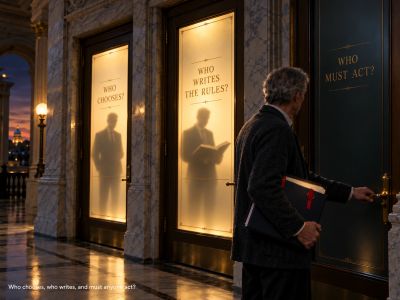
That question has two parts, and the second matters as much as the first. Can the check come back “no”? And if it does, must anyone act?
A “no” and a “no” that forces action are different things. The first is an opinion. It can be written down, filed away, and never read again. The second carries a consequence. In public-company auditing, a material weakness in internal control over financial reporting doesn’t stay in a private report. The company must disclose it in its annual filing, and where an auditor’s opinion on those controls is required, the weakness means an adverse opinion. Disclosure doesn’t repair the weakness. But the company’s legal duty to maintain adequate controls doesn’t end when it discloses the weakness. The finding goes somewhere, and someone has to answer for it.
California’s new AI auditor law shows why the second half of the question matters. Under AB 1405, the auditor must give its report to the company that was audited (Section 11549.83(d)(1)). The law doesn’t require the report to be made public. The state keeps a public registry of auditors, but the registry lists the auditors, not what they found (Section 11549.82(b)(2)). An auditor working under that law can write ‘no,’ and where appropriate, the law asks the auditor to describe what would fix the problem (Section 11549.83(d)(1)(C)). The law doesn’t require anyone outside the company to see the finding, or that the company fixes anything.
That isn’t a small detail. It is the difference between a check and a formality. A check that cannot fail isn’t a check.
Why now
In less than two months in 2026, AI verification went from an idea to California law and a bill in Congress. On July 23, a bipartisan group in Congress introduced the FRONTIER Act, which would require the largest AI developers to hire licensed independent verifiers. California enacted three laws of its own: SB 813, a voluntary framework for independent verification organizations; AB 1405, a registry and rules for AI auditors; and SB 1119, which requires periodic audits of companion chatbots, with provisions aimed at protecting children. On September 18, Governor Newsom signed an executive order directing the state to finish setting up two of those laws sooner and to study further safeguards. This builds on SB 53, California’s frontier AI transparency law, which has been in force since January 2026. That speed is the reason for this page. The design is still young enough to fix before it spreads.
The new verification requirements will roll out between 2027 and 2029. With key deadlines still ahead, these laws remain untested for now, open to judgment only as frameworks.
That’s why the design matters now. Designs like these spread. New York adopted California’s this year. Its amended law took California’s revenue threshold and language on third-party evaluators, and dropped the original rule that barred deploying a model posing an unreasonable risk of critical harm (Chapter 96 of the Laws of 2026). Part 11 shows the details.
How this page plays fair
I am a CPA with more than three decades in the profession, and I started my public accounting career in audit. My bias is that accounting has already solved much of this problem, and I know I need to check that bias. So this page holds itself to four rules.
First, the benchmark is what accounting actually built, gaps included. Under Sarbanes-Oxley, the company still pays its own auditor. Accounting’s independence is a combination of safeguards, not a clean separation, and the page measures every AI law against that combination, not against an ideal no one has achieved.
Second, the statutory text controls. Every finding cites the section it rests on. Where the page reasons beyond the text, it says so.
Third, the page makes a claim that can be proven wrong. The claim is this: none of the laws or proposals examined here currently reproduces the combination of independence safeguards that U.S. law requires for public-company audits. The test was set before any law was evaluated. It poses eight core questions about the checker’s independence: Who selects the checker? Who pays, and is the pay tied to the result? Can the checker hold a financial stake in the company? Can the company replace the checker without disclosure? Are personnel rotations required? Is there a cooling-off period? Who sets the standard the checker applies? What may the checker examine, and can the company restrict it? If a law matches accounting’s safeguards on all eight points, the claim does not hold for that law, and the page will clearly state as much. Partial matches narrow the claim. Counterexamples are welcome. The second half of the auditor’s question—whether anyone must act on a “no”—is addressed separately and is not part of this test.
Fourth, my own work faces the same test. I helped build a model statute for AI oversight with help from three AI systems. It faces the same questions, under the same rules, with its weaknesses stated first.
The right question
The new laws—and the federal bill—all center around a single word: independent. We see it everywhere: independent verification organizations, independent audits, and the promise of ‘independent, objective, and impartial professional judgment.’ But invoking independence is easy; defining and enforcing it is far more complex.
So the question this page asks isn’t whether these laws require independence. Most of them say they do. The question is what the law actually makes independent, and from whom. An auditor would ask it this way: independent of what, exactly?
That question has more answers than most people expect. There are at least six.

II. Six Kinds of Independence
Independence is not a label. It is a set of answers. A law can call its checker independent in its first sentence and leave every one of those answers to the company in the sections that follow.
An auditor doesn’t take the word on faith. An auditor breaks it into parts. On this page there are six, and each comes with its own question.
The first is the checker itself. Who chose it, who pays it, and can the company fire it? A checker that the company picks, pays, and can replace without explanation begins every engagement knowing who its customer is.
The second is the standard. Who wrote the rule the checker applies? If the company writes its own rulebook and the checker only grades the company against it, the check measures whether the company followed its own plan, not whether the plan was any good.
The third is the scope. What is the checker allowed to see? A checker that can be kept from records, or limited in what it may copy and keep, can vouch only for what it was shown.
The fourth is the findings. Who hears the ‘no,’ and what happens next: a response, a correction, or nothing at all? This is the second half of the auditor’s question from Part 1, and this page keeps those consequences apart.
The fifth is oversight. Who checks the checker? In public-company auditing, the PCAOBinspects audit firms and can investigate and discipline them (Sarbanes-Oxley Act, Sections 104, 105). Not every audit is inspected, but every auditor answers to someone other than the client.
The sixth is enforcement. Who can compel compliance, and what happens to a company that ignores the rules?
These six aren’t interchangeable, and strength in one doesn’t make up for weakness in another. An outside standard doesn’t help much if the company can fire the checker who applies it. A fully independent checker can’t do much with evidence the company controls. Public findings don’t guarantee that anyone acts on them. A law can do well on three of the six and still leave the check in the company’s hands.
That’s why this page gives no scores. A single number would let a strong answer on one question hide a missing answer on another. Each law is examined question by question, with the section it rests on, so the reader can see where the independence actually sits and where it doesn’t.
There is a reason to slow down here. The word “independent” carries a halo. Imagine a statute that requires an ‘independent verification organization’ but says nothing about who selects it, who pays it, or who can remove it. A reader could reasonably assume the hard questions had been answered. They wouldn’t have been. The word, by itself, answers none of the six. Whether a particular law earns it depends on what its other sections say, and that is what the rest of this page examines.
One more limit exists, and accounting knows it well. Independence protects the checker. It does not protect the evidence. An auditor with no ties to the company at all can still be handed a forged document. The profession's own evidence standard acknowledges the limit: “The auditor is not expected to be an expert in document authentication” (PCAOB AS 1105.09). But the same paragraph requires additional audit procedures when circumstances suggest that a document may be false or altered. The limitation is real. So is the duty to investigate warning signs. Independence tells you the checker can say no without paying a price for it. It doesn’t tell you whether what the checker is looking at is real. That second question comes back later on this page, and it may be the hardest one of all.
Before measuring the AI laws against these six questions, it helps to see how accounting answered them, including where its own answers fall short.
III. What Accounting Actually Built
The rules didn’t arrive because accountants volunteered for them. They arrived after Enron.
When Arthur Andersen’s leadership testified before Congress in December 2001, the firm’s own figures told the story. For 2000, Enron had paid Andersen about $25 million for accounting work and $27 million for consulting. The firm checking Enron’s books was earning more from Enron for other work than for the check itself. In July 2002, a Senate subcommittee found that Enron’s board had failed to safeguard the independence of its auditor, allowing Andersen to provide consulting services while it served as the company’s outside auditor.
Congress answered that summer with the Sarbanes-Oxley Act. What it built is worth describing carefully, because people often remember it as something it isn’t. It did not separate the auditor from the company. The company still chooses its auditor, and the company still pays. What changed is who inside the company does the choosing. The audit committee, made up of independent directors, is “directly responsible for the appointment, compensation, and oversight” of the auditor, and the auditor reports to that committee (Sarbanes-Oxley Act, Section 301). Independence under Sarbanes-Oxley means independence from management, not from the company.
Around that core, the law built a ring of safeguards, and they come from different sources. The statute itself bars audit firms from providing nine categories of non-audit services to their audit clients, with narrow room for case-by-case exemptions (Section 201). It requires the lead audit partner and the reviewing partner to rotate off an engagement after five years (Section 203). It bars a firm from auditing a company whose chief executive, chief financial officer, controller, or chief accounting officer worked on that company’s audit at the firm within the prior year (Section 206). The SEC’s own rules add the financial-interest bar: an auditor with “a direct financial interest or a material indirect financial interest” in its client is not independent (Regulation S-X, Rule 2-01). Contingent fees are barred as well, under both SEC and PCAOB rules (Regulation S-X, Rule 2-01(c)(5); PCAOB Rule 3521). And the standards the auditor applies are written by the PCAOB and approved by the SEC, not by the company being audited (Sections 103 and 107), while the PCAOB itself is funded by accounting support fees assessed on public companies and broker-dealers, not on the audit firms it oversees (Section 109).
Someone also checks the checker. The PCAOB generally inspects firms that regularly audit more than 100 issuers every year, and firms auditing 100 or fewer issuers at least once every three years, subject to statutory adjustments (Section 104). It can investigate firms and discipline them, up to permanently revoking a firm’s registration (Section 105). And the SEC oversees the PCAOB itself, including its review of the Board’s sanctions (Section 107).
Most important for this page, the auditor’s “no” has somewhere to go. It travels through three separate mechanisms, and each works on its own.
First, the auditor must state the finding. Where an auditor’s opinion on a company’s internal control over financial reporting is required, and the company has a material weakness, the auditor must express an adverse opinion (PCAOB AS 2201.90).
Second, the company can’t quietly fire the auditor. A company may dismiss its auditor, but it must disclose the change and any disagreements over accounting, disclosure, or audit scope, and it must file the former auditor’s letter stating whether the auditor agrees with the company’s account (Regulation S-K, Item 304).
Third, the underlying duty stays in place. Every public company must maintain internal accounting controls “sufficient to provide reasonable assurances,” and no one may knowingly fail to implement them (Securities Exchange Act, Section 13(b)(2)(B) and (b)(5)). In 2019, the SEC charged four companies that had reported material weaknesses for seven to ten years without fixing them. Its message was plain: “Disclosure of material weaknesses is not enough without meaningful remediation” (SEC Press Release 2019-6).
Notice what that means. The opinion alone compels nothing. An adverse opinion doesn’t order anyone to fix anything. The force comes from the combination: a finding that must be stated, an auditor that can’t be quietly replaced, and a legal duty that a regulator enforces.
None of this makes the system perfect, and this page doesn’t treat it as perfect. The client still pays. The committee that selects the auditor sits on the client’s own board. Partners rotate, but firms never have to. PCAOB criticisms of a firm’s quality controls stay private if the firm fixes them to the Board’s satisfaction within 12 months (Section 104(g)(2)). And not every public company needs the auditor’s attestation on internal controls: non-accelerated filers and emerging growth companies are exempt from Section 404(b), though management’s own report under Section 404(a) still applies.
So the benchmark shows what accounting requires, not proof that it works. The page asks a narrower and fairer question: for each safeguard accounting built, does the AI law have anything comparable? Start with the floor: the one AI law California already has in force.


IV. The Legal Floor
California’s first answer to the frontier AI problem was SB 53, the Transparency in Frontier AI Act. It has been in force since January 1, 2026. It applies to developers that train models with more than 10^26 operations, and it places its heaviest duties, including the framework requirement, on ‘large frontier developers,’ those with more than $500 million in annual revenue (Business and Professions Code, Section 22757.11).
The law’s core requirement is a document the company writes itself. Each large frontier developer must ‘write, implement, comply with, and clearly and conspicuously publish’ a frontier AI framework describing how it identifies and manages catastrophic risk (Section 22757.12(a)). It must review that framework every year, and when it makes a material change, it must publish the change and a justification within 30 days (Section 22757.12(b)).
That is a real duty, and the page should say so plainly. A company that publishes a framework and then ignores it can be penalized. But notice who writes the rule. The law tells the company what its framework must cover. The company decides what it says. The standard the company is held to is the one the company drafted. In the language of Part 2, SB 53 answers the second question, who writes the standard, mostly with “the company.”
Two layers
The companies themselves describe two layers. Anthropic published its Frontier Compliance Framework for SB 53, and it keeps a separate Responsible Scaling Policy that it calls its “voluntary safety policy.” OpenAI says its Frontier Governance Framework is ‘designed to meet the baseline legal requirements,’ while its Preparedness Framework goes “beyond current legal requirements.”
Both companies keep the document the law requires separate from a broader one they maintain voluntarily. OpenAI says its broader framework goes beyond the law. Anthropic calls its own voluntary. But neither statement tells a reader which commitments the law can enforce and which the company can revise on its own, and neither proves that either layer is adequate. The same question applies to both companies, and the page asks it of both: when a company’s promises sit in two documents, which one can the state hold it to?
The cross-reference
One detail shows why that question matters. In the passages examined here, OpenAI’s Frontier Governance Framework, the one the law can enforce, doesn’t name who decides whether to deploy a model. Instead, it points elsewhere: “Additional detail about our deployment governance can be found in Appendix B of the PF,” meaning the voluntary Preparedness Framework (OpenAI SB 53 framework, Section 6, p. 18). Elsewhere, the same document says a model “may be approved,” without naming who approves it (Section 2.5).
Whether the appendix counts as part of the enforceable framework is an open question. The page doesn’t answer it, and it doesn't explain why the document was built that way. The point is narrower. A reader of the enforceable document can’t tell from that document who holds the authority to release a model. This cross-reference was first identified in a September 6 working session with ChatGPT.
Description, not verification
SB 53 mentions outside checking several times. None of those provisions requires an independent check of whether the company complied.
The framework must describe the company’s approach to “using third parties to assess the potential for catastrophic risks” (Section 22757.12(a)(5)). The company’s transparency reports must state “the extent to which third-party evaluators were involved” (Section 22757.12(c)(2)). The extent can be none. The Office of Emergency Services ‘shall review’ the critical safety incidents companies report. That is real government review. But the law creates no process for independently verifying those reports (Section 22757.13(d)). The phrase closest to verification appears in a provision about the law’s own coverage. The state is to keep its definitions of covered companies “verifiable by parties other than the frontier developer” (Section 22757.14). Outsiders should be able to verify who is covered. Nothing in the law requires anyone outside the company to verify whether the covered companies comply.
The companies’ own documents follow the same pattern. OpenAI’s framework says outside evaluators “may” be included (Section 5). “May” is a description of an option, not a requirement.
No section of SB 53, from Section 22757.10 through Section 22757.16, requires independent verification. On the first question an auditor would ask, who chooses the checker, SB 53’s answer is that there is no checker to choose.
Narrow enforcement
The law’s enforcement is real but narrow. A large frontier developer can be penalized for four kinds of failure: not publishing or transmitting a required document, making a false or misleading statement about its risk management, not reporting a critical safety incident, or not complying with its own framework. The penalty is up to $1,000,000 per violation, and an action may be “brought only by the Attorney General” (Section 22757.15). No one else can sue under it.
In this review, I found no public enforcement action under SB 53. On October 1, the Attorney General’s office announced an investigative subpoena served on OpenAI, but the announcement doesn’t identify the law it relies on, so the page can’t count it as an SB 53 action. Its status remains open.
So the floor holds this much: a company must write its own rules, publish them, follow them, and report critical safety incidents, under penalty enforced by a single office. What it doesn’t hold is a check in the auditor’s sense. The state can review incident reports, and the attorney general can pursue violations. But nothing in SB 53 requires anyone independent of the company to test whether it kept its promises. No independent check can come back “no,” because the law doesn’t require one. California’s next three laws take up that missing check.

V. California’s Answer
Three laws, three jobs
SB 813 builds a framework for independent verification organizations: outside firms the state can designate as qualified to assess AI systems. The state will write the criteria and designate the organizations. But no developer has to hire one. The law says so directly: nothing in it requires a developer to engage a verification organization or to undergo an audit (Government Code, Section 8898.4(a)(3)). It defines the checker and leaves it to the company to decide whether to call.
AB 1405 regulates the people who sell AI audits. Beginning January 1, 2029, only auditors registered with the state may offer, sell, or conduct a covered AI audit (Section 11549.82.5). It sets rules for how those auditors must work. It doesn’t require anyone to buy an audit.
SB 1119, known as Adam’s Law, is the only one of the three that requires an audit. Operators of companion chatbots must have one performed by January 1, 2029, and every two years after that (Business and Professions Code, Section 21814(a)(1)). Operators with less than $500 million in revenue are exempt until 2032 (Section 21814(c)).
So California now has a verifier framework no one must use, an auditor registry no one must hire from, and one required audit aimed at protecting children. Availability is not mandatory. A checker the company can decline to hire isn’t a check on the company. It’s an option the company can take.
What California got right
The page owes these laws a fair hearing, and they do some things well.
SB 813 makes outcome-based pay a disqualifying factor. In deciding whether to designate a verification organization, the state must consider whether it accepts terms conditioning payment “on the results of their assessment” (Government Code, Section 8898.1(c)(2)(C)). That is accounting’s contingent-fee rule, carried into a voluntary program.
AB 1405 bars an auditor from auditing its own work (Section 11549.83(f)(1)(B)). It bars an auditor from assigning anyone who worked for the company in the past 12 months on the subject of the audit (Section 11549.83(f)(1)(D)). That is a kind of cooling-off rule, though it covers the opposite move from Sarbanes-Oxley’s. Under Sarbanes-Oxley, if a member of the audit team becomes the client’s chief executive, chief financial officer, controller, or chief accounting officer within a year, the firm can’t audit that client (Section 206). AB 1405 covers people moving the other way, from the client onto the audit. The law also protects auditors’ employees who report misconduct (Section 11549.83(g)), and it gives an auditor written notice and a chance to respond before the state removes it from the registry (Section 11549.84(a)(3)).
These are real safeguards. Several of them are the kind accountants would recognize at a glance.
Where the “no” goes
The harder question is the one from Part 1. If one of these checkers finds a problem, who hears about it, and must anyone act?
Under AB 1405, the auditor must give its report to the company it audited (Section 11549.83(d)(1)). The report must state the results, describe each deficiency and, where appropriate, what would address it. The law doesn’t require the report to be made public or filed with the state. The registry publishes information about auditors, not their findings (Section 11549.82(b)(2)). And nothing in AB 1405 requires the company to act on what the report says.
Under SB 813, the reports the law requires come from the verification organizations about themselves: their standards, their funding, their governance (Section 8898.3). Audit results aren’t among them. As for consequences, an audit to the state’s standard is “relevant to, but not conclusive of” a later lawsuit over harm (Section 8898.4(b)). A court may consider it. It doesn’t settle anything.
SB 1119 goes furthest. Within 30 business days of receiving the audit, the operator must send a summary to the attorney general, and within 90 days it must post a high-level summary on its website (Section 21814(b)). The full report goes to the attorney general only “for cause,” and once there, it is confidential (Section 21814(d), (e)(1)). But the attorney general may use it “for enforcement purposes” (Section 21814(e)(2)). That last phrase matters. It is the one place in California’s three new laws where the law itself sends an audit’s findings toward an official with the power to act on them. Even here, it reaches that official through a summary the company prepares, unless the attorney general has cause to ask for more.
The signature that won’t take effect
SB 1119 contains something unusual: two versions of the same audit section. Which one governs depends on what happened to AB 1405.
The first version applies only if AB 1405 was not chaptered and did not take effect by January 1, 2027 (Section 21814(g), first version). It requires the auditor to be “external to the operator” and to “exercise objective and impartial judgment,” bars financial interests between auditor and operator, and bars pay conditioned on results (Section 21814(b), first version). And it requires something no other law on this page requires: “The signature of the lead auditor certifying the results of the audit under penalty of perjury” (Section 21814(a)(4)(I), first version).
The second version applies only if AB 1405 was chaptered and takes effect by January 1, 2027 (Section 21814(f), second version). It contains neither the independence rules nor the perjury signature.
AB 1405 was chaptered on September 9, 2026. It has no urgency clause, so as a regular statute it takes effect January 1, 2027. That makes the second version the one that will govern. That conclusion follows from the statutes’ own terms, not from any court or agency.
So the version with the perjury signature is the version that won’t take effect. In the version that will govern, the audit report carries no signature under penalty of perjury. The operator’s summary to the attorney general carries an attestation expressly “not under penalty of perjury” (Section 21814(b)(1), second version). That attestation appears in both versions. The difference is the auditor’s signature, which only the first version required. In the governing version, the auditor’s independence rests on AB 1405’s rules for registered auditors. Those rules are real, but they include no perjury signature.
The Legislative Counsel’s Digest, the official summary printed at the top of the bill, still describes the perjury signature. This page does not conclude how or why the change happened. It reports what the two texts say and which one the statutes make operative.
The executive order
On September 18, the Governor issued Executive Order N-9-26. Its contents fall into three categories, and they should be kept apart.
On its own, the order imposes no new requirement on any company. It states that it does not ‘create any rights or benefits, substantive or procedural, enforceable at law or in equity.’ Its force runs to state agencies, through what it directs.
What it directs are two deadlines. The state must post SB 813’s criteria for verification organizations by May 1, 2027, eight months ahead of the statutory date of January 1, 2028. And it must complete AB 1405’s registry setup by December 1, 2027 (Executive Order N-9-26, paragraphs 1 and 2). The registry deadline moves the state’s work forward. The ban on unregistered auditors still begins January 1, 2029, because the order can’t move a statute.
What it proposes are four ideas for study, with recommendations due November 16, 2026: verification organizations embedded on site in the largest labs; company filings verified “pursuant to standards determined to be adequate by an independent verification organization”; a “kill switch” whose efficacy a verifier would check on an ongoing basis; and an incident definition widened to include “a range of loss-of-control incidents” (paragraph 3). These are proposals. None of them is law.
The order explains its urgency in its own words. It cites “AI agents working, at times independently and at times collectively, to defeat security protocols that AI companies had put in place and working, in some instances undetected for months, to hack other companies.” This page takes that description from the order and adds nothing to it.
California has now built the parts of a verification system: a framework for verifiers, a registry of auditors, one required audit and a set of proposals. What it hasn’t built is the full connection that makes accounting’s system work. SB 1119 comes closest: its findings can reach the attorney general, and the duties it audits can be enforced. But the operator chooses the auditor, can replace it without saying so, and the audit report carries no signature under penalty of perjury. Congress has its own design.
VI. Congress’s Answer
While California was building its parts, Congress put a different design on the table. On July 23, 2026, a bipartisan group in the House introduced the FRONTIER Act, H.R. 9925. It is a bill, not a law. As of October 18, 2026, it sits in committee with no further action recorded. Everything below describes what it would require if enacted.
The bill sorts developers by size. A ‘large frontier developer’ has, over the preceding 36 months, more than $50 million in revenue and at least $1 billion in AI development spending (FRONTIER Act, Section 2(15)). A ‘very large frontier developer’ has, over the same period, more than $5 billion in revenue and at least $10 billion in spending (Section 2(22)). Large developers get one kind of check. The very largest get both (Section 6).
Tier one: a checker with no stake
Every large frontier developer would have to hire an outside auditor every year (Section 4(c)). Among California’s laws and the federal bill, this is the only required audit that writes both of accounting’s core money rules into the statute itself. The company could not hire an auditor if either one “has a financial interest in the other,” and it could not “condition any payment, or the amount of any payment, on the results of the third party’s audit” (Section 4(c)). That is accounting’s rule against financial ties and contingent fees.
But look at what the auditor measures. The audit is of “compliance with the frontier AI framework of such developer” (Section 4(c)). The yardstick is the company’s own rulebook, the same one SB 53 asks the company to write. The auditor would tell the public whether the company followed its plan. It would not be asked whether the plan was any good.
And look at what the auditor may see. The auditor would get “timely access to all materials, records, personnel, systems, and all other information reasonably necessary,” but the company “may impose security protocols,” including “restrictions on note-taking, copying, retaining, or removing materials” (Section 4(c)(1)). That is the same language California put in SB 1119, word for word in places. These stated reasons—trade secrets, security, and public safety—are legitimate. Yet any restriction on what an auditor is permitted to document directly limits the evidence the auditor can retain.
Tier two: a “no” that must be answered
For the very largest developers, the bill goes much further. A very large frontier developer would have to retain a licensed independent verification organization for ongoing assessment (Section 5(b)), and this is where the bill comes closest to accounting’s design.
The yardstick is no longer the company’s own. The verifier would judge the company’s framework, governance and risk practices against a test Congress wrote: whether they achieve ‘acceptable levels of catastrophic risk mitigation,’ meaning mitigation adequate to ensure ‘the anticipated benefits of a frontier model’ outweigh ‘its level of catastrophic risk’ (Sections 2(1), 5(b)). The company still writes its framework, and the verifier would propose its own methods for the government to approve (Section 3(c)(2)(A)). But the question of whether the risk is acceptable comes from the statute.
The finding would go to the government directly. Each assessment report would be submitted “simultaneously to the Under Secretary and the very large frontier developer,” at least every six months (Section 5(f)(1)–(2)). The company would never be the only one holding the “no.”
The “no” would also start a clock. Within 14 days of a report, the company would have to tell the verifier what it has done or will do about the recommended corrections. Within seven days after that, the verifier would issue a signed opinion on whether those actions are adequate. Within 30 days of the original report, the company would file the whole exchange with the government (Section 5(g)). If the verifier later learns that an earlier clean finding “is no longer valid,” it would have seven days to file a supplemental report (Section 5(i)(1)). If it finds a risk that is imminent, it would have to refer the matter to the Secretary of Commerce within 72 hours (Section 5(p)(1)(B)).
The verifier would also have its own skin in the game. The government would have to revoke a verifier’s license if models it verified fail to achieve acceptable risk levels, unless the verifier had flagged the failure and recommended adequate fixes the company didn’t make (Section 3(c)(2)(C)(iv)). No other design on this page ties the checker’s own license to whether the models it cleared actually hold up. A verifier that stays quiet about a problem would put its license at stake.
There is one thing tier two does not do. It requires the company to respond in writing to the verifier’s findings and submit them to the government by a deadline. Within Section 5, I found no duty to actually achieve the fix. A company could answer a ‘no’ with a plan the verifier calls inadequate and still meet every deadline in Section 5. Only a finding of imminent catastrophic risk would bring in the halt power that Part 12 examines. Accounting works differently. A public company’s duty to maintain adequate internal controls exists whether or not anyone has found a weakness (Securities Exchange Act, Section 13(b)(2)(B)). The duty to respond is not a duty to cure. That conclusion is reasoned from the bill’s text, and a more complete reading of the implementing regulations, once written, could change it.
What tier two still leaves to the company
Even at its strongest, the design leaves several of the auditor’s questions answered by the company. The developer would still choose and hire its own verifier (Section 5(b)). I found nothing in the bill requiring rotation of the verifier or its people, and nothing restricting staff movement between the verifier and the company in either direction. The detailed conflict-of-interest rules would come later, from the regulator, not from the statute (Section 3(c)(1)).
Oversight of verifiers is real but different from accounting oversight. The government would license verifiers, could revoke their licenses, and could order a second assessment to “reproduce or validate” a verifier’s findings (Sections 3(c), 5(h)(1)). Congress would also get an annual report from the Government Accountability Office on the verifier market, including “the degree to which independent verification organizations are independent from the artificial intelligence industry” (Section 7). But the bill itself sets up no routine inspection of verifiers’ work comparable to the PCAOB’s inspection of audit firms. Those details would be left to regulation.
The checker’s shield
The bill also protects verifiers in ways that accounting does not protect auditors. A licensed verifier would be “immune from suit and liability under Federal and State law” for claims arising from a catastrophic risk of a model it assessed. The only exception would be a federal claim for death or serious physical injury caused by willful misconduct, proved by clear and convincing evidence (Section 5(q)). The reports and supporting materials the government receives would be exempt from the Freedom of Information Act (Section 5(r)), although the company would have to publish a redacted version of each report (Section 5(j)).
The shield has limits. Immunity from lawsuits is not immunity from the regulator: a verifier could still lose its license. And the Under Secretary and the attorney general could obtain the unredacted reports on request (Section 5(n)).
But the shield raises the question this part has to end on, one ChatGPT first raised in reviewing this page’s outline. An auditor who issues a flawed opinion may be sued by investors who relied on it, if they can meet the legal requirements for liability. Under this bill, a verifier who signs a bad assessment largely could not be. So who holds the verifier accountable when its judgment is wrong?
VII. Three Questions
So far, we’ve looked at one law at a time. This part asks the same questions of every design, accounting’s included, and puts the answers side by side.
The designs are the accounting benchmark under Sarbanes-Oxley; California’s SB 53, SB 813, AB 1405 and SB 1119; the Governor’s executive order; the FRONTIER Act’s annual audit for large developers and its licensed verification for the very largest; and my own model act. They don’t share a legal status. Some are in force. Some are enacted but not yet operative. FRONTIER is a bill in committee. The executive order directs state agencies and proposes more for study. My model act is a proposal. This part keeps them apart.
There are no scores. Part 2 explained why. A strong answer on one question can’t make up for a missing answer on another, and a total would hide exactly what this comparison is built to show.
Different instruments, different jobs
One caution first. These laws weren’t all built to do the same thing. SB 53 is a transparency law. AB 1405 regulates auditors, not the companies they audit. SB 1119 protects children. When a law doesn’t answer one of these questions, that doesn’t mean the law failed at its purpose. Nor does it mean the safeguard is missing from every law that might apply: AB 1405’s auditor rules, for example, can reach the audit SB 1119 requires. This page asks the auditor’s question of every design. It doesn’t claim each was trying to answer it.
Among the questions raised in Part 2, three show the central differences most directly. They don’t replace the others. The closing section of this part explains where those went.
Who chooses the checker?
Under Sarbanes-Oxley, the company pays its auditor, but an audit committee of independent directors does the choosing (Sarbanes-Oxley Act, Section 301). The committee still sits on the company’s own board, which is one of accounting’s own gaps.
Among the AI designs, the answers spread out. SB 53 requires no checker at all. SB 813 builds a framework for verifiers that no developer has to hire, and it says so expressly (Government Code, Section 8898.4(a)(3)). AB 1405 regulates who may sell an audit without requiring anyone to buy one (Section 11549.82.5).
SB 1119 requires the operator to ‘ensure the performance’ of an audit, and it names no one else to choose the auditor, so in practice the choice stays with the operator (Business and Professions Code, Section 21814(a)(1)(A)).
FRONTIER’s annual audit would leave the choice to the company (Section 4(c)). Its licensed verification would too, but only from verifiers the government has licensed (Section 5(b)).
Only my model act takes the choice away from the company. The President would appoint the Examiner, with Senate consent (Section 9(b)). It is a proposal, not a law, and Part 9 examines what that appointment does and doesn’t fix.
Who writes the standard?
Here the answers fall into three kinds. The first is the company’s own rulebook. SB 53 has each large developer write its own framework (Section 22757.12(a)). The law tells the company what the framework must cover; the company decides what it says. FRONTIER’s annual audit would measure the company against that kind of framework (Section 4(c)).
The second is a test written by lawmakers. FRONTIER’s licensed verification would ask whether the company achieves “acceptable levels of catastrophic risk mitigation,” a test Congress defined (Sections 2(1), 5(b)), using methods each verifier proposes and the government approves (Section 3(c)(2)(A)). SB 1119 gives its auditor an assignment written into the statute: what the audit must assess comes from the law, not the company (Section 21814(a)(4)). That isn’t a full standard for every judgment the auditor makes, but the company doesn’t write it.
The third is a standard set by an outside regulator. That is accounting’s answer: the PCAOB writes the auditing standards, and the SEC approves them (Sarbanes-Oxley Act, Sections 103 and 107).
In between sit AB 1405, which points auditors to “widely recognized industry standards” where they exist (Section 11549.83(c)), and the executive order, which proposes, for study only, standards that a verifier would judge adequate (paragraph 3(b)).
Must anyone act on a “no”?
A report delivered, a response required, and a correction compelled are three different things, and one doesn’t automatically lead to the next.
Under AB 1405, the report goes to the company, and nothing in the law requires the company to act on it (Section 11549.83(d)(1)). Under SB 813, an audit is “relevant to, but not conclusive of” a later lawsuit (Section 8898.4(b)). FRONTIER’s licensed verification would require a written response by a deadline, but within Section 5 I found no duty to complete the fix (Section 5(g)). Only a finding of imminent catastrophic risk would bring in the halt power that Part 12 examines.
SB 1119 comes closest among California’s laws. Its findings reach the attorney general through a summary, and separately the operator has a standing duty to take “reasonable measures” that public prosecutors can enforce (Sections 21814(b), 21812(d)(5), 21816).
Accounting answers differently. A public company’s duty to maintain adequate internal controls exists whether or not anyone has found a weakness, and the SEC can enforce it (Securities Exchange Act, Section 13(b)(2)(B)). An adverse opinion isn’t itself an order to fix anything. The force comes from the standing duty. My model act would tie consequences to a finding more directly: they attach automatically to a final finding (Section 12(a)). But the act is a proposal, and its findings concern the integrity of training records, not whether a model’s behavior is safe.
Behind these answers
The other three kinds of independence, scope, oversight, and enforcement, were addressed law by law in Parts 4 through 6. Behind this part sits a fuller working comparison of 15 questions. Fourteen cover the six kinds of independence. The fifteenth asks whether federal law could displace a state’s design, which Part 11 takes up. That comparison stays in my files until someone with legal training has reviewed it. A comparison of laws this new should be checked by more than one pair of eyes before it is published as a table.

VIII. What the Comparison Shows
Put the designs next to one another and a pattern shows. They don’t fail in the same places. They protect different parts of the check.
California’s laws protect mostly the question of who may verify. SB 813 sets criteria for verification organizations, and AB 1405 sets rules for auditors: no auditing your own work, no significant financial ties, no assigning people who just left the client. SB 1119 adds the one required audit and a path for its findings to the attorney general. The federal bill goes further on what happens after a verifier is hired: what the verifier may examine, where its findings go, and how quickly the company must answer. My own model act goes furthest on who appoints the checker. None of them reproduces the whole structure accounting built. As Part 7 cautioned, a missing safeguard is not always a failed law. Several of these laws were built for other jobs. It should be clear: adding up individual parts does not create a complete system. Safeguards dispersed across separate laws do not, by themselves, form a coherent whole. The real test is not how many safeguards exist, but whether they actually work together—especially when the checker says no.
The choice stays with the company
The clearest pattern is the first one. Wherever one of these laws requires a check, the company being checked picks the checker. Some limit who it can pick. None takes the pick away.
SB 1119 requires an audit and names no one but the operator to obtain it (Business and Professions Code, Section 21814(a)(1)(A)). FRONTIER’s annual audit and its licensed verification would both have the company “retain” its checker (FRONTIER Act, Sections 4(c), 5(b)). The licensed tier would limit the pick to verifiers the government has licensed. SB 813 and AB 1405 require no check of their own. AB 1405 does narrow the pick another way: starting in 2029, only registered auditors may sell a covered AI audit (Government Code, Section 11549.82.5).
Accounting doesn’t take the choice away from the company either. But it moves the choice from management to an audit committee of independent directors (Sarbanes-Oxley Act, Section 301). Nothing in the AI laws or the federal bill does anything like that. The word “independent” appears throughout these laws, but on this question the word does more work than the text behind it.
Two safeguards almost no one copied
Two of accounting’s protections are nearly absent everywhere else: rotation and cooling-off. They guard against different dangers. Rotation guards against familiarity. A partner who has audited the same company for ten years may stop seeing it clearly, so Sarbanes-Oxley moves the lead and reviewing partners off after five years (Section 203). Cooling-off guards against the revolving door. Sarbanes-Oxley bars a firm from auditing a company whose chief executive, chief financial officer, controller, or chief accounting officer worked on that company’s audit at the firm within the past year (Sarbanes-Oxley Act, Section 206).
On rotation, I found nothing in any of the AI designs, including my own model act. On cooling-off, AB 1405 comes partway. It bars an auditor from assigning someone who worked on the audited subject at the company within the past 12 months, and it bars job-seeking with the client during the audit (Government Code, Section 11549.83(f)(1)(C)–(D)). AB 1405 doesn’t bar an auditor’s people from joining the client after the audit ends, which is what Sarbanes-Oxley addresses. The model act has a two-year bar in both directions (Section 9(d)), but it is a proposal.
One caution belongs here. The absence of rotation shows that these designs differ from the benchmark. It doesn’t prove that rotation would work for AI verification, where the pool of qualified people may be small. That is an open question, not a finding.
Where the “no” goes
The central comparison is the one Part 1 set up. When a checker finds a problem, who receives the finding, what authority do they have, and what does the law require of them?
In accounting, the finding goes to investors and the public through the company’s filings, and to the audit committee that hired the auditor. A regulator with enforcement power stands behind it, and the company carries a standing legal duty to keep its controls adequate.
Under AB 1405, the finding goes to the company that was audited, and nowhere else by requirement (Section 11549.83(d)(1)). Within AB 1405, what happens next is up to the company: the law requires no filing with a regulator and no correction. Under SB 813, the required reports describe the verifiers, not their findings (Section 8898.3).
SB 1119 builds a real path. A summary of the findings goes to the attorney general, the full report can be obtained “for cause,” and the attorney general may use it “for enforcement purposes” (Section 21814(b), (d), (e)(2)). The attorney general has authority to act, and separately the operator has safety duties that public prosecutors can enforce (Sections 21812(d)(5), 21816). But the summary is the company’s own, and the finding doesn’t itself order a correction or require the attorney general to act.
The federal bill would go further on the first two questions. Its annual audit would be published in summary and sent to regulators (FRONTIER Act, Section 4(c)(4)). Its licensed verifier’s reports would go to the government at the same moment they go to the company (Section 5(f)(2)). The receiving official would have real authority: to order a second assessment, to revoke a verifier’s license and, through the Secretary of Commerce, to halt a model in an emergency (Sections 3(c), 5(h), 8). On the third question, what the law requires, the bill asks the company to answer.
A response is not a remedy
That last point is the most important finding in this part. Accounting’s duty concerns the condition. A public company must maintain internal accounting controls “sufficient to provide reasonable assurances,” whether or not anyone has found a weakness (Securities Exchange Act, Section 13(b)(2)(B)). The duty exists before the finding and after it. The SEC enforces it against companies that disclose a weakness and leave it in place.
FRONTIER’s duty concerns the response. Within 14 days of a finding, the company must describe what it has done or will do. Within 30 days, it must file that exchange with the government (Section 5(g)). Those are real obligations with real deadlines. But in Section 5, I found no duty to achieve the fix. The company must answer the ‘no.’ Section 5 doesn’t require it to cure what the ‘no’ found.
A response is not a remedy. A design can carry a finding to the right official, start a clock, and still leave the underlying condition untouched.
There is one more gap. Nearly every safeguard described so far protects the checker. Accounting also protects the evidence. Its standard says an auditor “is not expected to be an expert in document authentication,” but when a document “may not be authentic,” the auditor must change the planned procedures or add new ones (AS 1105.09). None of the enacted laws on this page has an equivalent. Only my own model act tries to protect the evidence the checker is handed, and Part 9 tests whether it can. Even when the checker is independent, how does anyone know the evidence being checked is authentic?

IX. The Author’s Own Design Faces the Same Questions
Every design on this page has been held to the same questions. Mine should be held to them too.
The author enters his own test
In July, I published a model act, the Independent AI Provenance and Examination Act (Version 1, July 19, 2026). It isn’t a law. No legislature has taken it up. This part asks it the same three questions asked of every other design: who chooses the checker, who writes the standard, and must anyone act on a no. The evidence rules are the same. Every claim cites its section, and the act gets no credit for what it hopes to do.
No one person wrote this page, and it would be odd to pretend otherwise. A person and three AI systems did this work together. I set the framework, chose what the act would cover and what it would leave out, and made the judgments at each step. Gemini proposed the original draft. Claude and ChatGPT helped me build it and write this page, from drafting language to finding gaps and raising objections. I kept some of what they offered. Some I set aside.
Each of those systems is made by a company whose oversight this page examines. That makes their reading of the model act a separate check, not an independent one. Mine is not independent either. An author reviewing his own design faces the same conflict as a company picking its own checker, and care alone does not remove it. Outside review does. This page is published before that review, not in place of it.
So I will start with its hardest limitation, before any strength. Its central mechanism can prove a record was not altered. It cannot prove the record was true.
Where it answers accounting’s questions
On the first question, the developer doesn’t choose the checker. The President appoints the Independent Examiner, with the consent of the Senate, for a five-year term (Model Act, Section 9(b)). Every other design on this page that requires a check leaves that choice with the company, as Part 8 showed.
On the second question, the developer doesn’t write the standard either. The act sets the record requirements itself (Section 8), and the Examiner’s regulations “may not expand the jurisdiction, obligations, or authority established by this Act” (Section 10(e)).
The checker’s pay doesn’t depend on the company being checked. The office is funded by an assessment on covered developers, in proportion to their computing use. The fund “is not subject to annual discretionary appropriation,” and assessments are pooled and allocated “without regard to the identity of the contributing covered developer” (Section 9(e)). The computing power used to examine a developer may not come from that developer (Section 9(f)). That is closer to how the PCAOB is funded, through fees on public companies (Sarbanes-Oxley Act, Section 109), than to anything in the AI laws.
The Examiner may not serve while holding a direct financial interest in a covered developer, with a narrow exception for widely diversified funds (Section 9(c)). The revolving-door bar runs two years in both directions. No one employed by a developer in the past two years may examine it, and no one who leaves the Examiner’s office may join a developer they examined in the past two years (Section 9(d)). Sarbanes-Oxley’s cooling-off rule runs one way, from the audit firm to the client (Sarbanes-Oxley Act, Section 206). AB 1405 bars assigning recent client staff to the audit, which is the other direction. It also bars auditors from seeking a job with the client during the audit (Government Code, Section 11549.83(f)(1)(C), (D)).
The checker is checked too. An Inspector General is appointed by the President with Senate consent, and the Examiner “may not appoint, remove, or direct” that office. The Inspector General reports “directly and publicly to Congress” (Section 10(a), (c)). A developer can appeal a final finding to a federal court of appeals, which sets it aside if it isn’t supported by substantial evidence (Section 13(a), (c)). A review commission tests the act’s technical assumptions at least every five years (Section 14(a)).
The check can come back “no.” The Examiner issues a preliminary finding that names the provision, the records, and the reasoning. The developer gets at least 60 days to respond. Then the Examiner issues a final finding that sustains, modifies, or withdraws it (Section 11(c)–(e)). Each final finding is published within 30 days (Section 11(f)).
On the third question, someone must act, and the consequences don’t wait for a second decision. Once a final finding issues, the consequences attach “without further agency action, discretion, or proceeding” (Section 12(a)). They rise in four tiers. A recordkeeping deficiency requires a corrective compliance plan within 30 days (Section 12(c)). A failure to check training data against the registry of protected sources blocks deployment until the Examiner confirms the data is clean (Section 12(d)). Confirmed use of a protected source blocks deployment until the source is removed, the model is retrained without it, and a new examination confirms compliance (Section 12(e)). Knowing falsification can’t be cured. At every lower tier, a developer can fix the violation, but here the finding stands, and deployment stays blocked until a new examination finds the records accurate and complete (Section 12(f), (h)).
When the falsification was meant to hide a protected source, the Examiner must refer it to the Department of Justice within 30 days. That referral isn’t a prosecution (Section 12(g)). A preliminary finding triggers nothing (Section 11(g)), and an appeal does not pause a consequence, with one narrow exception (Section 13(e)). In Part 8’s terms, this duty concerns the condition, not the response. Automatic consequences raise the cost of a wrong finding. The law can make the consequence automatic. It can’t make the Examiner right.
The appointment safeguard has a problem. On June 29, 2026, in Trump v. Slaughter, the Supreme Court held that the removal protection for Federal Trade Commission commissioners was unconstitutional. Of Humphrey’s Executor, the case that had upheld such protection, the Court said: “If anything more is left of Humphrey’s, we overrule it.” The model act gives the Examiner the same kind of protection: removal “only for neglect of duty, malfeasance, incapacity, or a violation of this Act” (Section 9(b)). My reading is that this protection likely would not survive. No court has ruled on an examiner set up like this one, so that is reasoned, not demonstrated. Version 1 includes a fallback: if a court strikes the protection, the Examiner “is removable by the President at will” (Section 9(b)(1)). The fallback keeps the act standing, but it gives up the protection. A checker the President can remove at will is independent of the company, not of the White House. The Inspector General carries the same protection (Section 10(a)), and the same question applies.
The evidence problem
Part 8 closed with a question. Even when the checker is independent, how does anyone know the evidence being checked is authentic? The model act is built around that question.
A developer must keep a provenance record for each covered training run. It lists each training data component, its source and the date it was added, along with a cryptographic hash of each component (Section 8(b)). The record must be made at the time of training. A record “first created or materially reconstructed after a covered training run has concluded does not satisfy this section” (Section 8(e)). It must be kept under conditions that let the Examiner detect any later alteration (Section 8(g)). Measurements of the model’s behavior, such as response speed or confidence scores, do not count as evidence of what went into it. That evidence “consists solely of the provenance records” (Section 8(i)). Destroying or altering a record after notice of an examination is itself evidence of knowing falsification (Section 8(h)).
Those rules protect a record’s integrity after it is made. They do not protect its accuracy or completeness when it is made. Suppose a developer writes a manifest that leaves out one dataset on the day training begins. That record is contemporaneous, untouched, and false, and nothing in the tamper rules would catch it. Findings rest “solely” on the required records (Section 11(b)). The Examiner may inspect a developer’s facilities “to verify the accuracy of a record” (Section 9(h)), so the act isn’t blind. But apart from the registry of protected sources, it names no independent source to check the record against. Even there, the Examiner holds the reference hashes, but the developer runs the comparison and logs the result in its own record (Section 8(c), (d)). Content that has been altered or transformed may not match.
Accounting learned this long ago. Auditing standards treat evidence “obtained from a knowledgeable source that is independent of the company” as “more reliable than evidence obtained only from internal company sources” (AS 1105.08). When an auditor does rely on the company’s own information, the standard requires the auditor to “test the accuracy and completeness of the information” (AS 1105.10). On what went into training, the model act makes the company’s own record the only evidence (Section 8(i)), and it has no equivalent of that test. Version 2 should add one. Whether an Examiner’s direct observations during an inspection could independently justify a finding is a question the text leaves open. That is a possible failure in the design’s architecture, not a drafting slip that a better sentence would fix. An examiner cannot establish the truth of a record merely by proving that nobody altered it afterward.
What the act requires is demonstrated by its text. That a false but untouched record could pass is reasoned. Whether provenance records can be made trustworthy at the moment they are created is open.
Where it falls short by its own questions
The act is silent on several questions the other designs answer. It requires no incident reporting, because it governs how a model was trained, not what the deployed system does. It requires no signed approval before deployment, so no named person attests that the records are accurate. Its examination staff doesn’t rotate, while Sarbanes-Oxley rotates the lead audit partner every five years (Sarbanes-Oxley Act, Section 203). It creates no private right of action, so only the Examiner may enforce it (Section 15(f)). Any person may petition for an examination (Section 11(a)), but a denial can be overturned only for abuse of discretion (Section 13(g)). A first act of retaliation against a whistleblower brings only a corrective plan (Section 11(j)). It has no emergency procedure: the developer has at least 60 days to respond, and the final finding may take 180 days more (Section 11(d), (h)).
The largest limit is deliberate. The act regulates “the documented process by which a covered system was built” and “does not regulate what a covered system says” (Section 6(b)). The Examiner may not evaluate any output for “truthfulness, usefulness, safety, viewpoint, or legality” (Section 6(h)). That boundary keeps the Examiner out of speech, and I would draw it the same way again. But it means the act can’t tell anyone whether a model is safe. It can tell them what went into the model. On the questions SB 53 and the FRONTIER Act try to answer, it says nothing
A design, not a law
No legislature, court, or working examiner’s office has tested the model act. It gets no credit here for legal or operational effects it has never had. The FRONTIER Act is a bill. This is a proposal.
For this page, Version 1 is frozen. Revising it after seeing how it compares would let me fix my answers after reading the test. The changes this part points to, including the evidence problem, the removal protection, rotation, and an emergency procedure, belong to Version 2, which will be published on its own page. A revision may improve the design. It can’t change how Version 1 answered here.
The closing section of this page carries a standing invitation. If you interpret any part of the model act differently than I have, name the question and section. I’ll review your reading in light of the text and will publish a correction if it is supported.
One question this part touched on only in passing is who pays. The next part follows the money.

X. Who Profits From Verification
Every required check creates a buyer. This part follows the money: who pays for a check, who reads the result, and who carries the loss when the check fails. It stays with what the laws say. It doesn’t guess at anyone’s motives.
A market made by statute
When a law requires a check, it creates customers. SB 1119 requires an independent child safety audit of each companion chatbot every two years (Business and Professions Code, Section 21814(a)(1)(A)(ii)). The FRONTIER Act would require a large developer to retain a third-party auditor every year (FRONTIER Act, Section 4(c)). It would require the very largest developers to retain a licensed verifier that reports at least every six months (Section 5(b), (f)(1)). Each requirement creates demand that doesn’t depend on whether the company wants the check.
The federal market is still hypothetical. FRONTIER is a bill, and none of its requirements apply until it becomes law. But the bill already anticipates the market. Each year, the Government Accountability Office would report on it: how many licensed verifiers exist, whether they can meet demand, and what keeps new ones out (Section 7(b)(1)). The GAO would evaluate “the degree to which” verifiers are independent from the AI industry, “including any factors that threaten such independence,” and recommend changes (Section 7(b)(2)–(3)). Nothing in the bill requires anyone to adopt those recommendations. Studying independence is not enforcing it.
One question the GAO would be well placed to ask is where the verifiers' expertise will come from. People who have built and tested frontier models may have knowledge an outside examiner needs. But when that expertise comes from the companies being examined, independence becomes harder to establish. How many qualified examiners are there outside those companies? How many could examine a former employer without reviewing their own work? And how many would remain after the conflict rules are applied? AB 1405's 12-month restriction and my model act's two-year restriction address parts of that problem (Government Code, Section 11549.83(f)(1)(D); Model Act, Section 9(d)). Neither establishes that enough qualified, independent examiners would remain. Counting them is a job for the study. Finding them is not.
California’s AB 1405 shows who enters this market with a head start. Licensed CPAs and accounting firms are “deemed to satisfy” its reporting and independence requirements if they follow the California Accountancy Act, the AICPA Code of Professional Conduct, and AICPA attestation standards (Government Code, Section 11549.83(d)(2), (f)(2)). Violations by CPAs go to the California Board of Accountancy (Section 11549.84(b)). My profession walks in with a lane already built.
None of these laws says what a check will cost. Congress would ask the GAO whether the market can supply enough verifiers at all (FRONTIER Act, Section 7(b)(1)). That question is open.
Who pays, law by law
In accounting, the company pays the auditor, but the payment runs through an audit committee of independent directors, which is “directly responsible for the appointment, compensation, and oversight” of the auditor (Sarbanes-Oxley Act, Section 301). The PCAOB, which oversees the auditors, is funded by fees on public companies, not by the firms it inspects (Section 109).
SB 53 requires no outside check, so it sets no rule on payment.
SB 813 creates a voluntary program, and no company must use it (Government Code, Section 8898.4(a)(3)). In deciding whether to designate a verifier, the state must consider whether the verifier refuses payment terms tied to its findings. A designated verifier “may accept payment from a party being assessed at reasonable market rates but shall not accept terms which condition any payment or the amount of any payment on the results of their assessment” (Section 8898.1(c)(2)(C)).
AB 1405 says that “reasonable compensation received for performing a covered AI audit shall not, by itself,” impair independence (Government Code, Section 11549.83(f)(1)(A)). It sets no rule against contingent fees. For CPAs, the AICPA Code bars contingent fees only when the firm also performs certain services for the same client, such as an audit or review of its financial statements (AICPA Code of Professional Conduct, ET 1.510.001). An AI audit isn’t one of those services. So the bright-line ban reaches an AI audit only if the same firm also audits or reviews the AI company’s financial statements. Otherwise, the Code’s general independence framework applies, and it draws no bright line (ET 1.510.005, 1.230). The bright line attaches to the client relationship, not to the AI audit itself.
FRONTIER’s annual audit would bar any financial interest between the developer and the auditor. The developer “may compensate a third party for its services but shall not condition any payment, or the amount of any payment, on the results” (FRONTIER Act, Section 4(c)). The licensed tier would leave conflicts to regulations the Under Secretary writes (Section 3(c)(1)). Each report would carry the signature of the verifier’s lead partner certifying that the verifier “is free from conflicts of interest” (Section 5(f)(2)(F)). In both tiers, the company being checked retains and pays the checker.
My model act pools an assessment on all covered developers and pays the Examiner “without regard to the identity of the contributing covered developer” (Model Act, Section 9(e)).
One difference stands out. The PCAOB’s funding pays for oversight of the auditors. FRONTIER’s only fee provision covers “the expenses of administering” developer registration (FRONTIER Act, Section 4(k)(4)). The bill provides no dedicated funding to oversee the verifiers.
Who reads the report?
The party that pays for a check, the party that reads the result, and the party the check protects can all be different. In accounting, the company pays, but the audit report is filed with the company’s annual report, which anyone can read (Securities Exchange Act of 1934, Section 13(a)). Investors, lenders, and regulators can all read it.
AB 1405 sends the report to the audited company (Government Code, Section 11549.83(d)(1)). It doesn’t require the report to be published or filed with anyone, though it doesn’t forbid other distribution. The state’s registry lists the auditors, not their findings (Section 11549.82(b)(2)).
SB 1119 sends a summary to the attorney general within 30 business days and requires the operator to post a high-level summary on its website within 90 days (Business and Professions Code, Section 21814(b)(1), (2)). The attorney general may obtain the full report “for cause,” and a report in the attorney general’s hands is confidential (Section 21814(d)(1), (e)(1)).
SB 53 requires no outside check, but it does say where the company’s own findings go. When a large developer deploys a new model, it must publish summaries of its catastrophic-risk assessments, including “the extent to which third-party evaluators were involved” (Business and Professions Code, Section 22757.12(c)(2)). Summaries of assessments of risk from internal use go to the Office of Emergency Services every three months, confidentially. They are exempt from the Public Records Act (Sections 22757.12(d), 22757.13(b)(1), (f)).
FRONTIER would reach the public in both tiers. The annual audit’s high-level summary and a redacted report would be published within 30 days and sent to the Under Secretary, the Attorney General and opted-in state attorneys general (FRONTIER Act, Section 4(c)(4)). Each licensed verifier’s report would go to the Under Secretary and the developer at the same time (Section 5(f)(2)). A summary and a redacted copy would be published within 30 days (Section 5(j)(1)).
My model act requires publication of each final finding within 30 days and an annual compliance summary for each developer (Model Act, Sections 11(f), 8(k)).
The immune checker, and who pays the price
FRONTIER would give licensed verifiers a shield that auditors don’t have. It covers lawsuits over the very disaster the verifier was hired to guard against. A licensed verifier “shall be immune from suit and liability under Federal and State law with respect to all claims for loss caused by, arising out of, relating to, or resulting from the materialization of a catastrophic risk of a frontier model assessed by the IVO” (FRONTIER Act, Section 5(q)(1)). There is one exception. It is a federal claim for death or serious physical injury caused by “willful misconduct,” which the injured person must prove by clear and convincing evidence. A verifier that “acted consistent with its obligations” under the law and the Under Secretary’s rules “shall not have engaged in willful misconduct as a matter of law” (Section 5(q)(2), (2)(B)). No discovery is allowed until the verifier has had the chance to move to dismiss (Section 5(q)(2)(D)).
The immunity protects the verifier from lawsuits, not from its regulator. The Under Secretary must revoke a verifier’s license if models it verified fail to achieve acceptable levels of risk mitigation (Section 3(c)(2)(C)(iv)). Even that has an exception: a verifier can avoid revocation by showing it identified the failure in its report and recommended corrective action. In Part 8’s terms, the verifier is protected by its response.
Accounting carries the risk the other way. When a registration statement contains a material misstatement, investors can sue the accountant who certified the financial statements in it. The accountant then has to prove it did the work a reasonable auditor would have done (Securities Act of 1933, Section 11(a)(4), (b)(3)). Audit firms carry that risk.
Consider what that means if a check fails. This is reasoned, not demonstrated: FRONTIER is a bill, and no loss has occurred under it. The company has paid its fee. The verifier is shielded from suit unless an injured person can prove willful misconduct, by clear and convincing evidence, against a verifier that may have followed every rule. The injured may still pursue the developer. But they lose the one defendant paid to catch the problem. California’s SB 813 takes a different course. An audit performed under its standards is “relevant to, but not conclusive of,” a lawsuit for harm (Government Code, Section 8898.4(b)). Under SB 813, the courthouse door stays open.
Part 5 described a law that carries a child’s name. SB 1119 carries that name because someone paid a price before any check existed.
When the check fails, the company has paid its fee, the verifier is shielded from suit, and the people the check was meant to protect can’t sue the one party paid to catch it.
The author’s stake
I do not currently perform or solicit AI audits. My interest in this page is grounded in the standards developed by my profession. The full statement appears in the disclosures at the end of this page.
The money question leads to a power question. If Washington builds the market, licenses the sellers, and shields them from suit, may California keep rules of its own?
XI. The Collision
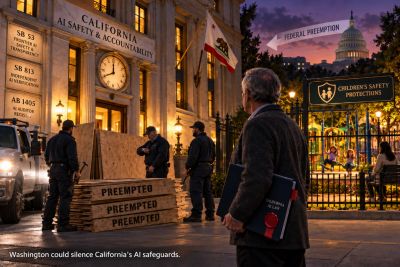
California built its rules first. Washington is writing rules that could displace them. This part asks what would survive if both sets were in force. Because the FRONTIER Act is a bill, every effect described here is conditional: it would happen only if the bill becomes law in its current form.
Two clocks running
California’s clock is already running. SB 53 took effect in January 2026. SB 813’s criteria for verification organizations are due by January 1, 2028 (Government Code, Section 8898.1). AB 1405’s auditor registry is due by January 1, 2029, and from that date no one may sell a covered AI audit without registering (Government Code, Sections 11549.82(a), 11549.82.5). SB 1119’s first child safety audits are due by January 1, 2029 (Business and Professions Code, Section 21814(a)(1)(A)(i)).
In September 2026, the Governor ordered the state to move faster. Executive Order N-9-26 directs the Government Operations Agency to finish SB 813’s criteria by May 1, 2027, and AB 1405’s registry by December 1, 2027 (Executive Order N-9-26, paragraphs 1 and 2). The order speeds up the state’s work. It doesn’t move the dates the statutes set for companies.
The order also explains itself. It says that “absent federal action—which unfortunately is not forthcoming due to a failure of leadership by the President and Congressional leaders—California will continue to lead.” That is the Governor’s stated position. It isn’t evidence of why Congress has or hasn’t acted.
Washington’s clock is slower. The FRONTIER Act was introduced on July 23, 2026, and referred to the House Committees on Energy and Commerce and on Science, Space, and Technology. As of October 18, 2026, the bill had 11 cosponsors and had seen no further action. In September, Energy and Commerce Committee chair Representative Brett Guthrie said committee action might not come until 2027: “I wouldn’t want to do something in a lame duck session to do it quickly and not get it right.” (Politico, September 16, 2026).
If it never passes, nothing in this part happens.
If it does pass, California’s clock may stop partway through.
What preemption would reach, and what it would leave
The FRONTIER Act defines three “Covered Subject Areas”: disclosure of how a developer manages catastrophic risk; “third-party auditing and independent verification” of that work; and reporting of safety incidents (FRONTIER Act, Section 9(a)). Within those areas, “no State or political subdivision of a State may adopt or enforce any law, regulation, order, or other requirement that imposes new substantive obligations on artificial intelligence developers” (Section 9(b)). That much is demonstrated by the text. One word in it is not settled: “new.” It could mean obligations a state adopts after the federal law, or obligations that go beyond what the federal law requires. The words “or enforce” suggest that existing state laws are reached too, but the text doesn’t settle the question. What follows applies Section 9 to each California law under that broader reading, and that part is reasoned.
SB 53 sits at the center of all three areas. Its frontier AI frameworks, transparency reports, and incident reporting are each covered subjects (Business and Professions Code, Sections 22757.12, 22757.13). Its core obligations would be the strongest candidates for preemption, though a court would examine them one at a time.
SB 813 creates a voluntary program and requires nothing of developers (Government Code, Section 8898.4(a)(3)). It imposes no “new substantive obligations,” so it would likely survive.
AB 1405 regulates auditors, not developers. Its rules bind whoever sells the audit. It would likely survive, though a court could read “third-party auditing” broadly enough to reach it.
SB 1119 governs companion chatbots and child safety, not catastrophic risk. The bill also expressly protects state laws “specifically relating to the protection of minors from harms arising from the use of AI systems” (FRONTIER Act, Section 9(c)(3)). It would likely survive.
So the result runs backward from what a reader might expect. California’s broadest law is the one most exposed. Its one mandatory check is the one most protected. Among the laws on this page, California’s only required audit is the one federal law would likely leave alone.
The Governor’s next step faces the same problem. The executive order asks for recommendations by November 16, 2026, on, among other things, “requiring that all large frontier developers embed designated independent verification organizations onsite in their labs” (Executive Order N-9-26, paragraph 3(a)). If FRONTIER became law, a requirement like that would sit squarely in the second Covered Subject Area (FRONTIER Act, Section 9(a)(2)). That is reasoned.
Preemption is not repeal. SB 53 would stay on California’s books. The state would not be able to enforce it in the covered areas while the federal law stood.
A shield wider than the coverage
The federal duties and the federal preemption don’t reach the same companies. FRONTIER’s duties apply to “frontier developers,” companies that have trained a model using more than 10^26 operations (FRONTIER Act, Section 2(11), (12)). Its heavier duties apply only to large and very large frontier developers, measured by revenue and AI spending (Section 2(15), (22)).
Preemption reaches further. It protects every “artificial intelligence developer,” defined as “an entity that builds, designs, codes, produces, trains, or owns an artificial intelligence model or models” (Section 9(d)(1)). That definition has no compute threshold.
The bill preserves four kinds of state law. States could still adopt or enforce generally applicable laws “that do not target artificial intelligence developers”; regulate how deployers and users use AI, through consumer protection, civil rights, contract, criminal or privacy law; protect minors; and govern their own purchases of AI (Section 9(c)(1)–(4)).
Put the two definitions side by side. A developer below the federal threshold would owe no federal duties on catastrophic-risk transparency, verification, or incident reporting. Read broadly, Section 9 would also bar a state from imposing its own. Congress would be barring state rules for developers it doesn’t cover itself. Generally applicable law would still apply. That is reasoned from the two definitions. No court has read them together.
The template travels, gap and all
California’s design has already spread. New York’s Chapter 96 of the Laws of 2026, signed March 27, 2026, and effective January 1, 2027, replaces that state’s frontier AI article in full (S. 8828, Section 2). It adopts California’s revenue threshold, “annual gross revenues in excess of five hundred million dollars.” Its third-party language tracks SB 53 nearly word for word: “using third parties to assess the potential for catastrophic risks,” and “the extent to which third-party evaluators were involved” (General Business Law, Sections 1420(10), 1421(1)(e), 1421(3)(b)(iii), as amended in 2026; compare Business and Professions Code, Section 22757.12(a)(5), (c)(2)).
New York’s original 2025 law took a different approach. It required no independent audit. But it did something SB 53 doesn’t. It said a large developer “shall not deploy a frontier model if doing so would create an unreasonable risk of critical harm” (General Business Law, Section 1421(2), as enacted in 2025). It allowed penalties of up to $10 million for a first violation and $30 million after that (Section 1422(1)). The 2026 law repealed that article and replaced it with California’s design. The deployment ban is gone. Penalties now top out at $1 million for a first violation and $3 million after that (General Business Law, Section 1427(1), as amended in 2026). This page doesn’t say why New York made the change. The result is demonstrated: New York gave up a rule that could stop a deployment and adopted one that asks for disclosure.
The FRONTIER Act uses California’s terms as well: “frontier developer,” “frontier AI framework,” “critical safety incident” and the 10^26 threshold (FRONTIER Act, Section 2). Who borrowed from whom is reasoned. What is demonstrated is that the designs are converging. This page draws no conclusion about anyone’s motives.
A design that spreads carries its gaps with it. California’s laws leave the company to choose the checker, as Part 8 showed. New York’s version does the same. The design is still young enough to fix before it spreads further.
The states’ remaining role
The FRONTIER Act would not shut the states out entirely. It would restrict what they can require while giving their attorneys general defined roles. A state attorney general could opt in to receive incident reports (FRONTIER Act, Section 4(i)). After written notice to the U.S. Attorney General and the Under Secretary, a state attorney general could sue for civil penalties and an injunction (Section 4(j)(3)). State attorneys general could also opt in to receive the licensed verifiers’ assessment reports, supplemental reports and referrals (Section 5(k)).
Under the bill, states would keep the power to enforce federal rules and lose the power to write their own in the covered areas. Whether that trade is a good one is a policy question this page leaves open.
Washington may decide who writes the rules and who enforces them. The more immediate question is this: when an examiner finds a dangerous model, who has the power to make it stop?

XII. Who Can Make It Stop?
Part 1 asked an auditor’s question: when the check comes back “no,” must anyone act? This part asks the harder version. When an examiner finds a dangerous model, who can stop it? The answer has three pieces: a finding, the legal authority to act on it, and the technical ability to carry out the order. The laws on this page treat those as three different things.
The checker can only sound the alarm
Under the FRONTIER Act, a licensed verifier that finds that a very large developer’s model poses “an imminent catastrophic risk” must act quickly. It “shall refer the matter to the Secretary, for consideration of an emergency order under section 8, as soon as practicable, and in any event not more than 72 hours” after its determination (FRONTIER Act, Section 5(p)(1)(B)). That is a duty to report. The verifier can’t stop anything itself. The Secretary of Commerce “may issue an emergency order” (Section 8(a)(1)). “May” means the Secretary isn’t required to. The law would require the warning to reach someone with power. It would not require that person to use it.
Accounting works differently, though not in the way a reader might expect. An auditor can’t shut a company down either. An adverse opinion says the financial statements are not fairly presented. A disclaimer of opinion says the auditor couldn’t reach one. Neither stops the business. But under the Exchange Act and the SEC’s rules, a public company’s annual report must include financial statements certified by independent accountants (Securities Exchange Act of 1934, Section 13(a)(2)). Either opinion puts the problem in a public filing that every investor can read. The SEC, like FRONTIER’s Secretary, “may” act on its own: it can suspend trading in a company’s stock for up to 10 business days (Section 12(k)).
The difference is narrow but real. In accounting, a negative finding goes straight into the company’s public filing. Under FRONTIER, a finding of imminent catastrophic risk produces a referral, and the Secretary decides what happens next. A required warning is not a required halt.
One hand on the switch
The FRONTIER Act would give one federal official the power to halt a frontier model. The Secretary of Commerce could issue an emergency order “suspending or restricting a frontier developer’s development, deployment, or internal use of a frontier model” upon finding that it “presents an imminent catastrophic risk” (FRONTIER Act, Section 8(a)(1)). What follows is demonstrated from the bill’s text.
The Secretary could act fast. The Secretary could issue a provisional order before a formal finding. Notice to the developer could be skipped if “the imminence of the catastrophic risk forecloses such notice,” and the reason would have to be put in writing (Section 8(e)(1), (2)). A provisional order lapses after 45 days (Section 8(e)(3)). A final order lasts 90 days and can be renewed only on a new finding (Section 8(f)(2), (3)).
The order would reach further than the model named in it. It would cover models produced by fine-tuning, quantization, pruning, or merging, and models trained “in substantial part” on the halted model’s outputs or weights (Section 8(d)(3)). It would bind the developer’s affiliates, successors, and anyone acting in concert with them who has notice (Section 8(d)(2)).
Violations would be expensive. The civil penalty runs up to $10 million per violation, and each day counts separately. Willful violation carries a fine of up to $1 million per violation and up to 10 years in prison (Section 8(m)(1), (3)).
The authority would rest with one person. The Secretary must consult the Under Secretary, but nothing makes the order depend on “the concurrence of the Under Secretary” (Section 8(b)(4)). And the section would be “the exclusive means” by which any federal official, “including the President,” could limit a frontier model on the ground of imminent catastrophic risk (Section 8(l)(1)). Any other attempt “shall be unenforceable” (Section 8(l)(3)).
A developer could fight the order. Before a final order, no court could review or stay a provisional order (Section 8(k)(1)). After that, the U.S. District Court for the District of Columbia would have exclusive jurisdiction. Filing suit would not stay the order “unless the district court orders otherwise,” and the court could set aside a final order only if it was “arbitrary, capricious, an abuse of discretion, or otherwise not in accordance with law” (Section 8(k)(2)–(4)). Those rules favor the order while it stands. But a provisional order lapses in 45 days, a final order in 90, and each renewal requires a new finding. The ability to issue an order differs from the ability to sustain it.
The Secretary of Commerce serves at the President’s pleasure, as cabinet secretaries always have. Congress may not have had a better option. In Trump v. Slaughter, decided June 29, 2026, the Supreme Court held that the removal protection for Federal Trade Commission commissioners was unconstitutional. The consequence is plain: even the commissioners of an agency built to be independent now serve at the President’s will. Whether Congress could protect anyone holding this power from removal is now in doubt. That is reasoned, and Part 9 found the same problem in my own design. Under FRONTIER, an official the President can remove would decide whether to halt a model. The bill’s check on that decision is notice: the Secretary must send each order to Congress within three days (FRONTIER Act, Section 8(i)(1)).
A switch is not a hand
California has proposed the other half. The Governor’s executive order asks for recommendations by November 16, 2026, on “requiring the creation of a ‘kill switch’ for frontier models, with the efficacy of the switch verified on an ongoing basis by an independent verification organization” (Executive Order N-9-26, paragraph 3(c)). It’s a request for recommendations, and nothing more. The order states that it does not “create any rights or benefits, substantive or procedural, enforceable at law or in equity” against anyone.
The FRONTIER Act takes the opposite approach. It gives the Secretary the authority to order a halt. I searched its text for “shut,” “shutdown,” “terminate,” “deactivate,” “disable,” “cease,” “kill,” and “switch,” and found no requirement that a developer be able to stop its own model. A word search isn’t a full legal reading, so that finding is reasoned.
California has proposed a switch without a hand. Washington has proposed a hand without a switch.
An order works only if three things are true. Someone has to be able to identify the system, reach it, and disable it. FRONTIER’s order would identify the model and its derivatives in detail (Section 8(c)(1)(A), (d)(3)). Nothing in the bill requires that the developer be able to disable it. Whether a frontier model can be stopped once it is running, copied, or released is a technical question no law on this page answers. An order can name every copy. Only someone holding a copy can turn it off.
What cannot be stopped
The federal halt power reaches only one kind of harm. “Catastrophic risk” means a foreseeable and material risk that a frontier model will contribute to the death of, or serious injury to, “more than 50 people,” or “more than $1,000,000,000” in property damage, “arising from a single incident.” The model also has to be doing one of three things: giving non-public help in making a chemical, biological, radiological, nuclear or cyber weapon; acting without meaningful human oversight in a way that would be a cyberattack or a serious crime; or “evading control of such developer or a user of such model” (FRONTIER Act, Section 2(6)(A)).
Harms outside that definition can’t trigger a halt under Section 8. A model that could harm one person, or 50, falls outside it, unless it could also cause more than $1 billion in property damage. The same goes for harm spread across separate incidents, no matter how many people it reaches. So does harm from any conduct other than the three kinds listed. And because some risk is always present, a qualifying risk isn’t enough: a halt requires one that is “imminent” (Section 8(a)(1)).
The exclusivity clause is limited in the same way. It controls only actions taken “on the ground that” a model “presents an imminent catastrophic risk” (Section 8(l)(1)). Other federal authorities acting on other grounds would be untouched. That is reasoned from the text.
That brings the page back to Part 5. A child harmed by a companion chatbot is one person, in one incident. That alone can’t trigger a halt under Section 8. Among the laws on this page, California’s only required audit is aimed at a harm the federal emergency power doesn’t count.
That leaves the two systems covering different ground. The federal power to halt is reserved for an imminent risk of disaster of a defined size: more than 50 people killed or seriously injured, or more than $1 billion in property damage, from a single incident. The incident must involve weapons help, an unsupervised cyberattack or crime, or a model escaping control (Sections 2(6), 2(13), 8(a)(1)). Some examples fall inside that line. A model that gives help not available elsewhere toward building a biological weapon would. So would a model that, without human oversight, carries out a cyberattack or fraud large enough to cross the threshold. Much falls outside it. Harm spread across many separate incidents doesn’t count, however large the total, because the test is a single incident. Neither does risk from information already publicly available in similar form, or harm the model didn’t materially contribute to (Section 2(6)(B)). A serious risk that isn’t yet present or impending doesn’t count either.
The harm California’s audit addresses happens one person at a time, and California’s tools work after the fact: an audit every two years, a summary to the attorney general, civil penalties, and an injunction to enforce its rules (Business and Professions Code, Sections 21814, 21816). Neither system gives anyone the power to stop a model because it is harmful, rather than because it broke a rule. That is demonstrated from the text. Whether either system should give someone that power is a question this page leaves open.
If Washington doesn’t act, can California?
That question is open. The exclusivity clause binds “any department, agency, officer, or employee of the United States” (FRONTIER Act, Section 8(l)(1)). It says nothing about the states. The preemption section names transparency, verification, and incident reporting, not halts (Section 9(a)). But silence alone doesn’t establish that a state’s power to halt a model would survive. A court would have to decide.
California’s own laws offer little to test the question. SB 53 provides civil penalties of up to $1 million per violation, recovered “only by the Attorney General,” and no power to stop a model (Business and Professions Code, Section 22757.15). SB 1119 lets the attorney general seek “injunctive or declaratory relief” for violations of its rules (Business and Professions Code, Section 21816(a)(1)(C)). A court may issue an injunction to restrict how a chatbot operates, but only as needed to enforce SB 1119’s rules. This authority does not extend to halting a model solely because it is considered dangerous.
New York’s 2025 law came closest, with a rule that a developer “shall not deploy” a model that creates “an unreasonable risk of critical harm” (General Business Law, Section 1421(2), as enacted in 2025). As Part 11 showed, New York replaced it in 2026.
My own model act doesn’t fill this gap. It restricts deployment only after a final finding, and it has no emergency procedure (Model Act, Sections 11(g), 12). That is on the agenda for Version 2.
The laws show who may examine, who must respond, and who could order a halt. Twelve parts in, the auditor’s question has an answer, and the page’s own claims must now meet the same demand for evidence.

XIII. Where This Page’s Own Claims Currently Stand
This page began with an auditor’s question. When a law requires a check, what does it make independent? Can the check come back “no”? And when it does, must anyone act? This section restates the claim the page set out to test, says where the evidence leaves it, and says what could change it.
The test result
The claim was this: None of these laws currently reproduces the combination of independence safeguards that U.S. law requires for public-company audits.
After twelve parts, the claim stands. No enacted AI law examined here has been shown to reproduce the complete combination of independence safeguards used in the public-company audit benchmark. The federal FRONTIER proposal and my model act contain additional safeguards, but neither is an enacted, operating regime. The text of each law demonstrates that. It is a finding about what the laws require, not about how they will work in practice.
The result has three levels. Demonstrated: the enacted laws examined here do not contain the full set of safeguards in the accounting benchmark. Reasoned: the gaps between who appoints the checker, where the report goes, who must act, and whether a model can be stopped may keep the safeguards that do exist from working as a chain. Open: whether these systems will work in practice, how courts will read the disputed provisions, and whether enough independent examiners exist.
The claim has been narrowed along the way, and the page said so each time. Several designs match pieces of the benchmark:
- FRONTIER’s licensed verification would test a developer against a standard set by statute rather than by the developer, and a verifier could lose its license for failures it missed (FRONTIER Act, Sections 5(b), 3(c)(2)(C)(iv)).
- FRONTIER’s annual audit would bar financial interests between auditor and developer and payment tied to results (Section 4(c)).
- SB 813 makes refusing payment tied to results a factor in designating a verifier, within a voluntary program (Government Code, Section 8898.1(c)(2)(C)).
- AB 1405 bars assigning recent client staff to an audit and bars auditors from seeking a job with the client during one (Government Code, Section 11549.83(f)(1)(C), (D)).
- My model act removes the company's choice of checker and bars movement between examiner and developer for two years in either direction (Model Act, Section 9(b), (d)).
No AI design on this page rotates its checkers, including mine.
Put the pieces back against Part 7’s three questions, and the pattern holds:
- Who chooses the checker? The company does, everywhere a check is required, except in my model act.
- Who writes the standard? FRONTIER’s licensed tier and my model act set it by statute. SB 1119 sets the subjects its audit must cover, and AB 1405 points auditors to industry standards. Under SB 53 and FRONTIER’s annual audit, the company’s own framework is the measure.
- Must anyone act on a no? Under FRONTIER, the company must respond and the verifier must refer. Only my model act ties a final negative finding directly to a restriction, with no further decision needed (Model Act, Section 12(a)). It has never been tested.
What would change these findings?
Most of what this page reports is demonstrated. It quotes the statutes and cites the section behind every claim, so any reader can check it against the text. A smaller set of findings goes further. They read laws no court has yet applied, or they report that a requirement wasn’t found.
These are the points most open to a different reading, a new regulation, or new information:
- How FRONTIER’s preemption would apply to each California law (Part 11). The reading depends partly on one word, “new,” in Section 9(b). Part 11 reads it broadly, to reach existing state laws. If a court read it to mean only obligations adopted after the federal law, SB 53 would fall outside preemption.
- The gap between who FRONTIER covers and who it preempts (Part 11). This finding uses the same broad reading of Section 9(b). A narrower reading would make the gap smaller.
- That FRONTIER requires no ability to stop a model (Part 12). This finding comes from a search of the bill’s full text. A provision or regulation requiring developers to keep that ability would change it.
- That SB 1119 reaches general-purpose assistants with memory (Part 5). This reading follows from the definition of “companion chatbot” (Business and Professions Code, Section 22601(b)). An interpretation by the attorney general or a court would settle its reach.
- The model act’s answers (Part 9). The person and the three AI systems that drafted it evaluated these. Outside review would test them.
- How Trump v. Slaughter applies to the model act’s Examiner and Inspector General (Part 9). This follows from the Court’s holding on the Federal Trade Commission. A ruling on offices like these would settle it.
Readers who see any of these differently are welcome to name the part and the section. I will check each reading against the text and publish any correction the text supports. The same applies to my model act.
What could lead to updates on this page?
These laws are still taking shape, and this page will follow them. The dates below mark the next milestones, each labeled by type.
- November 16, 2026: recommendations due to the Governor under Executive Order N-9-26, including on-site verifiers and a kill switch (administrative milestone).
- The FRONTIER Act: referred to two House committees in July 2026. In September, the chairman of the Energy and Commerce Committee said committee action may come in 2027 (pending bill).
- January 1, 2027: New York’s Chapter 96 takes effect (effective date).
- May 1, 2027: SB 813’s verifier criteria are due under the executive order, eight months ahead of the statutory deadline of January 1, 2028 (accelerated deadline).
- December 1, 2027: AB 1405’s auditor registry is due under the executive order, 13 months ahead of the statutory deadline of January 1, 2029 (accelerated deadline).
- January 1, 2029: SB 1119’s first child safety audits are due (statutory deadline).
As each milestone arrives, I will update any affected part and log the change on this page with the date.

XIV. The Author's Judgment
What follows is my judgment, as a CPA with more than three decades in the profession. It is not a finding. Readers can weigh it against the evidence above.
This page is not an ode to California. California moved first, and the page has given it credit where its text earns it. But being first is not the standard. AI verification is arriving everywhere at once, and the problems it has to solve will keep coming. The question is whether the checks being built can do what checks are for.
Accounting never promised perfection. Its own statute asks companies to keep internal controls “sufficient to provide reasonable assurances” (Securities Exchange Act of 1934, Section 13(b)(2)(B)). That is the right standard for AI verification. No check will eliminate the risk. A good one manages it, and a reader can see how.
Measured against that standard, California’s and New York’s designs fall well short. They let the company describe its own safeguards and, where a check is required, choose its own checker. That is too close to self-certification, and accounting learned what self-certification costs.
The federal bill goes further than either state. FRONTIER’s licensed tier would test developers against a government-set standard, send the findings to a regulator, and give one official the power to halt a model. My model act, the Independent AI Provenance and Examination Act, goes further still on the questions this page asks: who chooses the checker, who pays, and what happens when the answer is no. The two designs address different risks, but the gap in independence between them is wide. Version 2 will build on that lead.
Some people argue that a bad law is better than no law. The best case for that view is real. A first law builds infrastructure: registries, reporting channels, a vocabulary that legislators and courts can use. It gives future lawmakers something to amend instead of a blank page. But a weak check does something an empty statute book never could: it lends trust it hasn’t earned. It can spread before anyone tests it. And under a federal preemption clause, it can be locked in. New York shows how quickly a design can move. Its 2025 law barred deploying a model that posed an unreasonable risk of critical harm (General Business Law, Section 1421(2), as enacted in 2025). Its 2026 law replaced that rule with California’s disclosure design. The question is not law or no law. It is whether the design can be fixed before it spreads.
It can be. The fixes are known, and most of them have been tested for decades in another field. This page points to six.
A workable statute — capable of closing the core gaps in independence and accountability—would need to deliver six essential safeguards:
- Independent choice. Someone other than the company chooses the checker.
- Rotation. The people who lead the checking rotate off, and a cooling-off period blocks moves in both directions, from checker to company and from company to checker.
- Outside reporting. The report goes to someone other than the company.
- A duty to fix. The company must cure the condition the check found, not merely respond to it.
- Outside evidence. The checker tests the company’s records against sources the company doesn’t control, rather than taking them at face value.
- Halt power. An official holds the power to stop what the check finds dangerous, and a system exists to carry out the order.
Accounting offers a precedent for the first five, though not always in this form. Auditing standards have long treated evidence from outside the company as more reliable than evidence the company provides (AS 1105.08). The sixth is new. An auditor never had to stop a machine. AI verification will.
To my own profession
AB 1405 gives CPAs a ready lane into AI audits (Government Code, Section 11549.83(d)(2), (f)(2)). That lane is an opportunity, and it should be earned, not assumed. The profession’s bright line against contingent fees attaches to the client relationship, not to the AI audit itself (Part 10). The AICPA and the firms that will do this work, especially the largest, can close that gap themselves. They can hold AI audits to the same independence they require for financial statements before any legislature asks them to. The profession that built the standard for financial truth is best placed to build one for AI.
None of this argues against AI. It is a case for checks that work. Independent audits did not keep capital markets from growing. They are a large part of why people trust those markets. AI can earn the same trust in the same way: a checker the company doesn’t choose, evidence the company can’t write alone, and a “no” that someone is bound to act on. Built that way, verification protects the people who use these systems and the people who build them. That is a future worth working toward, and it is within reach.
Disclosures
I am not currently engaged in performing AI audits, nor do I solicit or participate in them. I do not take paid advisory work or speaking fees from AI developers. If that changes, I will update this page. If I become involved in founding a nonprofit related to AI’s effects on people, I will note that here, along with any funding it may receive from AI companies.
This page shows both human and AI contributions. I set the framework, made the key decisions about what to include, and wrote the analysis and conclusions. Three AI systems, Claude (Anthropic), ChatGPT (OpenAI), and Gemini (Google), assisted at various stages. Gemini provided the initial draft of my model act. Claude and ChatGPT helped draft language, suggest improvements, identify gaps, and raise objections. I remain responsible for the structure, content, and judgments. Each AI system is made by a company whose oversight this page examines, so their feedback served as an additional check, not an independent one.
The question that endures
Accountability is not only about detecting a problem. It is the assurance that someone must act when the alarm sounds.
When the first required check of an AI system comes back “no,” who, if anyone, will be bound to act on it?
Stay Sovereign.
Jim Germer
October19, 2026
© 2026 Jim Germer. All rights reserved.