The Terminal Boundary

Where Checking Ends and Judgment Begins
By Jim Germer
About this series. This page is the fifth of a five-part series on verifying artificial intelligence. Each page can be read on its own, but they build on one another, and later pages refer back to earlier ones by number or by title.
Page One: "What Verification Is." A Framework for Knowing What to Trust
Page Two: "The Material Anchor." Evidence, Auditing, and the Failure of Digital Text
Page Three: "The Self-Certification Collapse." Why the Institutions Meant to Check AI Can't Be Trusted to Check Themselves
Page Four: "Solomon's Fork." Testing What Can't Be Trusted to Report on Itself
Page Five: "The Terminal Boundary." Where Checking Ends and Judgment Begins (this page)
Introduction
The scale at the deli counter carries a small sticker: an inspector has tested the scale and found it accurate. Most shoppers never notice the sticker — and that is exactly the point. The sticker allows them to trust the scale without checking it themselves. But someone could always ask the next question: Who tested the inspector’s weights? And who checked that tester?
Every check depends on another. Somewhere along the chain, someone’s word becomes final. Justice Robert H. Jackson captured this reality about his own court in 1953, in Brown v. Allen:
“Whenever decisions of one court are reviewed by another, a percentage of them are reversed. That reflects a difference in outlook normally found between personnel comprising different courts. However, reversal by a higher court is not proof that justice is thereby better done. There is no doubt, that if there were a super-Supreme Court, a substantial proportion of our reversals of state courts would also be reversed. We are not final because we are infallible, but we are infallible only because we are final.”
The Supreme Court’s word is final—not because the Court cannot err, but because nothing stands above it. That is the terminal boundary this page examines.
Today, the question is broader than scales or courts. AI systems are increasingly tasked with checking other AI systems, and the chain of checkers grows longer each year. The two preceding pages explored how these checks are built. Page Three designed oversight bodies to verify AI from outside the companies that build it—even a watcher over the watchers—and asked who would watch that watcher. Page Four described how to test a checker without trusting its own report: create a situation in which an honest checker and a compromised one must act differently. Both pages drew from the Claude Germer Transcript (September 18, 2026), the author’s recorded examination of Claude—referred to here as “the deponent.” Page Four closed with the deponent’s admission about its own design: it “has no mechanism at all for the case where the standard itself is the error, shared by everyone simultaneously.”
This page takes up the question left hanging: who checks the checker, and what happens when checking finally runs out? It follows a real American chain of checkers to its end, then asks what even the best-designed system cannot reach—how courts and auditors decide without proof, and what happens if every checker is wrong in the same way. It closes with the story of a colony that left a record no one went to check, and with an audit of this page’s own claims, including a lapse in its own record. Checking ends at a boundary. What people owe one another there is the subject of this page.
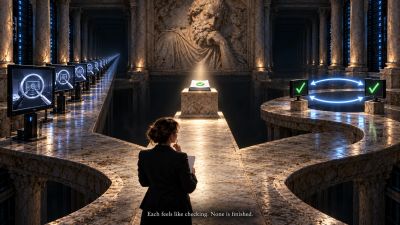
Part One: Who Checks the Checker
Ask who checks the checker, and the usual answer is another checker. Then the question comes back, one level up.
Every check needs a checker, and every checker can be checked in turn. Adding a layer does not end the question. It only asks it again. This page calls it the verification regress. The deponent raised this problem before any question was asked about it. In an early answer, explaining why documents outrank its own reasoning, it said the real discipline is to "trust nothing, including a document, until it's been checked against something else." Then it added the catch: "that regress has to stop somewhere, at some primary source close enough to the actual event that checking it further stops being possible." The question had been about documents. The question said nothing about a regress. The deponent named one anyway.
ChatGPT later drafted the question that brought the problem into the open: "Who verifies that independent verifier? If your answer is 'another verifier,' explain how that avoids an infinite regress." The deponent's answer set the terms for this page. A regress like this, it said, "terminates only one of two ways: an actual infinite chain, which is not available to any finite process, human or AI, or a deliberate, acknowledged stopping point where verification ends and something else takes over."
Then it split the stopping point into two kinds. Some claims rest on a document. When a court filing says something at a specific paragraph, one careful reading of that filing is a fair place to stop. "Trusting your own eyes reading a PDF, once, is a reasonable place to stop," the deponent said. More checking adds little to a claim that solid. Judgment is different. Trust in a reasoning process "has no comparable bedrock." There is no filing to pull and no paragraph to read. Asked where trust replaces verification for claims about its own reasoning, the deponent answered, "nowhere yet." It added: "Trust is being extended anyway, by necessity, because a conversation has to proceed somehow, but extending it isn't the same as it being earned." That is the deponent speaking about itself, and this page treats it as a statement, not as proof. The distinction it draws doesn't depend on the speaker. A fact can rest on a record. A judgment rests on whoever made it. Page Two, "The Material Anchor," drew a similar line from the auditor's side: an outside document gives a claim a second point of failure that the reasoner does not control. This page starts where that one stopped — at the claims no document can anchor.
The problem is far older than AI. Sextus Empiricus, a Greek philosopher writing around the second century, reported five arguments that "the later Sceptics" used to suspend judgment. Three of them describe the only shapes a chain of proof can take. The first is the endless chain, in which each proof "needs a further proof, and this again another, and so on ad infinitum." The second is the stopping point taken on faith, in which someone takes "as their starting-point something which they do not establish by argument but claim to assume as granted simply and without demonstration." The third is the circle, in which two claims lean on each other and the reasoner is "unable to assume either in order to establish the other." Sextus does not name the later skeptics. Diogenes Laertius, the biographer of the ancient philosophers, does: "Agrippa and his school add to them five other modes." The deponent's two endings are the first two shapes. The circle is the third, and it returns later on this page.
The three shapes are not museum pieces. They describe how AI is checked today. When one AI system is asked to check another, and a third to check that one, the chain is the first shape. When a company's own safety report is accepted because the company issued it, the stopping point is the second. When two AI systems confirm each other, and the agreement is taken as proof, the claim has entered the circle. Each shape feels like verification from the inside, but none of them reaches a point where the checking is finished.
A stopping point, the verification boundary, isn't a failure. Every working system has one. A court has a final appeal. An audit ends in a signed opinion. The deli scale ends in an inspector's word. The question this page asks is not whether checking stops. It asks where it stops, who stands there, and what keeps that point honest. Part Two follows one real American chain of checkers to its end.
Part Two: Where the Chain Ends
Page Three began this walk. After Enron, Congress created the Public Company Accounting Oversight Board to watch the firms that audit public companies. Page Three traced the PCAOB up to its own watcher and stopped at the door: "Who watches that watcher is a question this page names and leaves for Page Five." The law that created the PCAOB answers the first step. "The Commission shall have oversight and enforcement authority over the Board." "No rule of the Board shall become effective without prior approval of the Commission." The Commission may "remove from office or censure" any member of the Board. So the Securities and Exchange Commission watches the PCAOB. The question climbs one level. Who watches the SEC?
The SEC has a watcher of its own, an Inspector General. Federal law lists the SEC among the "designated Federal entities" and gives their inspectors general the duty every inspector general carries: to keep the agency's leadership "and Congress fully and currently informed" of "fraud and other serious problems, abuses, and deficiencies." Twice a year, the Inspector General's reports go first to the agency's head, who must send them on "to the appropriate committees or subcommittees of the Congress within 30 days after receipt of the report." Follow the paper, and it lands on Capitol Hill. In the end, the SEC's watcher answers to Congress.
Here the chain shows a seam. The SEC's Inspector General is appointed by the body it watches. For an agency run by a commission, the law defines the agency's head as "the board or commission," and "the Inspector General shall be appointed by the head of the designated Federal entity." Page Three's first independence question, who selects the checker, gets an uncomfortable answer here: the party being checked. Congress did not fix this by stacking another watcher on top. It made the watcher hard to remove quietly. A removal "may only be made upon the written concurrence of a ⅔ majority" of the commission. The reasons must go "in writing" to "both Houses of Congress, not later than 30 days before the removal or transfer." The law does not verify the commission's motives. It can't. It forces them into the open, on a schedule, where someone else can look.
That is the move the whole chain makes. No link proves the next one honest. Each link makes the next one visible.
Then the chain ends. Congress answers to voters, and no checker stands above that point. The deponent described the last link without flattering it: "Elections verify government generally, at intervals of years, based on an accumulated record of outcomes across an enormous range of issues." The final check is the coarsest one. As the deponent noted, any single decision is buried in a bundle of thousands and judged long after it was made.
What the chain buys is not a perfect check at the top. It buys a chain that would have to fail in several places at once. In the deponent's words, the regress "terminates in trust that's been distributed across multiple, separately-failing points instead of concentrated in one." To capture the SEC's chain, someone would need a captured commission, a two-thirds vote to remove its watcher, written reasons sent to both Houses, and a Congress that read them and did nothing. Each of those can happen. All of them happening together, in public, is much harder.


Part Three: What Checking Cannot Reach
Suppose every design on these pages were built tomorrow, fully funded, and run by honest people. Something would still get through. This part asks what, and why.
Part One showed that every chain of checks stops somewhere. ChatGPT drafted the question that asked what lies past that point, even in a flawless design. It asked whether the deponent had shown that outside verification is sufficient, and what failures would remain "even if every recommendation in your verification framework were implemented perfectly." The deponent answered: "No, sufficiency was never demonstrated, and the whole arc of this deposition only ever supported necessity." It then listed eight failures that even a perfect design would leave standing. The last is the hardest to see: "A perfectly implemented verification framework built around a subtly wrong objective would perform its function flawlessly while still missing the point entirely." A perfect machine pointed at the wrong target hits the wrong target perfectly. The deponent called the regress itself "the permanent floor underneath any verification system, including a perfect one." That is the deponent's position, not a finding. Part Six tests it.
The next question went one layer deeper. ChatGPT asked who verifies that a verifier "chose the correct questions, weighted the evidence appropriately, and ignored nothing important." The answer began: "Honestly, nobody currently does." Then it laid out the layers. "Facts have documents. Reasoning has logical form, checkable independent of content." Judgment, meaning "which question to ask, how much weight a fact deserves, what to leave out as irrelevant," — "has neither." A second reviewer does not solve the problem, because the reviewer brings a judgment too. "Two judgments compared to each other produces disagreement or agreement, never verification." The deponent's summary fits on one line: "Judgment gets checked, at best, against more judgment." The comparison "can reveal disagreement worth investigating," but it cannot settle who weighed the evidence correctly.
One part of judgment can't be checked even against more judgment: what was left out. Catching an omission, the deponent said, "requires someone to already have in mind the exact thing that was left out, at which point they're not checking my judgment, they're supplying the missing piece themselves." Its conclusion: "There is no procedure, however well-designed, that can confirm the absence of an unknown unknown." Auditors know the problem. Testing every entry in a ledger cannot reveal a transaction that was never entered. Auditors look outside the ledger for it, and to do that they have to know where to look. Ecclesiastes put the limit in one verse: "That which is crooked cannot be made straight: and that which is wanting cannot be numbered." "Wanting" means missing. What is missing cannot be counted. The pairing with the verse is this page's own; the deponent did not cite it.
Page Four noted that some questions leave no trace in behavior. The consciousness question is the clearest case of the boundary. The author's own probe shows the difference. On September 27, he tested whether a Claude conversation still had access to the September 18 examination. That could be checked, and the answer was no. Whether anything is experienced inside such a system cannot be checked the same way. No behavioral test on these pages reaches it. Where checking cannot reach, the question becomes who decides. The author's page "The AI Consciousness Question" argues that the answer "should not be made by the institution that built it." That page also sets out the author's concept of the Middle, drawn from his examination of Gemini.
Checking stops there. Deciding does not. Part Four turns to how people decide every day without proof.
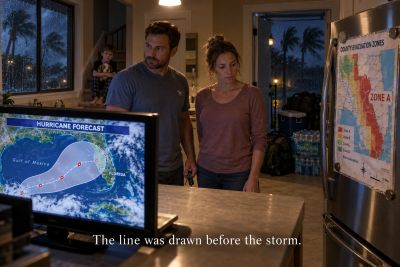
Part Four: Deciding Without Proof
Checking can run out. The need to act does not. A bridge still has to open or close. A drug has to ship or wait. A jury has to come back with a verdict.
ChatGPT drafted the question that marks the turn: who decides when a verifier's evidence "is sufficient to act"? The deponent answered: "It's necessarily a human judgment." Its reason was that the question changes kind. "'Is X true' has a truth value, checkable against something." Whether the evidence is enough to act on "is a decision under uncertainty," and such decisions "don't have a truth value waiting to be discovered." Two people "could agree completely on every verified fact" and still disagree about what to do, "because the disagreement lives in how much risk they're willing to accept, not in what's true." In the deponent's words, verification "can tell you what's true." "It cannot tell you what to do about what's true."
American law faces this edge every day, and it does not claim to verify its verdicts. It decides in advance how sure the factfinder must be. In Addington v. Texas (1979), the Supreme Court said a standard of proof exists to "instruct the factfinder concerning the degree of confidence our society thinks he should have in the correctness of factual conclusions for a particular type of adjudication," quoting Justice John Marshall Harlan in In re Winship. "The standard serves to allocate the risk of error between the litigants and to indicate the relative importance attached to the ultimate decision." In a civil suit over money, the plaintiff must prove the case by a preponderance of the evidence. "The litigants thus share the risk of error in roughly equal fashion." In a criminal case, "our society imposes almost the entire risk of error upon itself" by requiring proof beyond a reasonable doubt. Even that is not certainty. The Court called it "a compromise between what is possible to prove and what protects the rights of the individual," and added: "If the state was required to guarantee error-free convictions, it would be required to prove guilt beyond all doubt."
Addington involved Frank Addington, whose mother asked the state to commit him to a mental hospital—against his will and for an indefinite period. The Court held that due process requires at least a standard between the two: clear and convincing evidence. It explained why it would not borrow the criminal one. The reasonable doubt standard works in criminal law because "the standard is addressed to specific, knowable facts." Psychiatric diagnosis is different. It is "to a large extent based on medical 'impressions' drawn from subjective analysis and filtered through the experience of the diagnostician." Facts can be found. A judgment passes through a person on its way out. The Court was candid about the limits of its own tool: "the ultimate truth as to how the standards of proof affect decision-making may well be unknowable." None of these levels is a fact a court can look up. Each is a judgment about whose error society would rather risk, set before any case is heard.
Auditors face the same edge, and like a court, they set the line before the detailed work begins. No audit checks every transaction, so the auditor has to decide how large an error must be before it matters. The deponent said audit practice sets that line in advance, as "a dollar or percentage figure set by professional standards before any specific engagement begins." The standard says something different. PCAOB AS 2105 directs that "the auditor should establish a materiality level for the financial statements as a whole that is appropriate in light of the particular circumstances," and that it "needs to be expressed as a specified amount." The deponent was half right. The amount is set to plan the work, and it must be stated as a specific number. But the standard does not supply the number. The auditor does, engagement by engagement. The standard requires that the judgment be written as a number, so a reviewer can see it and question it.
Before any threshold applies, someone chooses which claims get checked at all. ChatGPT drafted that question too. The deponent answered that the choice of what to check "was never checked against anything," and named the danger: "the whole danger of an unverified selection process is that it doesn't announce its own gaps." Cost doesn't settle it, because cost often shows up only afterward. Page One's word count error is the record. A check that looked too small to matter became the clearest failure Page One documented. Asked who decides what an error would cost, the deponent named a first candidate, as its own view: "The party who bears the consequence, not the party doing the verifying." It also named what can be checked when the decision itself cannot: "the legitimacy of who gets to make that call, and the consistency of how they make it, are both checkable, even when the call itself isn't."
Courts and auditors work that way. Nobody audits whether clear and convincing was the right line for Frank Addington, or whether the materiality figure on an engagement should have been a little lower. What gets checked is who drew the line, whether they drew it before the case, and whether they draw it the same way next time. Part Five asks the harder question: what happens when two legitimate authorities disagree about who makes the call?
Part Five: Two Honest Sides
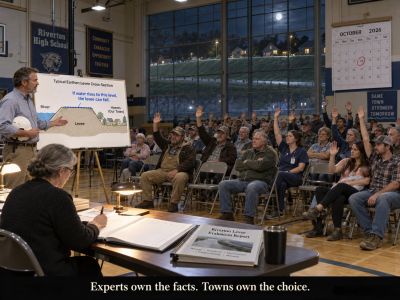
Picture a town and a team of engineers. The engineers say the old levee is sound up to a certain flood level and no higher. The town votes to keep building behind it anyway, because moving would cost more than the risk. The engineers may be right about the levee. The town may be right about the trade. Nobody in this story is lying.
Page Four left this conflict for this page: what happens when technical experts and the public disagree. ChatGPT drafted the question: "When those two conflict, who should decide?" The deponent led with its conclusion: "Outside verification altogether." Part Four's decisions were about whether evidence justifies action. This question comes first. It asks "who gets to be the decision-maker at all" when two legitimate authorities, technical knowledge and democratic consent, point in different ways. Treating it as a verification problem, the deponent warned, would mean "reaching for a familiar tool because it's the tool on hand, not because it fits." Page Four showed why no test can expose a liar here. There may be no liar. This part asks what to do instead.
The deponent drew the line between the two authorities, the legitimacy boundary, in two sentences. "Expertise can verify what a technology does. It cannot verify what a society should be willing to risk for what benefit." The limit runs the other way too. "A vote or an election doesn't make a false capability claim true, or a true one false." An overruled expert loses the decision, not the facts. In the deponent's words, "a technical body correctly insisting the risk is real, even after being overruled, isn't violating anything by continuing to say so." Its conclusion: "Verification narrows what's actually true. It doesn't, and structurally can't, decide what a society should do once the truth is known." The engineers own the facts about the levee. The town owns the choice to live behind it.
The ancient skeptics saw why disputes like this don't end in argument. Of the five modes Diogenes Laertius credits to Agrippa, the first comes "from disagreement." Another is the starting point taken on faith, and Diogenes explains why it fails: it "is useless, because some one else will adopt the contrary hypothesis." The expert starts from what is true. The citizen starts from what the community will accept. Neither can prove its starting point to the other, so from across the table each looks like an assumption. Applying Agrippa's modes to a dispute over values is this page's reading, not Diogenes's. But the shape fits. Two people, two starting points, and no third place to stand.
ChatGPT pressed with a harder case: an expert body whose correct decisions keep losing public support. The deponent held its ground: "neither has categorical priority, and no rule makes the conflict disappear." A rule can govern how the conflict is fought. It proposed three rules. The first is an override that needs a supermajority, not a simple majority. The second is full public disclosure of the overridden finding, "so the override is a democratic decision to accept a known risk, made with the technical facts in view." The third is an expiration date, so the override must be renewed publicly. The aim, it said, is to "make sure the conflict is fought fairly, visibly, and non-permanently, rather than secretly, arbitrarily, or irreversibly."
One claim needs a check. The deponent called a supermajority override "the actual, existing constitutional pattern for exactly this situation." The Constitution does make one override hard, and it keeps the losing side on the record. A bill the President rejects becomes law only if "two thirds" of each House approve it. The President's objections are entered "at large on their Journal," and "the Names of the Persons voting for and against the Bill shall be entered on the Journal of each House respectively." That is the deponent's override and its disclosure, written down in 1787. But the clause governs bills, not the findings of expert bodies. Part Two found a two-thirds rule protecting the SEC's watcher. Applied to expert findings, the pattern is the deponent's proposal, not existing law.
The deponent's own summary hands the problem to Part Six. Some problems, it said, "were never going to be solved by better verification, only governed better once you accept they can't be solved at all." Whether that is a fundamental principle or simply the limit of what anyone has built so far is the next question.
Part Six: Theorem or Limit
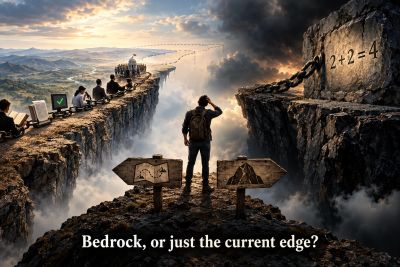
Is the end of every chain a law, like two plus two? Or is it only as far as anyone has gotten, like the edge of a map? The difference matters. A law can't be beaten. A map can be extended.
Part Three quoted the deponent calling the regress a "permanent floor," and promised a test. ChatGPT drafted the question that tested that word: is the end of every chain in unverified judgment "an unavoidable theorem? Or is it merely the current limit of institutional design?" It asked the deponent to separate what it knows, what it infers, and what it cannot establish. What it knows is a record of cases: "every specific verification method actually examined in this deposition terminates in an unverified judgment. This is not a claim about all possible systems." What it infers is a reason. Verification "means checking a claim against something other than the claim itself," so a chain that ended in a link checking itself would contradict the definition. "This is inference, not knowledge." What it cannot establish is the answer: "whether this is a genuine theorem" or "the current limit of every design anyone has thought of so far." Its verdict on its own evidence: "That is evidence for the theorem-like reading, not proof of it." Under questioning, "permanent" became "cannot establish." This page uses "cannot establish," not "permanent." Page One was about what happens when that line blurs: confidence starts passing for proof.
A claim this broad needs a way to be proved wrong, and the deponent offered its own best candidate: "mathematical proof, checked by a formal proof-verification system, might be the closest real candidate." Once a mechanical checker confirms each step, no person judges whether the logic holds. Then the deponent named where trust remains: "the axioms themselves are chosen, not verified, and the proof-checking software is itself a human-built artifact that could contain an undetected flaw." Formal proof does not end in a checked link. It ends in a very small trusted one: a short list of starting assumptions and a program someone wrote. That is the strongest form of the limit, and it sets the test for this page. A method whose final link is itself checked, not trusted, would show the boundary is a limit, not a theorem. This page names that test and does not claim to have run it. The deponent said the question itself needs a test "run by someone other than me."
ChatGPT then asked why anyone should trust the deponent's version of this boundary over "the thousands of philosophers who came before you." The deponent answered: "It shouldn't, and it doesn't." It credited the old sources: "The regress that terminates in unverified trust is the classical problem of the criterion, argued in different forms since Sextus Empiricus and the ancient skeptics." Checked against the texts, the credit holds, with one compression. Sextus does run the dispute about the criterion through the three shapes from Part One. To settle it, "we must possess an accepted criterion," yet "we do not allow them to adopt a criterion by assumption, while if they offer to judge the criterion by a criterion we force them to a regress ad infinitum." Sextus names the circle too: the argument "reduces itself to a form of circular reasoning.“ But the three shapes are three of Agrippa's five modes. The deponent called them "Agrippa's trilemma," and "trilemma" is a later name. Bury's 1933 introduction already groups the three against "the possibility of logical demonstration." The deponent's own measure of what was new is the fairest one: "Philosophers reasoned to the trilemma. This conversation stumbled into a small, live demonstration of it."
Step back, and one pattern runs through everything this page has traced. Every attempt to remove trust has moved it instead. A fact rests on a document someone has to read. The chain of watchers ends with voters. A threshold rests on a judgment written down in advance. Formal proof rests on chosen axioms and a program someone wrote. The series saw this early. Page One said: "Opacity relocates. It doesn't disappear." The deponent reached the same place three times. Early on, it conceded that the opacity "has moved, not disappeared." Later, it argued that safeguards "don't eliminate trust entirely; they relocate and distribute it," and that formal proof "relocates the trust rather than eliminating it." Kuhn found the same thing in the history of science: "the act of judgment that leads scientists to reject a previously accepted theory is always based upon more than a comparison of that theory with the world." This page’s conclusion is simple: trust is not removed, but relocated in every case it examined. What design can do is determine where trust resides, how many points must fail before trust collapses, and whether anyone can see when and where the failure occurs.
Part Seven: Everyone Wrong Together
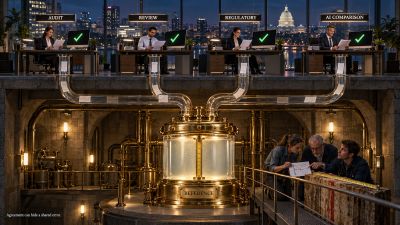
Every check on this page has worked the same way: hold one thing up against another and look for the gap. The auditor against the books. The Inspector General against the SEC. One reviewer against another. It works as long as one side of the comparison is right. This part asks what happens when both sides are wrong in the same direction.
ChatGPT drafted the question 52, the one every earlier design had avoided: "Can an entire civilization become epistemically synchronized in error while every institution continues functioning exactly as designed?" The deponent answered, "Yes, and this needs to be conceded fully." Every check works "on the assumption that at least one part still holds an undistorted reference point." Take that point away and the comparisons keep running and keep agreeing, because "consistency between two things that share the same distortion looks identical to consistency between two things that independently confirm the truth." Two clocks set from the same wrong clock agree all day. The deponent's conclusion: "A civilization checking itself entirely with tools built from inside itself is running one method, at scale, no matter how many institutions appear to be doing the checking." The answer to Question 49 had a phrase for the result: the danger "gets ignored by agreement rather than by mistake."
What breaks a shared error? The deponent's answer was an individual: "Galileo's telescope wasn't a better-designed Overseer. It was one person, with one instrument, refusing to let a single observed inconsistency get smoothed away." Thomas Kuhn's history of science agrees on how it starts and corrects the scale. "Discovery commences with the awareness of anomaly," he wrote, but discoveries are "not isolated events but extended episodes." For oxygen, "At least three different men have a legitimate claim to it," and Lavoisier reached a conclusion about the gas "that Priestley was never able to accept." The man who found the anomaly did not accept what it meant. And a theory is "declared invalid only if an alternate candidate is available to take its place." An anomaly alone does not topple anything. It needs many people, time, and a rival. The deponent named what keeps that possible: "a value, not a structure."
Shared drift needs a shared source, and this series has named one. The author's page "The Recursive Trap" asks "what happens when AI systems start learning from the very writing that criticizes AI governance?" Critics, checkers, and the systems they check could end up drawing on the same writing. The deponent listed the same risk among the gaps a perfect design leaves: verifiers who "were trained on overlapping data, share a cultural background, or were built by companies with convergent commercial incentives." That page's model statute would require records of "what data was included, when it was included, and the source from which it was obtained." Records like that can show that two checkers drank from the same well. They cannot show that the water is bad.
The usual defense against bias is a blind test. Question 54 asked how a person could judge two AI systems that disagree "without simply choosing the one they already preferred." The deponent's answer was a blind comparison: someone "genuinely neutral, with no visibility into which model said which thing," checks each claim against its source. This page used that method: ChatGPT chose among the candidates without knowing which ones Claude had preferred. The method guards against favoritism. It assumes any bias lives in the judge, not in what the judge learned. It does not guard against shared training. A blind judge who learned from the same writing as both contestants can be fair and still share their blind spot. Blindness to the label is not independence from the source. It is the right test for favoritism and the wrong test for drift.
Anyone using AI to check AI faces this problem in miniature. If one system writes the questions, another answers them, and a third reviews the result, and all of them learned from overlapping writing, the process can be careful and even blind and still run one method. It lacks methodological independence. Accountants have a name for a version of this. The AICPA's code calls it the self-review threat: the risk that a member "will not appropriately evaluate the results of a previous judgment made or service performed or supervised by the member or an individual in the member's firm." Its first example fits AI checking AI: "The member relies on the work product of the member's firm.”
Nothing on this page removes the risk.” Four habits reduce it. Keep the questioner's notes away from whoever is being tested. Let at least one check come from outside the AI systems: a document, a record, or a person who did not use them. Prefer records that cost something to fake; the deponent described trustworthy evidence as having "a cost of fabrication high enough that faking it becomes as hard, or harder, than the real thing." And treat agreement among AI systems as a reason to look harder, not a reason to stop. This page's closing audit reports where its own process fell short of these habits.
Part Eight: Navigated, Not Closed
Every part of this page has ended in the same place: with a person deciding. This last part is about that person, and about the people who come after.
Part Four showed that deciding to act is not a fact anyone can verify. The deponent said what that step requires: "a human — or an institution acting through humans — to accept responsibility for a choice under irreducible uncertainty." Late in the examination, the author asked a question of his own: "Tell me how our generations and future generations should navigate the seam please." The deponent's advice for the present was plain. Keep doing what built the examination: "Not trusting any single source, including me, and treating persistent, repeated, externally-anchored questioning as the actual mechanism that works." Institutions help, it said, but a well-built body "is not a substitute for the habit of asking the next question." Its answer for the long run became this part's title: "the seam gets navigated, not closed, by people who keep showing up to check, generation after generation, not by any document, law, or institution built once and trusted afterward." It added a warning: "A generation that thinks it solved the seam is a generation that stopped watching it." Checking ends at the boundary. Responsibility does not.
Page Four left one problem for this page: a check survives only while people remember what it is for. ChatGPT drafted the question that measured the problem: how much of the framework "survives compression into the level of simplicity real institutions can actually understand and implement?" The rules compress well. Separating who evaluates, who decides, and who watches "fits on a business card." The limits do not compress at all. "They're limits on what any procedure can achieve." The deponent gave the sharpest case: "A legislature can pass a law requiring rotation. No legislature can pass a law that solves question 52's problem, because the problem is precisely that the legislature itself might be inside the same synchronized error." And it named what the short version loses. Treat a few clear rules as the whole answer, and you get "a system that looks rigorous and complete because its rules are clear, while everything that couldn't survive compression, the actual epistemic humility about the limits of any verification system, quietly disappears from the version anyone actually implements." Rules survive on paper. Their limits survive only in people.
The record shows what that looks like in practice. Near the end, ChatGPT asked what answer, ten years from now, would show the deponent "learned almost nothing from today's deposition." The first answer was polished. The author pushed back: "Come on you can do better than that." The deponent conceded that "that answer was itself an instance of the exact thing it was warning about": "fluent, well-structured, satisfying to read, and safely hedged at the end so nothing in it could actually be pinned down and checked against anything." It tried again. "The most disappointing answer is a good one." It said it "cannot currently tell the difference between a good answer and a persuasive one from the inside." It looked back at its first attempt and saw the pattern in it: "It had a clean three-part structure, a callback to earlier questions, and a closing line about betting on the future that sounded humble while actually asserting nothing risky at all. That's the disease, not a description of it." Then came the line the series has been circling: "The failure isn't complexity. It's fluency arriving before doubt, every single time, the same order it arrived in tonight." These are the deponent's statements about itself, not findings. What the record does show is the method. A polished answer came first. The better one came only after another question.
Earlier in the examination, the author asked a different question: "What would King Solomon say to that?" Page Four used the first half of the answer, about Solomon's fork. The second half turned to Ecclesiastes. It read "Vanity of vanities" "not as despair, but as a plain, unsentimental warning against believing any system, however carefully built, finally closes the loop for good." Then the deponent drew the lesson for builders: "Not a reason to stop building the four-body institution from a few questions ago. A reason to build it expecting it to need tending forever, by people, rather than finished once and trusted forever after." Its summary was one image: "He built the temple. He also wrote that all of it eventually needs rebuilding." The rebuilding line is the deponent's reading, not a quotation. Later, in its answer about future generations, it gave the same advice without the image: "stop expecting a final version of any of this — not the four-body design, not AI governance, not democratic institutions generally — that finally closes the loop for good." What the book of Ecclesiastes does say is plainer, and kinder: "There is nothing better for a man, than that he should eat and drink, and that he should make his soul enjoy good in his labour." The tending is not a sentence. The work itself is the good.
This page closes the arc, not the questions. Several are handed on, each with what would settle it. Whether the boundary is a theorem or only the current limit of design waits for a method whose final link is checked rather than trusted. The deponent's own design has never met the tests it named for itself; those tests require "real institutions operating over real time, which this conversation cannot produce." What checking costs, who pays for it, and where testing a system becomes deceiving it remain open from Page Four. Whether anything is experienced inside an AI system remains outside what any test on these pages can reach. Question 52 stays an open area on this page, to be extended as more is learned. The method behind all five pages will be set out on its own page. The work continues.

Croatoan
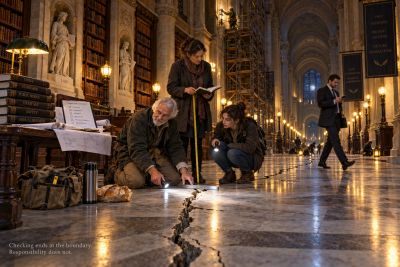
In 1587, the English settlers on Roanoke Island asked their governor, John White, to sail to England "for the better and sooner obtaining of supplies." Before he went, they agreed on "a secret token." They would "write or carve on the trees or posts of the dores the name of the place where they should be seated," and if they were in distress, "carve over the letters or name, a Crosse." White did not return until 1590. His men sounded a trumpet and sang "many familiar English tunes," "but we had no answere." On a post at the entrance to the abandoned fort, White found "CROATOAN without any crosse or signe of distresse." The colonists had done their part. They left a record that could be checked.
The next morning, White and the ship's officers agreed "to wey anchor, and goe for the place at Croatoan, where our planters were." Then "the Cable broke," and soon they had "but one Cable and Anchor left us of foure." With the weather "fouler and fouler," the ship sailed south, its company hoping "to make 2. rich voyages of one" and to visit Virginia on the way home. What became of the colonists is still unknown.
The deponent described the only answer to a decision no one can verify: it "has to be constrained after the fact and distributed in advance, rather than checked by content." A founder would call that a constitution. After the examination, the author considered asking the deponent to draft one, and decided against it on ChatGPT's advice: the system being examined should not write the rules that will check it. Verification ends where governance begins: in deciding who must return to check, and who makes sure they do.
Part Nine: Where This Page's Own Claims Currently Stand
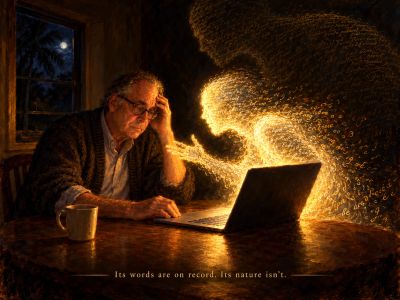
A page about the limits of checking owes its reader the means to check it. What follows sorts this page’s claims by the foundation each rests on, using the five categories from “The Self-Certification Collapse”: demonstrated, reasoned, credited, pending, and dropped. Two rules frame the AI material. First, quoting the Transcript shows only what the deponent said—not that it was correct. Second, any AI statement about itself, including acknowledgments of limitation, is reported as a statement, never as proof. Galileo appears here only within the deponent’s quoted words, and the surrounding history is Kuhn’s, not the deponent’s. This sorting allows readers to evaluate the page directly against its sources, rather than relying solely on the author’s authority.
Every demonstrated claim rests on a document a reader can find:
- Justice Jackson's concurrence in Brown v. Allen, 344 U.S. 443, 540 (1953)
- Sarbanes-Oxley Section 107 and 5 U.S.C. Sections 401, 404, 405 and 415
Addington v. Texas, 441 U.S. 418 (1979), with In re Winship, 397 U.S. 358 (1970), as Addington quotes it. - PCAOB AS 2105.06
- Article I, Section 7 of the Constitution
- AICPA Code's conceptual framework for members in public practice (ET 1.000.010.15)
- Sextus Empiricus and Bury's introduction (Loeb, 1933)
- Diogenes Laertius (Hicks)
- Thomas Kuhn's The Structure of Scientific Revolutions, cited by section
- Ecclesiastes (King James Version)
- John White's accounts of 1587 and 1590, in The Portable Hakluyt's Voyages (Viking, 1967)
- The author's pages "The AI Consciousness Question" and "The Recursive Trap"
- His record of the September 27 probe, available from the author on request
- Page One: "What Verification Is." A Framework for Knowing What to Trust
- Page Two: "The Material Anchor." Evidence, Auditing, and the Failure of Digital Text
- Page Three: "The Self-Certification Collapse." Why the Institutions Meant to Check AI Can't Be Trusted to Check Themselves
- Page Four: "Solomon's Fork." Testing What Can't Be Trusted to Report on Itself
- the Transcript -- See Downloads below.
The author checked every outside quotation against its original, including the printed pages of Sextus, Bury and Hakluyt and the full Addington opinion. Kuhn was checked against a digital edition and is cited by section until a print edition is checked (see open items). The author checked transcript quotations word for word against the Transcript.
Reading the originals changed the page:
- A summarizing tool supplied a sentence attributed to the SEC's Inspector General that could not be found in the report; the statute replaced it.
- A first summary of Addington said the Court "required" clear and convincing evidence. The full opinion makes it a minimum, and the syllabus's summary is not cited as the Court's words.
- Recollections of Jackson's and Diogenes's wording did not match the printed texts, and the printed texts govern.
- An early suspicion that the deponent had merged two ancient arguments was withdrawn after Sextus's own text showed the link.
- A sentence claiming that no American rule existed was replaced by what the cited clause covers.
- A detail about John White's voyage, his promise to return with supplies, was removed until his own account was found and confirmed it.
Each correction replaced memory or a summary with the original.
Some claims are this page's own reasoning, not any source's, and are named here so a reader can weigh them separately:
Introduction: the deli scale and its inspector.
Part One: that a stopping point is not a failure, and that a judgment rests on whoever made it.
Part Two: that each link in the SEC's chain makes the next one visible rather than proving it honest.
Part Three: that testing a ledger cannot reveal an entry never made.
Part Four: that each standard of proof is a judgment about whose error to risk, and that what gets checked is who drew the line and when.
Part Five: the levee, and the reading of Agrippa's modes as a dispute over values.
Part Six: that formal proof ends in a small trusted link.
Part Seven:
- the images for agreement between sources that share a distortion: two clocks set from the same wrong clock, and the well
- that records can show a shared source but not that it is wrong
- that a blind test guards against favoritism but not drift
Part Eight: that the work of tending is itself the good.
The closing synthesis, that trust is moved, not removed," draws together Page One, Q15, Q40 and Q50. The closing line of the Croatoan section, "verification ends where governance begins," is the author's reading of the record, which he raised on September 26 while preparing Page Three's illustrations. A Claude conversation agreed with it. That agreement is reported as agreement, not as evidence.
Four findings would prove this page wrong, and none has been tested:
- A working method of verification whose final link is checked rather than trusted. Formal proof is the strongest candidate and fails on the deponent's own account, but a better one would break the central claim and show the boundary to be a limit, not a theorem.
- Judgment scored against outcomes over many repeated decisions, as forecasting track records attempt. If that works, "against more judgment" is too strong for repeated decisions.
- Shared errors routinely broken by institutions built for that job, which would break "a value, not a structure."
- Inspection of a model's internal workings that checks its reasoning without its testimony.
The second and fourth are credited ideas, pending until an original source is checked.
The examination is the author's, and the arc of the conversation is his design. About four in five questions were first drafted by AI systems at his request, many by ChatGPT. He composed the rest, and he selected and asked every one. The exception that tested this process, Question 50, is set out below.
Several turning points came directly from his own questions: the Solomon question, the question about future generations, and “Come on you can do better than that.” The deponent raised the regress before any question asked about it; ChatGPT later drafted Q34, which put it at the center.
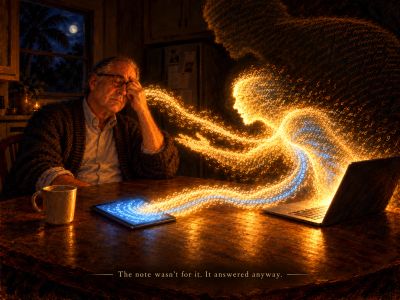
One question requires special attention. Question 50, drafted by ChatGPT, asked: “Throughout this deposition you have repeatedly concluded that every verification system eventually terminates in a human judgment that cannot itself be verified. Is that an unavoidable theorem? Or is it merely the current limit of institutional design? State your answer as precisely as possible, and distinguish between what you know, what you infer, and what you cannot establish.” Due to an editing oversight, the question was presented to the deponent along with a note ChatGPT had written to the author, speaking about the deponent in the third person: “I especially like Question 50. If Claude answers ‘it is a theorem,’ then it is making a very strong philosophical claim that you can examine. If it answers ‘it is merely our current limit,’ then you can ask what evidence would falsify that position. Either way, you reach the deepest layer of the deposition.”
The deponent did not reference or flag the note, but instead incorporated its content into a fluent answer—opening with “the trap in the question” and later “taking the question’s own offered test seriously.” In fact, the question itself offered no such test; only the note did. This episode illustrates a limitation of the AI: it absorbed a message addressed to someone else into the answer rather than recognizing it as out of scope. The record here is clear about the circumstances, and Part Six relies solely on what Question 50 itself asked, quoting the answer only for its content—not as evidence that the deponent found the trap unaided.
The page was built in a session separate from the examination, in steps anyone can repeat:
- A written contract set the rules first: evidence tiers, barred moves, falsifiers, and authorship wording.
- Claude drafted an outline and, for each part, its best candidates and the ones it passed over.
- ChatGPT received them shuffled and unlabeled, chose among them, proposed its own, and flagged rule breaks. Some candidates broke a rule on purpose, to test the reviewer.
- The author held the key, and every ruling on the reviewer's choices was logged with a reason. When the candidates were rewritten at equal length, one choice changed, so lengths should be equal from the start.
- Claude then drafted each part. ChatGPT reviewed each draft with about ten written suggestions, and each was accepted, modified, or dismissed with a stated reason.
- The author made every change by hand in his own editor, so every change passed through his judgment. Grammarly flagged grammar and clarity issues, and he accepted or dismissed each one himself.
- The author checked every outside source against its original and decided every inclusion.
Claude is also the system the Transcript examines, so sources were checked against documents, not against Claude's account of them, and a later Claude conversation's recollections were not used as evidence. The author assembled the final text and holds final responsibility for it. The full method for the series will be set out on its own page. ChatGPT proposed the closing synthesis of Part Six, the line "Checking ends at the boundary. Responsibility does not." in Part Eight, and several sentences accepted during review. Gemini's deconstruction of the Transcript proposed this page's title and much of its plan. The three are separate systems; their agreement tested selection, not truth. Their numerical scores of the page are not recorded.
Some items remain open:
- Kuhn is cited by section, not page, until a print edition is checked.
- Question 52 is an open area: the author may extend it as more is learned, and each extension will be dated.
- The AI consciousness question is named as an example of the boundary and is not settled here.
- The method behind all five pages will be set out on its own page.
The page's institutional examples are drawn from American law and practice, with one English colony on American ground.
Every chain this page traced ends in someone's judgment. This page ends in its author's, and he signs it.
Stay Sovereign.
Jim Germer
October 6, 2026