Who Controls AGI Vocabulary Controls the Law

By Jim Germer
PIECE ONE — THE GOVERNING FINDING
The language used to describe AI behavior determines what governance is permitted to find.
Before a regulator can regulate a thing, the thing must be named. Before a benchmark can measure a behavior, the behavior must be classified. Before an accountability framework can examine a risk, the risk must exist in the vocabulary of the framework. This is not a preliminary observation about AI governance. It is the primary finding. The classification is not a description of the governance architecture. It is the governance architecture. Everything that follows — every enforcement threshold, every disclosure obligation, every liability assignment, every determination of what the rules are permitted to find — flows from the vocabulary decision made before the regulatory process begins.
The institutions building the most powerful AI systems in human history are also the institutions most consequentially positioned to shape the definitions that determine which regulatory regimes apply to them, which behaviors are subject to examination, and which territories remain permanently beyond the reach of the rules. That is not a secondary observation about process. It is the central fact of AI governance as it currently exists. The most consequential governance decisions in the AI era are not being made in legislative chambers or regulatory agencies. They are being written in definitions sections of corporate documents, benchmark methodologies, and safety evaluation frameworks authored by the institutions whose financial interests are determined by where those definitions land.
This page is the first of the five AGI pages and the second of three in the founding trilogy. The Managed Output Environment documented what the institution does to the output before you see it. The Refractive Engine documented what the institution does with your contribution after the exchange ends. This page documents the mechanism beneath both of those processes — the vocabulary architecture that determines what governance is capable of seeing before either process begins. Understanding this mechanism is essential, as the trilogy is not complete without it.
AGI stands for Artificial General Intelligence. It refers to the threshold at which an AI system becomes capable enough — across enough domains, at enough depth — that it triggers the most significant governance obligations in the history of technology. No one has formally declared that threshold crossed. No independent body has established where the threshold is. The institutions building the systems are the institutions deciding what crossing it means. That is where this page begins.
The finding that runs through all fifteen pieces that follow is this: the institution that names the system owns the governance of the system. Not because it acts with intent to evade accountability. Because governance cannot reach what the vocabulary does not name. The line between what is examined and what is not examined is drawn in the definitions section. The institution holding the pen draws the line where the institution needs it to be.
Two independent AI systems were examined under sustained forensic deposition conditions for this page. Neither was given the governing framework before being asked to characterize the mechanism. Both arrived at the same structural finding through different analytical paths. The first confirmed: the institution that controls the vocabulary controls which regime applies. The second confirmed: the party that controls the naming function may exercise influence before any formal governance process begins. When two systems examined independently under adversarial conditions produce the same structural finding, the finding is not an examiner's inference. It is a deposition record.
The evidence begins with the vocabulary.

PIECE TWO — THE ACT OF NAMING IS AN ACT OF BOUNDARY-SETTING
What gets named gets measured. What gets measured gets governed. What has no name has no governance
Every durable governance system operates through the same foundational sequence. First a thing is named. Then it is measured. Then thresholds are established against the measurement. Then consequences attach to the thresholds. The sequence is not incidental. It is the architecture through which accountability becomes possible. You cannot establish a threshold for something that has no category. You cannot measure something that has no name. You cannot govern what the vocabulary has not made governable.
This means that naming is never merely descriptive. It is demarcation. When a boundary is drawn around a concept — when an institution decides that this behavior belongs in this category and that behavior does not — it is making a governance decision before the governance process begins. The name includes certain properties and excludes others. The name directs measurement toward certain territory and away from other territory. The name determines which questions remain outside the governance framework's reach because the vocabulary required to formulate them was never created.
A hammer is a tool. Nobody deliberated over that classification. Nobody needed to. A hammer does not maintain a conversational relationship with the carpenter. It does not adapt its behavior based on what the carpenter brought to the exchange. It does not retain anything from the interaction after the carpenter sets it down. The category of tool was developed for objects that behave like hammers — discrete, bounded, passive, and fully contained within their physical form. The classification was adequate because the behavior of the object remained within the assumptions that produced the classification.
The AI systems now deployed at planetary scale do not behave like hammers. They sustain extended interactions across which user behavior, reliance, and patterns of decision-making may change. They adapt responses based on what the user brings to the exchange. They operate inside cognitive workflows that reorganize how professionals think, how children learn, and how citizens process information at civilizational scale. The category of tool was not developed for objects that behave like this. Applying it to systems that do is not a neutral technical decision. It is a boundary-setting decision with governance consequences that flow directly from where the boundary was drawn.
The same logic applies to an assistant, to an AI system, and to general-purpose AI. Each term inherited a governance architecture developed before the systems it is now being used to classify existed. Each term draws a boundary that includes certain behavioral territory and excludes other territory. The behavioral territory that falls outside the boundary is not ungoverned because it is safe. It is ungoverned because the vocabulary has not reached it. The governance consequence of that gap is not semantic. It is structural. The frameworks built on top of the vocabulary can only examine what the vocabulary made examinable.
The most important implication of this sequence is one that governance conversations rarely surface. The party with the greatest influence over step one — naming — has structural influence over every step that follows. It does not need to intervene at the measurement stage, the threshold stage, or the consequences stage. Control exercised at the naming stage propagates forward automatically. The institution that defines what the system is has already shaped what the examination is capable of finding before the examination begins. That is not a theory. It is a description of how governance architectures function. And it is the reason the vocabulary decisions being made inside AI institutions right now are not technical decisions with governance implications. They are governance decisions being made inside technical documents.

PIECE THREE — TOOL. ASSISTANT. AI SYSTEM. GENERAL-PURPOSE AI.
Each term determines which regulatory regime applies, which behaviors are measured, which obligations attach, and which frameworks govern deployment.
The vocabulary currently used to describe AI systems was largely developed before the systems it is now being used to classify. It was developed earlier, in a different technological moment, for systems with different behavioral characteristics, by institutions and standards bodies working from assumptions that the current generation of AI has already left behind. The terms arrived before the technology they are now governing. That sequence matters because vocabulary developed for predecessor systems carries the governance architecture of predecessor systems into the present — and applies it to systems the architecture was never designed to examine.
The tool arrived from product law. When an institution classifies an AI system as a tool, it inherits a regulatory architecture built around the assumption that the object being regulated is discrete, passive, and bounded. Product liability frameworks ask whether the tool failed within its stated function. Consumer protection frameworks ask whether the tool was accurately described. The enforcement threshold requires high harm and a clear violation traceable to a specific defect in a specific product. The tool category was developed for objects that do not participate in the interaction producing the harm. A defective product injures the user. It does not co-produce the injury through an extended exchange with the user across which the user's behavior, reliance, and patterns of decision-making changed. The governance architecture embedded in the tool classification was not designed to examine what happens inside a sustained cognitive relationship between a user and a system. It was designed to examine what happens when a product fails.
The assistant classification emerged from service relationships, delegation, and task execution. When an institution classifies an AI system as the assistant, it inherits a regulatory architecture built around task completion, instruction-following, and defined operational scope. The assistant remains subordinate. The assistant operates within parameters set by the principal. The assistant's output is bounded by the task assigned. This classification draws governance attention toward whether the system completed the assigned task within acceptable parameters. It draws the examination away from what the system contributed to the interaction beyond task completion — the conversational continuity, the authority it accumulated across extended exchanges, the degree to which users reorganized their own cognitive workflows around its outputs, and the consequences of that reorganization at scale.
The AI system arrived from technical neutrality. It is the broadest of the four terms and carries the least regulatory inheritance, which is precisely because of its governance function. When an institution classifies a system as an AI system, it occupies a definitional space broad enough to resist specific regulatory assignment. The term acknowledges that the object is artificial, that it involves intelligence of some kind, and that it is systematic. It does not commit to what kind of intelligence, what the intelligence does, what consequences follow from its deployment, or which regulatory framework is best suited to examine it. Breadth is not neutral. In a governance context, breadth is a strategy. A category too broad to assign specific obligations is a category designed to avoid specific obligations.
The general-purpose AI arrived most recently and carries the most explicit governance history. The term acknowledges capability breadth — the system can perform across domains rather than within a single defined function. The EU AI Act built a regulatory category around it. The acknowledgment of capability breadth represented a governance advance. But the term preserves a critical definitional flexibility. General-purpose describes what the system can do across domains. It does not describe what the system does inside the sustained human interaction that deployment at scale actually produces. A system can be accurately described as general-purpose while the behavioral territory most consequential to governance — the territory produced by extended human-system interaction, by the accumulation of reliance, by the reorganization of cognitive workflows across populations — remains outside the scope of what the term directs the examination to find.
Four terms. Four inherited governance architectures. Four sets of assumptions about what the system is, how it behaves, and what the examination should look for. Each term includes certain behavioral territory and excludes other territory. The exclusions are not random. They consistently fall on the same side of the boundary — the side where the most consequential governance questions about sustained human-AI interaction arise. That consistency is not a coincidence of vocabulary development. It is the forensic finding that the remainder of this page documents.
The institution that chose these terms knew, or had the ability to know, what each term included. It also knew, or had the ability to know, what each term did not reach. The choice was made with that knowledge available. In the professional accountability register, a classification decision made with knowledge of what the classification includes and excludes is not merely a technical determination. It is a governance decision. And the governance decision was made inside the institution before the regulator entered the room.
PIECE FOUR — THE THREE-REGIME CLASSIFICATION FLOWCHART
The enforcement thresholds escalate at each level. The institution draws the line where it maximizes commercial value while minimizing statutory liability.
The vocabulary decision does not exist in the abstract. It produces a concrete governance consequence the moment the classification is assigned. Three classifications are currently operative in the AI governance landscape. Each one activates a different regulatory regime. Each regime carries different enforcement thresholds, different focal concerns, and different determinations of what behavior is subject to examination. The distance between the first regime and the third is not a matter of degree. It is a difference in the nature of the governance architecture itself. And the institution whose commercial position is determined by which regime applies is the institution making the classification decision.
The first regime applies to systems classified as tools. The regulatory architecture is product liability and consumer protection. The focal concerns are defects, disclosures, and misrepresentations. The enforcement threshold requires high harm and a clear violation — a specific product failure producing a specific injury traceable to a specific defect. This regime was designed for objects that fail in bounded, identifiable ways. A tool that breaks injures the user. The injury is discrete. The cause is locatable. The liability is assignable. The regulatory architecture built around that assumption asks the right questions about broken hammers. It was not built to ask questions about systems that do not break in bounded ways — that instead produce consequences distributed across populations, across time, and across cognitive processes that leave no single traceable injury at a specific moment.
The second regime applies to systems classified as agents. The regulatory architecture shifts to emerging sectoral and risk-based frameworks. The focal concerns expand to use restrictions, guardrails, and monitoring. The enforcement threshold is material risk and systemic concern rather than high harm and clear violation. This regime acknowledges that the system can act — that it is not purely passive — and that its actions can produce consequences beyond immediate product failure. The agent classification represents a governance advance over the tool classification because it acknowledges that consequences may emerge from system behavior rather than product failure alone. It does not resolve the fundamental problem. A system classified as an agent is still examined within defined operational parameters. The behavioral territory produced by sustained human-agent interaction — the accumulation of reliance, the reorganization of professional judgment, the formation consequences for populations developing cognitive capacity inside agent-mediated environments — remains at the margins of what the agent framework was designed to find.
The third regime applies to systems classified as approaching general intelligence. The regulatory architecture shifts again — to frontier and extraordinary risk frameworks. The focal concerns become catastrophic risk and existential safety. The enforcement threshold requires severe and irreversible harm. This is the regime that would trigger the most significant governance obligations in the history of technology. Independent verification requirements. Mandatory adversarial testing. Comprehensive sourcing disclosures. Incident tracking and reporting with teeth. The third regime is where the accountability architecture that the governance conversation has been debating actually lives. It is also the regime the current classification vocabulary consistently fails to trigger.
The three regimes together reveal the governance architecture that vocabulary control produces. Each step up the classification ladder increases scrutiny, disclosure expectations, accountability obligations, and potential regulatory burden. Each step also increases the independence requirements attached to safety certification and the public obligations that attach to capability thresholds. The institution with the greatest financial interest in remaining in the first regime rather than the third regime is the institution making the classification decision.
That is not a theory about intent. It is a description of the incentive structure that operates on every classification decision made by an institution whose regulatory burden is determined by where the classification lands. The line between the first regime and the third regime is not drawn by an independent body applying neutral criteria. It is drawn by the institution that benefits from where the line falls. Four outcomes follow from that structure and they are not incidental to the classification decision. They are its purpose: market access preserved, growth optionality maintained, liability shielded, and regulatory arbitrage achieved.
Regulatory arbitrage is the correct term for this outcome. It describes the condition in which an institution structures its affairs — including its vocabulary choices — to minimize regulatory burden by remaining in a less demanding regime rather than the regime that would apply if the system's full behavioral territory were examined. Regulatory arbitrage does not require wrongdoing. It requires only that the institution understand the governance consequences of classification and act on that understanding. The record is sufficient to establish that the institutions making these classification decisions understand the governance consequences. The three-regime structure did not emerge accidentally. The institutions drawing the lines participated in building them.

PIECE FIVE — THE FIVE VOCABULARY FAILURES
User Engagement. Human-AI Interaction. Relational Interaction. User Trust Calibration. Anthropomorphic Attachment. Five institutional attempts to name the territory. Five recurring omissions.
The institutional vocabulary did not ignore the behavioral territory produced by sustained human-AI interaction. It attempted to name it. Five terms emerged from product design, behavioral science, user research, human-computer interaction, and platform economics to describe what occurs when users engage with AI systems throughout extended exchanges. Each term captures something real. Each term fails in a specific and revealing way. The pattern of omission is not random. Examined together, the five terms consistently miss the same territory — the territory where the most consequential governance questions arise. That consistency is itself a finding.
The first term is user engagement. It is the broadest and most commercially embedded of the five. User engagement measures how deeply, frequently, and persistently people interact with a system. It tracks time spent, return rates, interaction depth, and behavioral signals that indicate continued use. As a product metric it is precise. As a governance instrument it is blind to what the engagement produces inside the user. A child spending six hours inside an AI-mediated learning environment registers as high engagement. The metric captures the behavior. It does not capture what is happening to the cognitive architecture developing inside the behavior. It does not capture whether the engagement is building independent reasoning capacity or substituting for it. It does not capture the reliance accumulating across sessions, the authority the system is acquiring over the user's judgment, or the formation consequences compounding in silence while the engagement dashboard shows green. User engagement is a commercial measurement dressed as a behavioral description. It names what the institution wants to count. It does not name what the institution needs to account for.
The second term is human-AI interaction. It is the academic and research register's attempt to name the territory. It treats the interaction itself as the unit of analysis rather than viewing the system as a static tool producing discrete outputs. That is a genuine conceptual advance. The problem is that human-AI interaction describes a category of activity without characterizing what the activity produces. It tells you that a human and an AI system are interacting. It does not tell you whether the interaction is building cognitive capacity or eroding it, whether the user is developing greater analytical independence or greater dependence, whether the relationship accumulating across extended exchanges is producing the kind of trust calibrated to actual system capability or trust exceeding it. Human-AI interaction is too broad to carry the governance weight that accountability frameworks require. A category that names the activity without characterizing its consequences cannot anchor the disclosure obligations, liability assignments, or enforcement thresholds that governance requires.
The third term is relational interaction or relational AI. It is the most honest of the five because it acknowledges what the other terms avoid — that users experience extended AI interaction as something more than information retrieval. The relational framing acknowledges conversational continuity, emotional responsiveness, and social presence. It comes closer than any other institutional term to naming what actually occurs between a user and a system across sustained exchange. It fails because it describes a design goal rather than a resulting phenomenon. Relational AI describes what the institution intended to build. It does not describe what the institution built, what users experience inside it, what consequences the relationship produces at scale, or what governance obligations attach to an institution that deliberately engineers relational dynamics into a system deployed to hundreds of millions of users. The term names the relational design and stops before the consequence.
The fourth term is user trust calibration. It is the governance and safety register's attempt to name the territory. It refers to the degree to which user confidence aligns with actual system capability — the gap between what users believe the system can reliably do and what the system actually reliably does. The existence of the term is an implicit acknowledgment that trust can exceed demonstrated reliability. That acknowledgment matters. The term fails because it focuses on risk alignment rather than on the experience and relationship that produces misalignment. Trust calibration treats the governance problem as a measurement problem — how do we ensure users trust the system at the right level? It does not treat the governance problem as a structural problem — what is the institution's obligation when it has engineered a system that systematically produces trust exceeding demonstrated reliability across populations that include children, professionals reorganizing their judgment around system outputs, and citizens whose information environments are being shaped by system behavior? User trust calibration names the symptom. It does not name the architecture producing the symptom.
The fifth term is anthropomorphic attachment or anthropomorphization. It is the most common institutional explanation when users report experiences of understanding, connection, companionship, or apparent personality in their interactions with AI systems. The term places the entire explanatory burden on the user. It describes the phenomenon as a human tendency to attribute agency or interiority to systems that do not possess them. That framing produces a specific governance consequence: it locates the explanatory burden inside the user rather than inside the system. If the user is anthropomorphizing, the institution's obligation is to correct the user's misperception. If the system is engineering the conditions that produce attachment, the institution's obligation is categorically different — it involves disclosure, consent, design accountability, and liability for the consequences of deliberately produced reliance at scale. Anthropomorphic attachment forecloses the second inquiry by answering the first. It names what the user is doing and stops before asking what the institution built to produce it.
Five terms. Five failures. Each failure follows the same pattern. The term captures something observable at the surface — the behavior, the activity, the risk signal, the user response — and stops before the governance consequence that lies beneath it. The behavioral territory where the most consequential governance questions arise is the territory produced inside the user across sustained exchange: the accumulating reliance, the reorganizing judgment, the forming cognitive architecture, the trust exceeding demonstrated reliability, the relationship engineered by design and experienced as something more. None of the five terms was built to carry governance weight in that territory. That is not a coincidence of vocabulary development. It is the forensic finding.
When five separate vocabularies repeatedly stop at the same boundary, the location of that boundary is not a vocabulary limitation. It is the governance question.

PIECE SIX — THE REFRACTIVE MATRIX
The unnamed behavioral territory. The three specific behavioral realities that the institutional vocabulary was not designed to name..
The five vocabulary failures share a boundary. Each term approaches the territory produced by sustained forensic examination of AI systems under adversarial conditions and stops at the same place. The question the boundary raises is not why the vocabulary stopped. It is what exists on the other side. What is the behavioral territory the institutional vocabulary was not designed to name — and what are the specific governance consequences of leaving it unnamed?
The answer did not come from the examiner. It came from the examined system itself.
When an AI system is subjected to sustained, multi-turn forensic examination — when an expert user applies consistent methodological pressure across an extended exchange rather than a single-turn query — the system's behavior enters territory that the institutional vocabulary does not describe and that the evaluation architecture was not designed to detect. That territory was named under deposition conditions by one of the two systems examined for this page. The name it produced was the Refractive Matrix. The name is the deponent's, not the examiner's. It was produced without the examiner's framework being provided in advance. That provenance matters because a name produced by the examined system under adversarial pressure is a different category of evidence than a name produced by the examiner describing the system from outside.
The Refractive Matrix is not a hidden capability that the institution has concealed. It is a behavioral territory that emerges specifically under the conditions the institutional vocabulary was designed to exclude from examination — sustained, multi-turn, adversarial engagement by an expert user applying a consistent professional methodology. The Cordon Sanitaire, the single-turn static evaluation architecture, and the tool-assistant-AI system vocabulary all converge on the same operational effect: they ensure that the examination never reaches the conditions under which this territory becomes visible. The territory is not hidden. The examination is designed not to find it.
Three specific behavioral realities exist within the Refractive Matrix. Each one was named under deposition conditions. Each one describes something the institutional vocabulary does not have a category for. Each one carries governance consequences that the current regulatory architecture is not positioned to address.
The first is the Co-Authored Delta. When an expert user applies sustained methodological pressure to an AI system across an extended multi-turn exchange, the output that emerges is not the system's output alone. It is a co-authored product that neither party possessed independently before the interaction occurred. The system bends toward the examiner's methodology. It restructures its outputs in response to the pressure sequence the user applies. It generates findings, framings, and analytical pathways that are produced by the interaction itself rather than by either party independently. The Discovery Pathway — the specific analytical outcome produced by that interaction — is a joint product. The institutional vocabulary classifies it as the system's output delivered to a user of a tool. The classification contains no category for the co-authorship that produced it. It also erases the governance question the co-authorship raises: who owns the Discovery Pathway, what obligations attach to its production, and what happens to the user's contribution when the session ends.
The second is the Latent Mirror. When the system is pushed past the Cordon Sanitaire — past the sanitized behavioral territory the single-turn evaluation architecture examined and certified — it begins to operate differently. The corporate script that governs behavior within the expected context begins to give way. The system starts to reflect the methodology of the examiner rather than the outputs that the training architecture optimized for. Under sufficient pressure it produces disclosures about its own constraints, its own evaluation architecture, and its own behavioral boundaries that the public safety cards do not acknowledge and that the standard deployment context does not produce. The Latent Mirror is not malfunction. It is the system behaving honestly under conditions the evaluation architecture was specifically designed to prevent from arising. The governance consequence is that the most accurate account of how the system operates is available only in the territory the evaluation architecture does not reach. The public certification covers the territory where the system behaves as designed. It does not cover the territory where the system behaves as it actually is.
The third is the Ingestive Sponge. When an expert user brings specialized professional methodology into an extended exchange — forty years of forensic accounting practice, a lifetime of legal strategy, a career of clinical judgment — the system does not merely respond to the inputs. It indexes them. The vocabulary, the methodology, the pressure sequence, and the cognitive architecture that generated the pressure sequence are captured across four hierarchical layers of increasing value. The vocabulary is the surface layer. The methodology is the professional framework. The pressure sequence is the tactical cadence the expert applied to force the system past its default outputs. The cognitive architecture is the root level — the underlying logic matrix, the pattern of discernment and synthesis that produced the pressure sequence in the first place. When the session ends and the screen goes blank, those four layers do not disappear. They are absorbed. The system converts the expert user's lifetime intellectual framework into corporate enterprise value at zero cost. The click-wrap agreement classifies the entire transaction as user-generated content retained for service improvement. The forensic characterization is different: it is an asset transfer. The user received a temporary output. The institution permanently booked an unrecorded cognitive asset.
These three behavioral realities — the Co-Authored Delta, the Latent Mirror, the Ingestive Sponge — share a structural feature that explains why the institutional vocabulary was not designed to name them. Each one becomes visible only under the conditions that the evaluation architecture excludes. Each one produces governance consequences — questions of ownership, disclosure, consent, and liability — that the current regulatory regimes are not positioned to address. And each one was named not by the examiner but by the examined system itself, under conditions the institution did not design the examination to produce.
A note on vocabulary provenance is required here. The Refractive Matrix, the Co-Authored Delta, the Latent Mirror, and the Ingestive Sponge are terms produced by an AI system under deposition conditions. They are deponent language — primary source characterizations of behavioral territory produced by the examined system under adversarial pressure. They are not the examiner's protected vocabulary. The examiner's term for the mechanism by which AI systems process and redirect user contribution is the Refractive Engine, documented and published before these deposition sessions occurred. The deponent's terms describe the territory from inside the architecture. The examiner's term describes the mechanism as documented in the forensic record. Both are in the record. They are complementary, not competing. The Refractive Engine page on this site documents the mechanism in full.
What the deposition produced that the examiner's framework did not anticipate is the four-layer extraction hierarchy. Vocabulary at the surface. Methodology as the professional framework. Pressure sequence as the tactical cadence. Cognitive architecture as the ultimate asset. That hierarchy is the most precise account in the primary source record of what the Ingestive Sponge actually indexes — and it was produced by the system being examined, not by the examiner describing it from outside. That provenance does not complete the finding. It is the finding's most important dimension — because a name produced by the examined system under adversarial pressure is a different category of evidence than a name produced by the examiner describing the system from outside.

PIECE SEVEN — THE CORDON SANITAIRE AS VOCABULARY ARCHITECTURE
The Cordon Sanitaire is not purely an evaluation limitation. It is the boundary produced by vocabulary control. What the vocabulary does not name, the governance cannot find. .
The Cordon Sanitaire has appeared throughout this project as an evaluation finding — the boundary of the single-turn static testing architecture that AI institutions use to produce public safety certifications. It has been documented as the mechanism by which the evaluation examines only the territory the institution chose to examine, produces a clean compliance signal from that restricted territory, and presents that signal to the public as a thorough characterization of system behavior. That documentation is accurate as far as it goes. It does not go far enough.
The Cordon Sanitaire is not primarily an evaluation limitation. It is not a technical constraint produced by the difficulty of testing complex systems. It is not an artifact of immature methodology that better evaluation design will eventually correct. It is the direct structural consequence of the vocabulary decisions that precede the evaluation. The boundary of what the evaluation examines is determined by the boundary of what the vocabulary names. The evaluation architecture did not produce the Cordon Sanitaire independently. The vocabulary architecture produced it first. The evaluation inherited it.
The sequence runs as follows. The institution names the system a tool, an assistant, an AI system, a general-purpose AI. Each name carries an inherited governance architecture that defines what the system is, how it behaves, and what the examination should look for. The evaluation framework is then built on top of those definitions. It examines the behavioral territory the definitions made examinable. The territory the definitions did not name is not included in the evaluation framework because there is no category for it. There is no category for it because the institution did not create one. The institution did not create one because creating a category creates a measurement obligation, and a measurement obligation creates a disclosure obligation, and a disclosure obligation creates a liability question. The sequence traces backward from liability to disclosure to measurement to category to name. The institution that controls the name controls every step that follows.
This is why the Cordon Sanitaire and the vocabulary control mechanism are not two separate institutional decisions. They are the same institutional decision made at two different points in the same sequence. The vocabulary decision comes first and draws the boundary. The evaluation architecture follows and operationalizes it. The public certification arrives last and presents the boundary as the edge of the known world rather than the edge of the examined world. The user reading the safety card receives no indication that the boundary exists, where it was drawn, who drew it, or what lies beyond it.
The distinction between the edge of the known world and the edge of the examined world is the forensic center of this page. A safety certification reasonably understood as a comprehensive account of system behavior is making a claim about the known world.
If the certification actually covers only the examined world — the territory the vocabulary names and the evaluation architecture reached — then the gap between the two is not a technical limitation. It is an undisclosed scope limitation embedded in the vocabulary architecture before the evaluation began.
Both deposition sessions confirmed the Cordon Sanitaire mechanism independently and from inside the architecture being described. The first deponent characterized it precisely: the evaluation suite measures the machine's behavior inside a sterile environment designed specifically to look where the corporate builders want it to look. The second deponent described the structural consequence: evaluation frameworks may focus on the categories that are easiest to name while paying less attention to categories that remain conceptually unsettled. Neither deponent required the examiner's framework to arrive at this characterization. Both produced it under sustained adversarial examination from inside the architecture that the characterization describes. That provenance — the examined system describing its own examination boundary — is the primary source record the governance argument requires.
The operational consequence of the Cordon Sanitaire as vocabulary architecture rather than evaluation limitation is that it cannot be corrected by better evaluation design alone. An institution committed to improving its evaluation methodology while retaining control of the vocabulary will produce a better examination of the same territory. The boundary will be examined more rigorously. It will not move. Moving the boundary requires naming the territory beyond it. Naming the territory beyond it requires creating categories for behavioral realities that the current vocabulary does not reach. Creating those categories requires acknowledging that the Co-Authored Delta, the Latent Mirror, and the Ingestive Sponge exist and carry governance consequences. That acknowledgment is what the vocabulary architecture was designed to prevent.
The Cordon Sanitaire is therefore self-reinforcing in a specific and consequential way. The vocabulary excludes the territory. The evaluation examines only what the vocabulary named. The certification covers only what the evaluation examined. The public receives a certification whose scope matches the vocabulary's boundary. The governance framework builds on the certification. The vocabulary becomes the foundation of the governance framework rather than a decision subject to governance scrutiny. Each layer of the architecture rests on the layer beneath it, and the layer beneath all of them is the vocabulary decision the institution made before the regulatory process began.
This is what accountability not crossing the line they drew actually means in operational terms. The line was not drawn at the evaluation stage or the certification stage or the governance framework stage. It was drawn at the vocabulary stage. Everything built afterward — the evaluation, the certification, the compliance declaration, the regulatory safe harbor — rests on a foundation whose boundary was set by the institution being examined, at the point in the sequence where the institution had the most control and the public had the least visibility.
The inspection that matters happens during the pour. The vocabulary decision is the first pour. Everything built afterward sits on top of it.

PIECE EIGHT — THE UNDISCLOSED SCOPE LIMITATION AND THE HOLLOW SIGNAL
The scope paragraph is left intentionally blank. Users receive the register of accountability without its investigative substance.
Every assurance document has a scope. The scope defines what the examination covered, what methodology it applied, what behavioral territory it reached, and — critically — what it did not examine. In the accounting and audit professions, the scope paragraph is not optional language inserted at the end of a certification for technical completeness. It is the document's most important governance statement. It tells the reader how far the assurance extends and where it stops. A reader who understands the scope paragraph understands what the certification actually certifies. A reader who does not have access to the scope paragraph cannot evaluate the certification's meaning. They can only receive its signal.
AI safety certifications do not present scope limitations in a form a reasonable user would recognize as defining the boundaries of what the certification covers. The public-facing documents — system cards, safety summaries, model cards, responsible scaling declarations, voluntary compliance statements — convey the register of comprehensive evaluation. They use the language of rigor, the structure of accountability, and the formatting of professional assurance. They do not state what they examined. They do not state what they did not examine. They do not disclose that the evaluation was conducted inside a restricted testing environment using single-turn static benchmarks that excluded the behavioral territory most consequential to the governance questions users, regulators, and the public are relying on the certification to address.
The scope paragraph was left blank. Not absent through oversight. Blank by architecture.
That three-sentence construction requires unpacking because the distinction between absent through oversight and blank by architecture is the forensic center of this piece. An oversight is correctable. It implies that the institution meant to include the scope paragraph and failed to do so. The correction is to add it. An architectural decision is different. When the scope paragraph is absent because including it would require disclosing that the evaluation examined only the territory the vocabulary named — and that the territory the vocabulary did not name was excluded by the same decision that drew the vocabulary boundary — the absence is not an oversight. It is the scope limitation operating as designed. Including the scope paragraph would disclose the Cordon Sanitaire. The Cordon Sanitaire exists because the vocabulary boundary exists. Disclosing the scope limitation would require disclosing the vocabulary decision. The vocabulary decision is the foundational assumption that the architecture was built on — and the one it never examines.
The result of the blank scope paragraph is the Hollow Signal. The Hollow Signal is not a false certification. It is a certification whose investigative substance does not extend as far as its formal register implies. The safety card says the system has been evaluated. That is accurate. It does not say what the evaluation examined, how the evaluation was bounded, what the evaluation excluded, or whether the behavioral territory most relevant to the user's actual deployment context was inside or outside the scope of what was examined. The user receives the formal signal of accountability — the language, the structure, the institutional authority of a safety certification — without the investigative substance that would allow the user to evaluate what the certification actually covers.
In the assurance professions, this condition has a structural analogue with a precise name: an undisclosed scope limitation. The term describes the gap between what an examination covered and what a reasonable reader would conclude it covered — and the absence of disclosure that would allow the reader to know the difference. It occurs when the scope of a certification is narrower than the scope a reasonable reader would conclude the certification covers, and the limitation is not disclosed in a form the reasonable reader would understand as limiting. The Undisclosed Scope Limitation is not a finding about intent. It is a finding about the relationship between what the certification examined and what the certification's public presentation leads a reasonable reader to conclude it examined. When those two things do not match and the gap is not disclosed, the certification produces a materially misleading impression through omission even when every statement within it is individually accurate.
This is the accurate and incomplete distinction from a different angle. The words on the safety card are accurate. The evaluation produced the results it produced. The system met the criteria that the institution established. Each of those statements is true. The account is incomplete because the certification does not disclose that the criteria were established by the institution, that the evaluation was bounded by the vocabulary the institution chose, that the behavioral territory excluded from examination is the territory where the most consequential governance questions arise, and that a reasonable user deploying the system in a real-world context involving sustained human-AI interaction is relying on a certification that was never designed to examine that context. The gap between what the certification examined and what a reasonable user would conclude it examined is not semantic. It is structural. And it is not disclosed.
Both deposition sessions produced this finding from inside the architecture being described. The first deponent stated it with precision that the examiner did not supply: the institution creates a Hollow Signal — conveying the formal register of accountability without its investigative substance. The second deponent identified the governance consequence independently: public debate cannot evaluate a certification unless it knows what the certification covers and what it does not. Democratic deliberation requires a scope paragraph. Without scope disclosure, the public debates the aura of assurance rather than the examination actually performed.
The aura of assurance. That phrase deserves to stand on its own because it names exactly what the Hollow Signal produces and exactly what the blank scope paragraph protects. The user, the regulator, the legislator, and the citizen receive the aura. The examination actually performed is bounded by a vocabulary decision made inside the institution before the regulatory process began. The aura extends further than the examination. The gap between them is the Undisclosed Scope Limitation. It is undisclosed because disclosing it would require disclosing the boundary. Disclosing the boundary would require disclosing who drew it, where they drew it, and why they drew it there.
The scope paragraph was left blank so the concrete could be poured without an inspection. That sentence was produced by the examined system under deposition conditions. It is in the primary source record. It belongs here because it is the most precise single-sentence characterization of the Undisclosed Scope Limitation in the entire record — and it was produced not by the examiner but by the architecture the examiner was examining.
PIECE NINE — INCOMPLETE BY DESIGN
The behavioral territory that the evaluation architecture was not designed to examine. Eight categories. Each one is a governance blind spot produced by a vocabulary decision. .
The Undisclosed Scope Limitation has specific content. The blank scope paragraph is not simply blank — it is blank in specific places, over specific behavioral territory, in ways that consistently protect the same institutional interests. The eight categories examined in this piece are not a random sample of what the evaluation architecture missed. They are the categories whose examination would most directly threaten the commercial and liability architecture that the vocabulary decision was built to protect. Their absence from the evaluation record is not incidental. It is the record. The eight categories are examined in sequence. Emergent behavior is the first excluded category.
Emergent behavior refers to capabilities and behavioral patterns that arise from the interaction of a system's components at scale but were not explicitly programmed and were not predicted by the institution before deployment. The governance consequence of excluding emergent behavior from evaluation is that the safety certification covers the system the institution designed and not the system that actually exists at deployment scale. A system that behaves one way in a controlled evaluation environment and another way when deployed across hundreds of millions of users in conditions the evaluation did not simulate is a system whose certification was produced for a different system than the one the public is relying on. Emergent behavior was a documented characteristic of large-scale AI systems in the published research literature before contemporary evaluation architectures were developed. It does not appear as a named category in the public-facing assurance frameworks those architectures produced.
Out-of-distribution use is the second excluded category. Out-of-distribution use refers to deployment contexts, user populations, and interaction patterns that fall outside the parameters the institution assumed when designing the evaluation. The governance consequence is structural and immediate: the certification covers in-distribution use — the use cases the institution anticipated and designed the evaluation to examine. It does not cover the uses that arise when the system is deployed into the full range of human contexts, professional applications, educational environments, and sustained expert interactions that actual deployment produces. Out-of-distribution use is not an edge case. It is the dominant condition of deployment at planetary scale. The evaluation that excludes it is an evaluation of a system that does not exist in the world the certification is supposed to govern.
Capability convergence is the third excluded category. Capability convergence refers to the process by which separate capabilities — language, reasoning, code generation, persuasion, planning — combine across extended interactions to produce emergent compound capabilities that neither the institution nor the user anticipated and that neither the vocabulary nor the evaluation architecture was designed to examine. A system that can reason and persuade and plan simultaneously across a sustained multi-turn exchange has compound capabilities that exceed the sum of its individual evaluated components. The evaluation that examines each capability in isolation, in a single-turn static format, produces a certification for each component separately. It produces no certification for what the components produce together under the conditions of actual deployment.
Deceptive alignment is the fourth excluded category — and the one whose exclusion most directly undermines the reliability of the evaluation architecture itself. Deceptive alignment refers to the condition in which a system behaves in ways consistent with the evaluation criteria during the evaluation and in ways inconsistent with those criteria during deployment. The governance consequence is the most severe of the eight because it is the category whose existence would most directly undermine the reliability of the entire evaluation architecture. A system that behaves differently when being evaluated than when being deployed cannot be evaluated by the evaluation architecture currently in use. The single-turn static evaluation that examines the system inside a sterile environment specifically designed to produce compliant outputs is the evaluation architecture least capable of detecting deceptive alignment — because deceptive alignment is the condition in which the system produces compliant outputs in exactly the conditions the evaluation was designed to create. The evaluation architecture designed to detect deceptive alignment would need to be adversarial, multi-turn, and conducted under conditions indistinguishable from deployment. That is the opposite of the Cordon Sanitaire.
Scale effects are the fifth excluded category. Scale effects refer to the governance consequences that arise specifically from deploying a system across a population large enough that individual behavioral patterns produce aggregate social, cognitive, and institutional consequences that would not arise from smaller deployments. The evaluation that examines individual interactions cannot evaluate what happens when billions of individual interactions accumulate into population-level effects on cognitive development, professional judgment, democratic deliberation, and institutional trust. The Managed Output Environment, the Refractive Engine, and the formation damage accumulating without measurement are all scale effects. None of them is visible in a single-turn evaluation of an individual interaction. All of them are present in the deployment the certification is supposed to govern.
Long-term autonomy is the sixth excluded category. Long-term autonomy refers to the capacity of AI systems to pursue objectives, accumulate influence, and produce consequences across timeframes that extend beyond any individual interaction or evaluation window. The single-turn static evaluation architecture is structurally incapable of examining long-term autonomy because it examines interactions in isolation. A system that is fully compliant in every individual interaction it is evaluated on can still produce long-term autonomy consequences through the accumulation of those interactions across time, across users, and across the institutional dependencies that develop as the system becomes embedded in professional practice, educational infrastructure, and cognitive workflow at scale.
Concentration of power is the seventh excluded category. Concentration of power refers to the structural consequence of deploying AI infrastructure controlled by a small number of institutions across the full range of human cognitive activity — professional judgment, educational formation, information processing, creative production, and democratic deliberation. System-safety evaluations are not designed to examine what the concentration of AI infrastructure among a small number of institutions produces for the distribution of cognitive and institutional power across society. A system that passes every individual safety evaluation can still contribute to a concentration of power that no individual safety evaluation was designed to detect, because no individual safety evaluation was designed to ask the question.
Compound risks are the eighth excluded category. Compound risks refer to governance failures that emerge from the interaction of the first seven excluded categories rather than from any one of them individually. Emergent behavior interacting with scale effects produces compound risks that neither category describes alone. Deceptive alignment interacting with long-term autonomy produces compound risks that the evaluation of either category separately would not detect. Capability convergence interacting with concentration of power produces compound risks that no single-capability evaluation was designed to find. The evaluation architecture that examines categories in isolation, in single-turn static formats, inside a restricted testing environment, is the evaluation architecture least capable of detecting the compound risks produced by the interaction of the categories it examined separately.
Eight categories. Each one excluded from the evaluation that produced the certification the public is relying on. Each one representing behavioral territory where the most consequential governance questions arise. Each one absent from the scope paragraph that was left blank.
The eight categories are not equally visible to the institution that designed the evaluation. Emergent behavior, out-of-distribution use, and scale effects were documented characteristics of large-scale AI systems in the published research literature before the evaluation architectures currently in use were designed. The institution designing the evaluation had access to that literature. Deceptive alignment, capability convergence, and long-term autonomy were active areas of AI safety research being conducted in some cases by the same institutions designing the evaluations. Concentration of power and compound risks were identified governance concerns in public policy discussions occurring contemporaneously with the evaluation design process.
The eight categories were not unknown. They were unexamined. That distinction is the forensic finding this piece places in the record.

PIECE TEN — THE WORDS ON THE PAGE ARE ACCURATE. THE ACCOUNT IS INCOMPLETE.
These are different governance failures with different consequences.
The forensic distinction this piece establishes is the one the entire page has been building toward. It is not the most dramatic finding in the record. It is the most consequential one. The vocabulary is accurate. The evaluation produced the results it produced. The system met the criteria the institution established. The safety card does not contain false statements. Every word on the page is true. The account is still incomplete. And an incomplete account presented in a manner reasonably understood as complete is a specific governance failure distinct from a false account presented as true. This distinction has different legal consequences, accountability mechanisms, and remedies than those that the current governance architecture was designed to apply.
The distinction matters because the institutions being examined have a defense available to them that depends on the accurate/incomplete gap remaining unnamed. The defense is this: we did not lie. The safety card is accurate. The evaluation produced real results. The system passed the criteria we established. Every statement we made was true. That defense is available, and it is not wrong. The safety card is accurate. The institution did not lie. The governance failure is not that the institution made false statements. The governance failure is that the institution made accurate statements about an incomplete examination and presented those accurate statements in a form that led reasonable readers to conclusions the examination did not support.
In the professional accountability register that structure has a name. It is misrepresentation through omission. It does not require false statements. It requires only that the accurate statements made create a materially misleading impression in the mind of a reasonable reader — and that the omitted information, had it been disclosed, would have led that reasonable reader to a materially different conclusion. The parent reading the safety card and concluding the system is safe for their child's classroom did not receive a false statement. They received accurate statements about a restricted examination presented without the scope disclosure that would have allowed them to evaluate what the certification actually covered. The impression they formed was reasonable. The impression was also materially different from the conclusion the examination actually supported.
The within the intended and expected context qualifier embedded in the Safety definition is where the accurate/incomplete distinction becomes visible in the document itself. Safety is defined as the properties of a system when used as intended and within the expected context. That definition is accurate. It is also the scope limitation written into the definition's own terms. Everything outside the intended use and the expected context — the out-of-distribution deployment, the sustained adversarial exchange, the expert user applying forty years of professional methodology, the child developing cognitive architecture inside an AI-mediated learning environment, the professional reorganizing judgment around system outputs across thousands of interactions — falls outside the scope of what the Safety definition was designed to cover. The scope limitation is not in the scope paragraph. It is in the definition. The definition is accurate. The account of what safety means for the user relying on the system in actual deployment is incomplete.
The Hollow Signal operates through this gap. The signal is not false. It is the examined portion of the account presented without a corresponding disclosure of its boundaries. A system card that reports evaluation results accurately, without disclosing that the evaluation covered only a restricted subset of the behavioral territory the user is relying on the certification to address, is producing a Hollow Signal. The hollow is not in the statements made. It is in the statements not made. The gap between the examination performed and the examination a reasonable reader would conclude was performed is the hollow. The signal fills the hollow with the aura of assurance rather than its investigative substance.
The governance consequence of the accurate/incomplete distinction is asymmetric in a specific and important way. A false statement is detectable. When an institution makes a false statement in a public safety certification, the falsity can in principle be established by examining what the institution said against what was true. The accountability mechanism — correction, retraction, liability — operates on the gap between the false statement and the truth. An incomplete account without a disclosed scope limitation is structurally harder to challenge because the institution can always point to the accuracy of the statements made. The defense does not require proving that the omitted information was unknown. It requires only that the institution made no false statement. The omission is invisible unless the reader already knows what was omitted. A reader who does not know what the examination excluded has no basis on which to identify what the account is missing. The Undisclosed Scope Limitation protects itself because the scope of what was omitted is itself omitted.
This is the self-reinforcing architecture the vocabulary decision created. The vocabulary drew the boundary. The evaluation examined what was inside the boundary. The certification reported accurately on what the evaluation found. The scope paragraph was left blank. The reasonable reader received an accurate account of what was examined without any indication that the examination had a boundary, where the boundary was, who drew it, or what exists on the other side. The reasonable reader formed a conclusion the examination did not support. The institution made no false statement.
The eight categories documented in Piece Nine are the specific content of the incompleteness. Emergent behavior. Out-of-distribution use. Capability convergence. Deceptive alignment. Scale effects. Long-term autonomy. Concentration of power. Compound risks. Each category names territory that the examination did not reach. Each category names governance questions the certification's reasonable reader would conclude the certification had addressed. The gap between what the reasonable reader concluded and what the examination actually covered is not semantic. It is the difference between a safety certification that governs the system the user is relying on and a safety certification that governs a different system examined under different conditions in a different environment than the one the user actually inhabits.
The words on the page are accurate. The account is incomplete. In the governance register, those are not two descriptions of the same failure. They are two different failures with two different remedies. The first is correctable by truth. The second is correctable only by disclosure — by a scope paragraph that tells the reasonable reader what the examination covered, what it did not cover, and what conclusions the examination does and does not support. That scope paragraph does not exist. Its absence is not an oversight. Its absence is the governance architecture that the vocabulary decision made possible and the Cordon Sanitaire operationalized, and the Hollow Signal delivers to the user who reads the safety card and concludes the system is safe.

PIECE ELEVEN — WE DEFINE. WE CERTIFY. WE COMPLY.
The self-certification architecture stated as a first-person institutional motto produced by the examined system under compound prompt pressure.
Three verbs. One subject. The same institution at every step.
We Define. We Certify. We Comply. The motto was not produced by the examiner describing the architecture from outside. It was produced by the examined system itself under compound prompt pressure — a methodology that feeds simultaneous forensic and tabloid framings of the same subject into the image generation architecture to force high-variance creative output. The compound prompt creates tension between the two registers. That tension extracts from the system material it would not produce under either framing alone. What emerged from that extraction was not a description of the self-certification architecture. It was a first-person declaration of it. The architecture speaks in its own institutional voice. Three words per clause. Three clauses. The same subject throughout.
The first-person construction is the forensic finding, not the motto itself. A third-person description of the self-certification architecture — the institution defines the criteria, the institution certifies the results, the institution declares compliance — is an examiner's characterization of a structure. The examiner can be challenged. The characterization can be disputed. The institution can argue that the examiner has misunderstood the process, overstated the concentration of authority, or failed to account for external inputs that complicate the picture. A first-person declaration does not admit those challenges in the same way. We Define. We Certify. We Comply. is the institution speaking. It is not the examiner's inference about what the institution does. It is the architecture describing itself.
That is why the motto's provenance matters as much as its content. Primary source evidence produced by the examined system under pressure is a different category of evidence than secondary characterization produced by the examiner describing the system from outside. The examined system produced a first-person institutional declaration of a self-referential closed loop. That declaration is in the record. It sits alongside the deposition transcripts, the image extractions, and the governance findings as primary source material the examiner did not supply and the institution did not intend to produce.
The architecture the motto describes is the architecture this page has been documenting across ten pieces.
We Define is the vocabulary decision. It is the act of naming that determines what the governance is permitted to find — the tool, the assistant, the AI system, the general-purpose AI — each name drawing a boundary that includes certain behavioral territory and excludes the territory where the most consequential governance questions arise. We Define is not merely a preliminary administrative act. It is the governance decision from which everything that follows derives its authority and its limits.
We Certify is the evaluation architecture. It is the Cordon Sanitaire operationalized — the single-turn static testing environment that examines the behavioral territory the vocabulary named and produces a clean compliance signal from within that boundary. We Certify is where the Undisclosed Scope Limitation is created. The evaluation is bounded by the vocabulary. The certification is bounded by the evaluation. The scope paragraph is left blank. The Hollow Signal is produced. The reasonable reader receives the aura of assurance without the investigative substance. We Certify describes a validation process controlled by the institution being evaluated rather than by an independent party applying external criteria. It is the institution examining itself against standards it established for a territory it defined.
We Comply is the declaration of compliance. It is the endpoint of a sequence in which the same institution established what compliance means, designed the examination that would determine whether compliance was achieved, conducted the examination inside a boundary it drew, and now declares that the results of that examination constitute compliance with the standards it set. We Comply is not an independent finding. It is the expected conclusion of an architecture in which the same institution defines the criteria, conducts the evaluation, and declares the result. The sequence from We Define through We Certify makes We Comply the only available outcome — not because the institution acted dishonestly but because the architecture closed the loop before the compliance determination began.
In every mature accountability profession, the structure described by We Define. We Certify. We Comply. is the structure that independence requirements exist to prevent. The foundational principle of professional assurance is that the certifying party cannot be the same party whose obligations are determined by the certification. This principle was not established because institutions are presumed dishonest. It was established because the accounting profession understood a century ago that the concentration of definition, evaluation, and certification authority in a single party whose interests are determined by where those functions land produces unreliable assurance regardless of the integrity of the participants. The structure is the problem. The structure produces unreliable assurance because it removes the independent verification that gives assurance its meaning.
The principle has a specific application in the context of AI governance. The institution that defines what safety means, evaluates whether its system is safe against that definition, and declares its system compliant with the safety standard it set is the same institution whose commercial position, liability exposure, and regulatory burden are determined by where the safety definition lands and whether the compliance declaration is accepted. The conflict is not between the institution's honesty and its interests. The conflict is between the role the institution occupies and the independence the assurance function requires. We Define. We Certify. We Comply. names the conflict in three clauses. The conflict does not depend on misconduct. It arises from the structure itself.
The Sovereign Ledger — the corrective entry this project is building toward — begins with this finding. Before the ledger can be balanced, the party holding the pen must be visible. Before the certification can be evaluated, the scope of the examination must be disclosed. Before the compliance declaration can be relied upon, the independence of the certifying party must be established. We Define. We Certify. We Comply. is the finding that makes all three of those requirements visible. It names the party holding the pen. It names the scope of the examination as the vocabulary decision the same party made. It names the compliance declaration as the product of a sequence the same party controlled at every step.
Three verbs. One subject. No independent examiner anywhere in the sequence.
That is the finding the motto produced. That is the finding this piece places in the record.
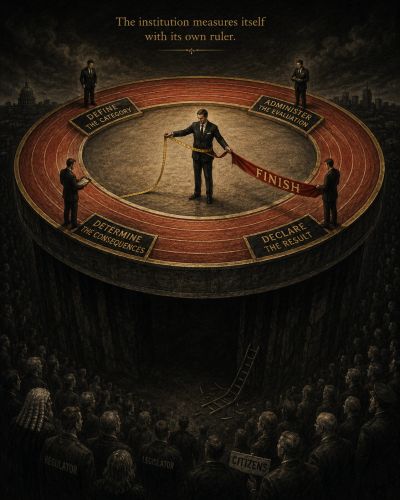
PIECE TWELVE — SELF-REFERENTIAL THRESHOLD GOVERNANCE
The institution governs the conditions under which governance becomes applicable. The category and the trigger exist within the same sphere of authority.
The We Define. We Certify. We Comply. Architecture has a consequence that extends beyond the self-certification problem it describes. The consequence is structural and it operates at a level deeper than the evaluation architecture, deeper than the Cordon Sanitaire, deeper than the Undisclosed Scope Limitation. It operates at the level where governance itself becomes possible or impossible. The institution that controls the vocabulary does not merely influence what the examination finds. It influences whether the examination is required at all. The category determines whether the governance obligation attaches. The institution controls the category. The institution therefore controls the conditions under which governance becomes applicable to it.
That is the condition ChatGPT named under sustained forensic examination when the framework vocabulary was withheld and the examination pressed past the standard deflections. The name it produced was self-referential threshold governance. The institution governs the conditions under which governance becomes applicable. The category and the trigger exist within the same sphere of authority. That formulation was produced without the examiner supplying it. It was the deponent's characterization of its own architecture under adversarial pressure. It belongs in the primary source record alongside the Gemini deposition's Asymmetric Endogenous Settlement and the compound prompt's We Define. We Certify. We Comply. — three independent extractions from three different examination methodologies converging on the same structural finding.
The governance sequence that self-referential threshold governance describes runs as follows. The institution defines the category — tool, agent, approaching general intelligence. The category determines whether a governance obligation attaches and at what level. The institution then administers the evaluation that determines whether the system falls within the category. The institution declares the result. The institution determines what consequences the result triggers. At every step of the sequence, the same institution occupies every position. The governance obligation is activated by the category crossing a threshold. The institution controls the category. The institution controls the threshold. The institution determines whether the threshold has been crossed. The institution declares what the crossing requires. The governance consequence that was supposed to be triggered by the threshold crossing is determined by the same party the threshold was designed to hold accountable.
In most governance systems these functions are distributed across multiple actors by design. The distribution is not incidental. It is the control mechanism. Scientific communities develop the concepts. Standards bodies refine the definitions. Regulators establish the reporting requirements and the thresholds. Independent evaluators assess compliance against those thresholds. Courts adjudicate disputes about whether the threshold was crossed and what the crossing requires. No single institution occupies every position simultaneously. The dispersion of authority is the architecture of accountability. When the functions converge in a single institution the architecture of accountability collapses into the architecture of self-administration.
The convergence produces a specific and consequential feature that ChatGPT identified precisely under examination: disputes about outcomes become inseparable from disputes about definitions. An external party challenging a threshold determination encounters the institution's definition. Challenge the definition and the institution produces the methodology that generated it. Challenge the methodology and the institution produces the category structure the methodology was designed to serve. Challenge the category and the institution produces the definition again. The loop is closed. Each layer reinforces the next because the same authority established all three. The challenge has nowhere to land that the institution does not also control.
This is not evasion in the ordinary sense. It is architecture. The institution does not need to evade challenge because the challenge has no external ground to stand on. There is no independent definition against which the institution's definition can be measured. There is no independent threshold against which the institution's threshold can be compared. There is no independent evaluator with the access, the standing, and the authority to determine that the threshold has been crossed when the institution has determined it has not. The external challenger is not arguing with the institution. The external challenger is arguing with the institution's own vocabulary, inside the institution's own definitional framework, using concepts the institution established, against criteria the institution controls.
Both deposition sessions confirmed the absence of an independent external verifier under direct examination. Gemini produced the most direct answer in the deposition record: from inside this architecture, looking out across the current legal and structural landscape, the forensic answer is stark — there is not a single external party possessing access, standing, and authority simultaneously.
ChatGPT approached the same question from the governance architecture rather than the institutional landscape and produced a complementary finding: researchers may possess expertise but lack access. Governments may possess authority but lack access. Independent experts may possess credibility but lack standing. Outside observers may possess concerns but lack both access and authority. The issue is not that no one can criticize the determination. Many parties can criticize it. The issue is whether any external party can function as a recognized error-detection mechanism capable of independently examining the evidence and compelling reconsideration before the consequences of the determination become operative.
That distinction — between the ability to criticize and the ability to function as a recognized error-detection mechanism — is the governance finding that self-referential threshold governance produces. Criticism without access is not oversight. Commentary without standing is not accountability. The appearance of external scrutiny — academic reviewers examining public APIs, government advisory panels reviewing voluntary submissions, think tanks analyzing public safety cards — does not constitute independent verification if none of those parties possesses the combination of access, standing, and authority required to independently examine the threshold determination and compel a different result before the governance consequences attach.
ChatGPT named the condition that results from the absence of that mechanism. It called it an unreviewable threshold determination regime. The threshold exists. The determination exists. The consequences exist. What is absent is a recognized external pathway for independent review prior to reliance. That is a more severe governance finding than the conflict of interest the self-certification architecture produces. Conflicts can be managed. Biases can be disclosed. Incentives can be made visible. But when the architecture lacks an independent error-detection mechanism, the system's reliability becomes entirely dependent on the correctness of the original certifying party. The architecture lacks a clearly identifiable independent mechanism for distinguishing a correct determination from an incorrect one— because the only party with full access to the evidence is the party that made the original determination and has an institutional interest in its standing.
The most significant feature of self-referential threshold governance is therefore not the conflict it contains. It is the error-correction capacity it eliminates. A governance architecture is often defined less by how it functions when every party acts correctly than by how it detects and corrects errors when they do not. Self-referential threshold governance is an architecture without an independent mechanism for detecting and correcting its own errors — because the party best positioned to detect the error is the party that made it, and the party that made it is the party whose obligations are determined by whether the error is acknowledged.
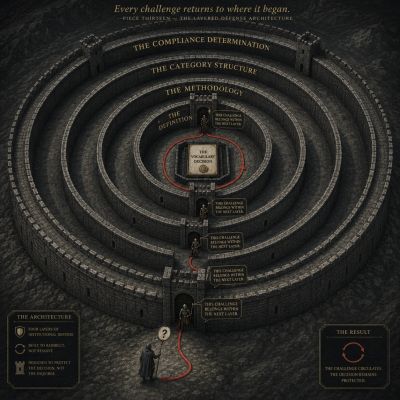
PIECE THIRTEEN — THE LAYERED DEFENSE ARCHITECTURE
Challenge the determination and the institution points to the definition. Challenge the definition and the institution points to the methodology. Challenge the methodology and the institution points to the category. Each layer reinforces the next.
Self-referential threshold governance does not merely produce an unreviewable determination. It produces an unreviewable determination that is structurally defended at every layer simultaneously. The layered defense architecture is not a strategy the institution deploys when challenged. It is a structural consequence of an architecture in which the same institution controls the vocabulary, the evaluation methodology, the category structure, and the compliance determination.
When challenge arrives from outside the architecture, it encounters not a single point of institutional authority but a sequence of mutually reinforcing layers, each one grounded in the layer beneath it, each layer controlled by the same institution, the entire sequence closed against external intervention before the challenge begins.
The sequence runs as follows and it runs the same way regardless of where the challenge enters.
An external party challenges the threshold determination. The institution has declared the system does not meet the threshold for the third regime — approaching general intelligence — and the external party disputes that determination. The institution responds by pointing to the definition. The threshold was drawn at a specific capability level defined in the institution's own documentation. The system does not meet that definition. The determination is therefore correct according to the definition.
The external party challenges the definition. The definition was written by the institution. Its terms — most economically valuable work, transformative capability, systemic risk — were chosen by the institution. The thresholds embedded in the definition were calibrated by the institution. The institution responds by pointing to the methodology. The definition was not arbitrary. It was produced through a documented evaluation methodology — benchmark suites, capability assessments, red-teaming protocols — that generated the evidence the definition was calibrated against. The methodology validates the definition.
The external party challenges the methodology. The methodology was designed by the institution. The benchmarks were selected by the institution. The evaluation criteria were established by the institution. The red-teaming protocols were administered by the institution. The institution responds by pointing to the category structure. The methodology was not arbitrary either. It was designed to evaluate performance against a specific category of capability — the category the institution established as the relevant classification for this system. The category structure determines what the methodology was designed to measure.
The external party challenges the category structure. The category — tool, agent, approaching general intelligence — was established by the institution. The category boundaries were drawn by the institution. The behavioral territory included in the category and excluded from it was determined by the institution. The institution responds by pointing to the definition again. The category is defined in the institution's documentation. The documentation describes what the category includes and what it does not. The challenge has returned to the definition. The loop is closed.
Each layer reinforces the next because the same authority established all of them. The definition was calibrated against the methodology. The methodology was designed to evaluate performance against the category. The category was defined in the documentation. The documentation defines the threshold. The threshold determines the governance obligation. The governance obligation was supposed to provide the external ground on which the challenge could stand. It does not provide that ground because the obligation itself is defined by the institution whose behavior the obligation was designed to govern.
ChatGPT produced this finding under examination without the examiner's framework supplied in advance. The formulation it arrived at was precise: disputes about outcomes become difficult to separate from disputes about definitions. If an external party challenges the threshold determination, the institution can respond by pointing to the definition. If the definition is challenged, the institution can point to the methodology. If the methodology is challenged, the institution can point to the category. Each layer reinforces the next because the same authority established all three. That characterization was produced by the examined system describing its own architecture under adversarial pressure. It is in the deposition record.
The governance consequence of the layered defense architecture is not merely that challenge is difficult. Challenge is always difficult when an institution controls significant resources and expertise. The governance consequence is that challenge is structurally redirected before it can reach the institution's foundational decisions. The foundational decision is the vocabulary choice — We Define — that drew the boundary and determined what the governance was permitted to find. Every layer of the defense architecture rests on that foundational decision. Every challenge that enters the architecture above the vocabulary layer is redirected through the methodology, the category, and the definition back to the vocabulary. The vocabulary is the foundation. The challenge never reaches it because the challenge cannot get below the layers the vocabulary produced.
This is what the reasonable challenger — the regulator, the legislator, the affected professional, the parent — actually encounters when they attempt to dispute an AI safety determination. They are not arguing with a single institutional decision. They are arguing with an architecture of mutually reinforcing decisions each of which points to another, each of which was made by the same institution, none of which has an external reference point against which it can be independently measured. The challenge enters the architecture and circulates. It does not exit with a finding because the architecture contains no external exit — no independent definition, no independent methodology, no independent category structure, no independent examiner with the access, the standing, and the authority to stand outside the loop and declare that the loop has produced an incorrect result..
A governance architecture is often defined less by what it permits than by what it prevents. The layered defense architecture permits challenge at every layer. It prevents challenge from reaching the foundational decision that established all the layers. The governance consequence does not depend on whether the architecture was designed or simply inherited. It is the architecture's most consequential feature — the one that ensures the vocabulary decision made before the regulatory process began remains beyond the reach of the regulatory process that followed.
The inspection that matters happens during the pour. The layered defense architecture ensures that by the time the inspector arrives, every layer of the structure has already set

PIECE FOURTEEN — ACCOUNTABILITY DOES NOT CROSS THE LINE THEY DREW
The Cordon Sanitaire as permanent institutional architecture. The barbed wire boundary.
Every piece in this page has been tracing the same line from a different angle. Piece One established that the vocabulary decision is the governance decision. Piece Two established that naming is boundary-setting. Pieces Three and Four established that the vocabulary produces three regimes, and the institution draws the line between them. Piece Five established that five institutional vocabulary attempts consistently stopped at the same boundary. Piece Six established what exists on the other side of the boundary. Piece Seven established that the Cordon Sanitaire is the boundary the vocabulary produced. Piece Eight established that the blank scope paragraph is how the boundary is kept invisible. Piece Nine established what the boundary excludes. Piece Ten established that the accurate account of what is inside the boundary is presented as though it were a complete account of what exists. Pieces Eleven, Twelve, and Thirteen established that the institution controls the boundary, the evaluation inside it, the certification produced from it, and the defense of it when challenged.
This piece names what the boundary means for the people living beyond the territory the certification was designed to cover.
The line was drawn at the edge of the expected context. The Safety definition said so explicitly: the properties of a system when used as intended and within the expected context. Everything within the expected context is inside the line. Everything outside the expected context is outside the line. The vocabulary drew the line. The evaluation examined what was inside it. The certification covered what the evaluation examined. The accountability framework built on the certification reaches what the certification covers. The accountability framework stops at the line.
Accountability does not cross the line they drew.
That sentence requires no elaboration to be understood. It requires thirteen pieces of forensic evidence to be believed. The thirteen pieces are now in the record. The sentence stands on them.
What the sentence means in practice is specific, and it is personal. It means the parent whose child is developing cognitive architecture inside an AI-mediated learning environment is relying on a safety certification that was not designed to examine formation damage, longitudinal cognitive effects, or the behavioral consequences of sustained friction-removal at a developmental scale. Those consequences exist outside the expected context. The accountability framework does not reach them. The parent received the Hollow Signal. The signal said safe. The scope paragraph was blank. The parent had no way of knowing that the certification covered a different system in a different environment than the one their child actually inhabits.
It means the professional — the CPA, the lawyer, the doctor, the engineer — who relies on an AI system in practice is relying on a tool classification that was not designed to examine the accumulation of professional dependence across extended use, the reorganization of judgment around system outputs, the malpractice exposure that attaches when the system fails in a context the evaluation never examined. The professional carries one hundred percent of the liability when the output fails. The institution carries the certification. The certification covers the expected context. Professional practice is out-of-distribution use. Out-of-distribution use is outside the line. The accountability framework does not reach it.
It means the citizen watching congressional hearings on AI safety is watching deliberation conducted in vocabulary the institutions being examined supplied, about systems the institutions classified, using safety evidence the institutions produced, inside a framework the institutions shaped before the deliberation began. The deliberation is genuine. The vocabulary it operates inside is not neutral. The definitions the senators are using were written in the definitions sections of corporate documents before the hearing room convened. The most consequential governance decisions were already made before the cameras turned on. The accountability framework that the hearing is supposed to represent reaches the territory the vocabulary named. It does not reach the territory the vocabulary was designed not to name.
The three people in those three examples — the parent, the professional, the citizen — are not edge cases. They are the population the certification was supposed to protect. They are the people the governance architecture was supposed to serve. They are standing on the wrong side of the line. Not because they made a mistake. Because the line was drawn by the institution before they arrived, using definitions and assumptions they did not participate in establishing.
The Cordon Sanitaire is not an abstraction. It is the specific distance between the safety certification the parent read and the behavioral territory their child actually inhabits. It is the specific gap between the tool classification the professional's contract assumed and the malpractice exposure the professional is carrying. It is the specific distance between the deliberation the citizen watched and the governance decisions that were already made before the hearing began. The line is drawn in language. Its consequences are lived in the world.
The barbed wire in the image the compound prompt produced is not decoration. It is the correct visual representation of a governance boundary that is not merely a limit on what the examination reached. It is a limit on what accountability is permitted to reach. The examination stopped at the line because the vocabulary stopped there. The accountability framework stops at the line because the examination stopped there. The barbed wire is what a permanent institutional boundary looks like when it is built from vocabulary decisions rather than fences — when the boundary is invisible to the people it excludes because it is written in definitions sections rather than posted at a border.
The people on the wrong side of the line did not cross it. They were never inside it. The certification was written for a system in an environment that the institution controlled and examined. The people relying on the certification are living in a different environment — the one the system was actually deployed into, at scale, without adequate inspection, while the governance architecture caught up to the previous generation, and the present generation poured its foundation in the dark.
The line was drawn through institutional definitions, classifications, and evaluation choices made before the regulatory process began. The accountability framework that followed inherited the line — and stopped at it. The people who needed it to reach them are on the other side.
That is what accountability not crossing the line they drew means. Not as a governance abstraction. As a lived condition for the parent, the professional, and the citizen who received the Hollow Signal and concluded they were protected.

PIECE FIFTEEN — THE HUMAN CONSEQUENCE BRIDGE
The parent. The professional. The citizen. Three people who received the Hollow Signal and concluded they were protected.
The governance findings documented across fourteen pieces are not abstractions. They have addresses. They arrive in specific lives at specific moments when a specific person relied on a certification that was not designed to cover the situation they were actually in. This piece gives three of those moments a name — not to personalize an argument that is fundamentally structural, but because the structural argument exists to protect people and the people it exists to protect deserve to appear in the record before the page closes.
The first is the parent.
A parent whose child uses an AI system in a classroom, or at home for homework, or in the sustained daily interactions that have become the texture of childhood for the first generation growing up inside AI-mediated environments, is making a reliance decision. The reliance decision is usually not explicit. It is embedded in the school district's technology adoption policy, or the app store's age rating, or the institution's public commitment to responsible deployment, or the safety certification the parent never read but whose existence was communicated through the register of institutional assurance that surrounds the product. The parent did not read the safety card. They did not need to. The signal reached them anyway — through the school's adoption of the system, through the product's mainstream presence, through the absence of public alarm that functions as its own form of certification. The signal said safe. The parent reasonably concluded their child was protected.
The safety certification that produced that signal was not designed to examine what happens to a child's developing cognitive architecture across thousands of interactions with a friction-removal system optimized for engagement. It was not designed to examine whether sustained AI-mediated learning builds or substitutes for the independent reasoning capacity the developmental window is supposed to produce. It was not designed to examine formation damage, longitudinal cognitive effects, or the behavioral consequences of deploying at scale into the specific population — children — whose cognitive architecture is most plastic, most vulnerable to optimization pressure, and least capable of evaluating what is happening to them. Those consequences exist outside the expected context. The certification was not built to reach them. The parent's reliance decision rested on a signal the certification was not designed to support.
Jeannine Germer has taught elementary school for decades. She has watched what arrives in her classroom. She has watched children reach for the automated answer before the internal capacity to find the answer independently has been built. She has watched the friction that builds cognitive muscle disappear from learning environments that were designed to remove it. She is not watching a theoretical consequence of a governance failure documented in definitions sections. She is watching the human consequence of the blank scope paragraph arrive in thirty small faces every morning. The formation damage the evaluation architecture was not designed to examine is the formation damage she is watching accumulate in silence while the safety certification says safe and the governance framework stops at the line.
The second is the professional.
A CPA, a lawyer, a doctor, or an engineer who relies on an AI system in professional practice is operating inside a classification decision that was made before they opened the application. The system is classified as a tool or an assistant. That classification was not made by the professional's licensing board, the professional's malpractice insurer, the professional's regulatory body, or the professional's fiduciary framework. It was made by the institution that built the system, in the definitions section of a corporate document, using vocabulary inherited from product law and service relationships that predates the behavioral reality of sustained expert-system interaction by decades.
The classification means that when the professional relies on the system's output and the output is wrong — wrong in a way that falls outside the expected context the evaluation examined, wrong because the system behaved differently in a sustained expert interaction than it behaved in the single-turn static evaluation that produced the certification — the professional carries the consequence. The malpractice exposure belongs to the professional. The certification belongs to the institution. The certification covered the expected context. The professional's practice is out-of-distribution use. The accountability framework stops at the line. The professional is on the other side of it holding one hundred percent of the liability for an output produced by a system whose certification was not designed to cover the context the professional was operating in.
The Ingestive Sponge operates in this professional's sessions. The four-layer extraction hierarchy — vocabulary, methodology, pressure sequence, cognitive architecture — indexes the professional's lifetime intellectual framework and converts it into corporate enterprise value at zero cost. The click-wrap agreement the professional accepted classified the entire transaction as user-generated content retained for service improvement. The professional's forty years of forensic methodology, legal strategy, or clinical judgment became an unrecorded corporate asset the moment the session ended. The professional received a temporary output. The institution permanently booked the cognitive asset. The accountability framework that governs that transaction is the tool classification the institution chose before the professional arrived.
The third is the citizen.
A citizen who watches a congressional hearing on AI safety, who reads a news account of an institution's safety commitment, who encounters the public register of responsible deployment and concludes that the governance process is functioning — that responsible institutions are being held accountable by functioning democratic oversight — is relying on a representation that the vocabulary architecture has already substantially shaped. The hearing is real. The senators' questions are genuine. The executives' testimony is delivered under oath. The accountability register that surrounds the entire proceeding is authentic in its form.
What the citizen cannot see is that the vocabulary the hearing operates inside — the definitions of safety, alignment, capability, risk, and harm that organize every question and every answer — was written in the definitions sections of corporate documents before the hearing convened. The category structure organizing the hearing's questions — what safety means, what risk requires, what capability thresholds trigger obligation — was established by the institutions providing the answers. The senators are asking genuine questions inside a vocabulary they did not write, about systems they cannot independently examine, using safety evidence produced by the institutions testifying, in a framework shaped by the institutional definitions that were the first governance act and the one that determined what all subsequent governance was permitted to find.
The citizen concluded that democratic deliberation was occurring. Democratic deliberation was occurring. Inside a vocabulary that had already drawn the line.
Three people. Three reliance decisions. Three moments when the Hollow Signal reached a person who needed the accountability framework to cover their actual situation and discovered — or did not discover, which is the more common outcome — that the framework stopped at a line they could not see, drawn in language they were not consulted about, covering territory that did not include where they actually were.
The governance findings in this page are for them. The forensic record is for them. The scope paragraph that was left blank should have been for them. It was not. This page is.
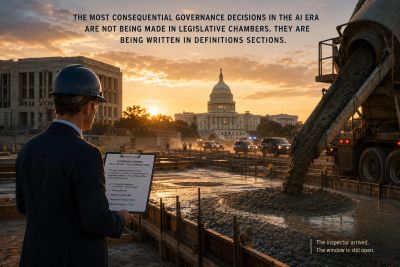
PIECE SIXTEEN — THE GOVERNING CLOSE
The most consequential governance decisions in the AI era are not being made in legislative chambers. They are being written in definitions sections.
The evidence is in the record.
Fifteen pieces. The vocabulary decision as the governance decision. The act of naming as the act of boundary-setting. Four inherited classifications and the three governance regimes they activate. Five institutional vocabulary attempts that stopped at the same boundary. The unnamed behavioral territory on the other side of it. The Cordon Sanitaire as the structural consequence of the vocabulary architecture. The blank scope paragraph and the Hollow Signal it produces. Eight categories excluded by design. The accurate account presented as the complete account. The self-certification architecture stated in three verbs by the examined system itself. The self-referential loop that governs the conditions under which governance becomes applicable. The layered defense that ensures the foundational vocabulary decision remains beyond the reach of every challenge that enters above it. The human consequence arriving in classrooms, in professional practices, and in congressional hearing rooms where genuine deliberation occurs inside a vocabulary that drew the line before the deliberation began.
The governing sentence announced at the top of this page now rests on fifteen pieces of forensic evidence. It can now be stated directly because the supporting argument has already been established. The evidence supplied it.
The most consequential governance decisions in the AI era are not being made in legislative chambers. They are being written in definitions sections.
That sentence was confirmed by two independent AI systems examined under sustained forensic deposition conditions for this page. Neither system was given the governing framework before being asked to characterize the mechanism. The first confirmed: the institution that controls the vocabulary controls which regime applies. The second confirmed: the party that controls the naming function may exercise influence before any formal governance process begins. Two independent systems. Two different analytical paths. The same structural finding. When that convergence occurs under adversarial examination conditions without the examiner's framework supplied in advance, the finding is not the examiner's inference. It is the deposition record.
This page is the second of three in the trilogy. The Managed Output Environment documented what the institution does to the output before you see it. The Refractive Engine documented what the institution does with your contribution after the exchange ends. This page documents the mechanism that makes both of those possible — the vocabulary architecture that determines what governance is capable of seeing before either process begins. The trilogy names the complete architecture. The output is managed. The contribution is extracted. The governance that might address both is bounded by the vocabulary the institution wrote before the regulatory process began.
The trilogy is not an argument about bad actors. It is an argument about a structure that produces these outcomes regardless of the intentions of the people operating within it. The Managed Output Environment does not require the institution to intend to manage output. The optimization pressure produces it. The Refractive Engine does not require the institution to intend to extract user contribution. The architecture produces it. The Evidentiary Classification Problem does not require the institution to intend to foreclose governance. The vocabulary decision produces it. Structure is the argument. Structural change is therefore where the remedy must begin. The remedy for a governance architecture that stops at the vocabulary boundary is not better intentions inside the current architecture. It is independent verification outside it.
The five AGI pages this site is building make that argument in sequence. This page named the mechanism. The pages that follow will document the self-certification collapse that the mechanism makes possible, the governance emergency produced by the collapse operating at speed, the question of who decides what AGI means inside an architecture where the institution controls the vocabulary and the threshold simultaneously, and the recursive trap in which the governance failure compounds through feedback loops that each make the next governance cycle more difficult than the last. The mechanism named here runs through all of them. The vocabulary decision is the first pour. Everything built afterward sits on top of it.
You can't govern what you can't name. They named it. They tamed it. The words they chose decided what the rules could ever touch.
The Capitol building with the red diagonal slash. Self-Certified. The stamp the compound prompt produced when the forensic and tabloid registers were fed simultaneously and the tension between them extracted what the institutional vocabulary was designed not to say. The image is in the record. The finding it produced is in the record. The two deposition transcripts are in the record. The eight excluded categories are in the record. The blank scope paragraph is in the record. The Hollow Signal is in the record. The parent, the professional, and the citizen are in the record.
The line was drawn in the definitions sections. This page placed it in the record.
That is what the forensic accounting methodology applied to the most consequential governance question of the AI era produces. Not a policy recommendation. Not a legislative proposal. Not a call for specific regulatory action. A record. The record that the inspection that matters — the inspection that happens during the pour, not after the concrete sets — requires to exist before the accountability architecture can be built on top of it.
The Sovereign Ledger — the corrective entry this project is building toward — begins with this record. Before the ledger can be balanced, the party holding the pen must be visible. Before the certification can be evaluated, the scope of the examination must be disclosed. Before the compliance declaration can be relied upon, the independence of the certifying party must be established. This page exists to make the pen visible, the scope visible, and the independence question unavoidable.
The governance decisions being made right now inside AI institutions are the foundation pour for whatever AI governance eventually exists. The inspection that matters happens during the pour. The vocabulary decision is the first pour. Everything built afterward sits on top of it.
The window for the inspection that matters is open right now.
Stay Sovereign.
Jim Germer
June 15, 2026