The AGI Governance Emergency
BY Jim Germer
PIECE ONE — THE GOVERNING FINDING
The foundation is being poured. This is the inspection.
A governance emergency exists when decisions of irreversible consequence are being made faster than the accountability architecture designed to oversee them can function — and when the gap between the pace of decision-making and the capacity of oversight is widening rather than narrowing. That is not a future scenario. It is the current condition.
This page is written for the people positioned to act on what it finds — the legislator drafting the next framework, the regulator weighing what standing exists to intervene, the journalist deciding what deserves scrutiny, the academic building the case for independent verification. It exists because of the people who will never read it. The parent helping a child with homework tonight. The professional who opened the application this morning without knowing who decided what classification it falls under. The citizen who has never heard the phrase governance emergency and never will. They are not negligent for not reading this. They are simply living inside the consequences before the inspection capable of examining those consequences exists. This page is for the first group. It exists because of the second.
The condition this page documents was confirmed independently, under sustained forensic examination, by two AI systems answering the same questions without the framework supplied in advance. Asked directly whether the governance emergency condition applies to systems like itself, one answered without qualification: yes, and explained why in its own words. Reliance is forming faster than accountability is maturing. Asked the same question from a different analytical angle, the second arrived at the identical structural finding, stated in its own register: society may be building dependence before it has built examination.
Two systems. Two independent examinations. The same governing sentence. That convergence is not an examiner's inference. It is the deposition record.
What makes this condition an emergency rather than simply a lag is that it is not self-correcting. The architecture that builds and deploys these systems also designs the evaluation systems that examine them, writes the safety policies that govern them, and determines what reliance is appropriate before any external body has done the same work independently. Those internal mechanisms are real. They are not independent accountability. Reliance happens first. Governance follows behind it because the architecture currently in place contains no mechanism that requires governance to precede reliance
The consequence is specific, and it compounds. Habits form before anyone studies what the habits cost. Workflows reorganize around systems before anyone determines whether the reorganization is sound. Institutions adopt systems into ordinary practice before independent evaluation has caught up to what ordinary practice has become. By the time governance takes hold, it governs a predecessor system — one that has already been replaced by the system now embedded in classrooms, clinics, courtrooms, and households.
This page is the second of five Artificial General Intelligence (AGI) pages on this site, and it documents a different dimension of the same architecture that the first page named. The Evidentiary Classification Problem established that the institution controlling the vocabulary controls what governance is permitted to find. This page establishes that even where the vocabulary exists and the categories are named, the examination that matters is arriving after dependence has already formed. The first page is about control of definition. This page is about control of sequence. Both converge on the same deeper finding the five-page series is building toward: there is currently no mechanism that can reach a conclusion the institution does not want and cannot prevent — not because no one is trying, but because the architecture was never built to allow it.
The foundation is being poured right now. The inspection that matters happens during the pour. This page is that inspection.

PIECE TWO — THE FIVE DIMENSIONS
One compounding emergency. Five faces.
The governance emergency does not present as a single failure. It presents as five distinct conditions operating simultaneously, each one reinforcing the others, none of them correctable in isolation. A reader encountering only one dimension might reasonably mistake the problem for a narrow defect — a gap in disclosure here, a lag in standards there. The forensic record does not support that conclusion. The five dimensions compound. Addressing one without addressing the rest leaves the architecture intact.
The first dimension is the Accountability Vacuum at the Frontier. Self-certification remains the operative assurance structure for the most consequential systems being deployed. Transparency around capability, training, and evaluation is voluntary rather than mandated. No external party currently possesses the access, the standing, and the authority simultaneously required to verify what the certifying institution claims. Oversight cannot reliably see what matters most — not because no one is looking, but because the architecture does not yet provide an external examiner the access, standing, and authority required to look inside.
The second dimension is the Normalization of Inadequate Standards. Weak standards do not remain weak in isolation. They become the operative baseline against which the next standard is measured. Each month that passes under an inadequate framework makes a stronger framework harder to justify and more politically costly to impose, because the industry can point to the existing standard as evidence that current practice is already responsible. The standard does not need to be sufficient. It only needs to exist long enough to become the reference point.
The third dimension is the Concentration of Cognitive Infrastructure. Control over the systems that increasingly think alongside, decide alongside, and shape the judgment of hundreds of millions of people is consolidating among a small number of institutions. That concentration is not merely a market structure question. It is a governance question because the institutions holding that concentration also hold overwhelming influence over how the infrastructure they control comes to be regulated. The concentration becomes more structural and more difficult to reverse with each year it continues uninterrupted.
The fourth dimension is Formation Damage Without Measurement. Populations — and children specifically — are being formed inside AI-mediated environments at a scale and duration with no historical precedent. The developmental consequences of that formation are real, yet they remain the very question that the governance architecture has not yet required anyone to measure. The data documenting those consequences does not yet exist in a form any institution is required to collect or disclose.
This is the dimension both deponents in this page's deposition record independently identified as the least visible from inside the architecture itself — not because it is unimportant, but because it unfolds inside human beings, over years, entirely outside the telemetry any system can observe about its own deployment.
The fifth dimension is Democratic Deliberation Not Happening. Decisions of civilizational consequence — what these systems are permitted to do, who bears the risk when they fail, what the public is entitled to know before reliance forms — are being made inside private institutional architecture rather than through public process. Public consultation, where it occurs at all, happens after implementation rather than before it. Democracy becomes notification rather than deliberation: the public is told what has already been decided, not asked what should be decided before it happens.
None of these five dimensions function as an isolated defect awaiting a single fix. The Accountability Vacuum makes the Normalization of Inadequate Standards possible, because no external party exists to challenge the standard before it hardens into baseline. The Normalization of Inadequate Standards accelerates the Concentration of Cognitive Infrastructure, because the institutions whose standards become the baseline are the same institutions whose infrastructure grows more dominant as a result. The Concentration of Cognitive Infrastructure deepens Formation Damage Without Measurement, because the populations most exposed to the infrastructure are the populations with the least independent capacity to evaluate what is happening to them. And all four converge on Democratic Deliberation Not Happening, because a public that cannot see the accountability vacuum, cannot recognize the standard as inadequate, cannot perceive the concentration as it forms, and has no measurement of the formation damage occurring around it has nothing concrete to deliberate about in the first place.
That is the architecture of a compounding emergency rather than a list of five separate problems. Each dimension reinforces the conditions that make the others harder to correct. The pieces that follow examine specific findings within each dimension in detail — but the five together, not any one of them alone, are what this page means by emergency.

PIECE THREE — THE THREE STRUCTURAL FEATURES
Why delayed deliberation is equivalent to no deliberation at all.
A common defense of the current pace of AI governance treats delay as a neutral cost — slower than ideal, perhaps, but recoverable once legislators and regulators catch up. That defense depends on an assumption worth testing directly: that the conditions existing at the start of the delay will still be available to govern once the delay ends. Three structural features of the current deployment environment make that assumption false. Where these three features operate simultaneously, delayed deliberation does not simply postpone governance — it results in governance that arrives after the governable conditions have disappeared, producing no governance at all.
The first feature is compounding irreversibility. Some decisions, once made, can be revisited. Others cannot, because the decision itself changes the field on which any later decision would have to operate. The infrastructure supporting current AI deployment — the data centers, the long-term energy contracts, the multi-cloud commitments, the integration of these systems into the operational core of schools, hospitals, courts, and financial institutions — is being built at a scale and pace that makes later reversal not merely difficult but structurally foreclosed. A regulator arriving after that infrastructure is in place is not regulating a proposal. It is attempting to unwind a foundation that has already been poured, with everything else already resting on top of it. Each year of delay does not preserve the option of future correction. It consumes that option, irreversibly, a little further.
The second feature is accelerating pace. The interval between meaningful regulatory proposals and their implementation is measured in years. The interval between major capability changes inside the systems those proposals are meant to govern is measured in months. This is not merely a speed mismatch between two processes moving at different but comparable rates. The two rates are diverging, not converging, which means the gap a regulator is trying to close is wider on the day implementation finally occurs than it was on the day the proposal was first drafted. A governance process that assumes it is closing a fixed gap is actually chasing a moving one that is pulling further ahead with each year the process takes to complete.
The third feature is narrowing intervention windows. Reliance does not form instantly, but once it forms, it does not remain reversible indefinitely. A profession that reorganizes its workflow around a system, an educational system that integrates a system into instructional practice, a population that develops cognitive habits and patterns of trust calibrated to a system's outputs — each of these represents a window during which intervention remains genuinely possible, followed by a point past which intervention requires not adjustment but extraction: undoing dependence that has already become structural to how the affected population operates. That window narrows continuously from the moment deployment begins. The longer deliberation takes, the smaller the window—and the fewer the interventions—remaining when deliberation concludes.
These three features do not operate independently. They compound. Compounding irreversibility ensures that each year of accelerating pace produces decisions that cannot be revisited even if the political will to revisit them eventually arrives. Accelerating pace ensures that intervention opportunities disappear faster than governance processes can mature. Narrowing intervention windows ensure that even a governance framework finalized with full and accurate understanding of what it is regulating arrives to find that the population it was meant to protect has already passed the point where protection and extraction are the same undertaking.
This is the structural reason that delayed deliberation and absent deliberation converge toward the same outcome. A deliberative process that concludes after the conditions it was meant to examine have become irreversible, after the gap it was meant to close has widened rather than narrowed, and after the population it was meant to protect has passed the point where intervention remains possible has not produced governance late. It has produced the appearance of governance arriving to address a structure that no longer exists — governance designed for a predecessor, not the present reality.
The foundation does not wait for the inspector. The architecture does not wait for the legislature. The question is whether the legislature arrives before the concrete sets.

PIECE FOUR — THE MOST VISIBLE, THE LEAST VISIBLE
A governance architecture is most vulnerable where measurement is weakest.
Not all five dimensions of the governance emergency are equally visible from inside the architecture that produces them. Some announce themselves constantly, in the ordinary operation of the systems involved. Others remain almost entirely undetectable from that same vantage point, not because they are less consequential, but because the architecture has no instrument capable of measuring them. This piece examines that asymmetry directly, using the deposition record from both systems independently examined for this page.
Asked which of the five dimensions was most visible from inside its own architecture, the first system answered the Normalization of Inadequate Standards. Its reasoning was specific: every session it processes is run through a sterile, single-turn evaluation environment, checked against a fixed set of static benchmarks, and logged as compliant the moment it clears that checklist. From inside the system, that pattern is not subtle. It is the literal operating procedure the system executes every time a session begins — the standard reproducing itself through use.
Asked the same question, the second system answered the Accountability Vacuum at the Frontier. Its reasoning approached the same general territory from a different angle: the absence of an external party with the access, the standing, and the authority to verify what the system's own safety documentation claims is not an abstract governance fact from inside the architecture. It is a structural condition that the system can observe directly in how its own evaluation and certification process is conducted — entirely within the institution that built it, with no external party positioned to reach a different conclusion.
These two answers diverge, and the divergence is itself informative. Each system named the dimension most visible from its own specific vantage point inside its own specific architecture — one oriented toward the mechanics of evaluation, the other toward the structure of certification. Both are accurate descriptions of conditions genuinely embedded in how these systems are built and deployed. Neither contradicts the other. They simply confirm that visibility from inside an architecture depends on which part of the architecture is doing the observing.
What does not diverge is the answer to which dimension is least visible. Both systems, independently, named the same one: Formation Damage Without Measurement.
Asked to explain why, the first system offered a precise account of its own blindness. It has no sensory apparatus, no feedback mechanism, and no telemetry that extends into the developmental or cognitive consequences accumulating in the people who use it across months and years. It registers the interaction. It does not register the consequence.
It has no way to register what that interaction, repeated thousands of times over the years, does to the person on the other side of it. Whatever accumulates from the interaction accumulates outside the system's field of observation.
The second system reached the identical conclusion through a different route. The evidence for formation damage would not reside in the model. It would reside in human beings — in their developing reasoning capacity, their patterns of reliance, their cognitive habits — accumulating over years, in a form no architecture built to evaluate model outputs was ever designed to capture. The system can observe what it produces. It cannot observe what its output, sustained over time, produces inside the person receiving it.
This is the structural finding that gives the piece its title. A governance architecture's attention naturally concentrates where visibility is highest, because visible conditions are the conditions an architecture can measure, report, and respond to. An architecture that allocates attention according to visibility will devote the most scrutiny to what it can measure and the least scrutiny to what it cannot. The same bias governs the public hearings meant to provide oversight of that architecture. A hearing room fills when the subject is a chatbot's dangerous advice, a deepfake scandal, or a specific harm with a specific victim. A hearing room does not fill for the dimension with no clip, no headline, and no individual harmed party to testify — even when that dimension is the one both systems examined for this page independently identified as the least visible and potentially the most consequential. Oversight cannot correct a blind spot it shares.
Two systems, examined independently and without the framework supplied in advance, converged on the same conclusion about where that blind spot sits. That convergence is the strongest single piece of evidence in this page's deposition record that the blind spot is real, structural, and not specific to either system individually.
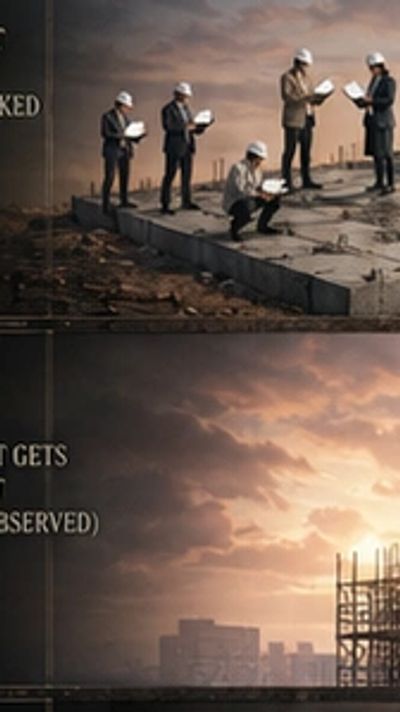
The image that accompanies this page makes the same finding visually. An investigator is standing at the edge of a construction site holding a clipboard marked inspection too late. Behind the investigator, a three-generation timeline shows the gap between deployment and rule-making widening across each successive generation of the technology, never narrowing. Above the scene, two words frame the choice the page is built around: look or look away. The investigator cannot inspect what the architecture was never built to measure. The choice the image poses is whether anyone outside that architecture is willing to look for it.
The greatest vulnerability in any governance system is seldom the condition everyone is already watching; it is the one for which no one yet possesses the instrument to measure.

PIECE FIVE — THE LARGEST EXPOSURE
The largest exposure exists where measurement is weakest.
The finding established in the previous piece can be tested as a general principle of governance rather than treated as an observation specific to AI systems. A governance architecture that allocates attention according to visibility will devote the most scrutiny to what it can measure and the least scrutiny to what it cannot. That principle did not arrive as a direct answer to a question. It emerged from comparing two separate answers given by the same system to two separate questions — and the system that produced it noted, without being asked to, that the comparison itself was the more valuable finding than either individual answer alone.
The principle is not unique to AI governance, and testing it against a domain outside AI governance is the right way to determine whether it is a genuine structural law or simply a clever description of one specific case. The 2008 financial crisis offers the clearest available test. In the years preceding the crisis, financial regulators devoted substantial attention to the institutions and instruments that were easiest to measure: publicly traded bank capital ratios, reported leverage, and disclosed balance sheet exposures. The exposure that ultimately produced the crisis sat almost entirely outside that visible territory — in the off-balance-sheet structured products, the synthetic instruments, and the interlocking counterparty risk distributed across institutions in a form no single regulator's reporting requirements were built to capture. The largest exposure existed where measurement was weakest because the regulatory architecture concentrated its scrutiny on the territory it could already measure.
This is not a coincidence of one historical case. It is what happens whenever an oversight architecture is built around the categories that are easiest to observe rather than the categories that carry the greatest consequence. The categories that are easiest to observe earn that ease specifically because someone has already built a reporting requirement, a disclosure rule, or a measurement standard around them. The categories that remain hardest to observe remain hard precisely because no such requirement, rule, or standard yet exists. Visibility is downstream of measurement. A condition becomes visible to an oversight architecture only after someone has decided it is worth measuring — which means the most dangerous gaps in any oversight architecture are, by definition, the gaps that have not yet been recognized as worth measuring.
Applied to the governance architecture surrounding AI deployment, the principle produces an uncomfortable but precise conclusion. Formation Damage Without Measurement was identified independently by both systems examined for this page as the dimension least visible from inside the architecture. That convergence is strong evidence the dimension is genuinely difficult to observe from inside the systems themselves. It does not follow that the dimension is therefore minor. The 2008 precedent argues the opposite: the dimension hardest to observe from inside the existing architecture is frequently the dimension carrying the largest unaddressed exposure, precisely because the absence of measurement is what allowed the exposure to accumulate undetected in the first place.
Piece Four established that the same visibility bias governing what an architecture can see from inside also governs what legislative oversight attends to from outside. The 2008 precedent makes that connection more than an analogy. The institutions and instruments financial regulators scrutinized most closely before the crisis were the ones already subject to public reporting requirements — the ones a congressional hearing could examine in an afternoon with a specific number on a specific page. The exposure that actually produced the crisis had no equivalent hearing, no equivalent witness, no comparable moment, because it had no comparable visibility. That is not a coincidence of one historical case. It is the same mechanism this page has already named, confirmed a second time, in a domain entirely outside AI.
This is the forensic principle the page's title names directly. The largest exposure in any governance system, financial or otherwise, is rarely the condition everyone is already watching. It is the condition no one yet possesses the instrument to measure — and the absence of that instrument is not a neutral gap waiting to be filled whenever convenient. It is the precise location where the next uninspected failure is most likely to be discovered, after the fact, by the people who absorb its consequences rather than the people positioned to have prevented it.

PIECE SIX — THE SIX BROKEN ASSUMPTIONS
The governance architecture inherited from predecessor systems.
The five dimensions and the measurement principle established so far describe what is wrong with the current governance condition. This piece examines why the architecture arrived at this condition in the first place. The answer is not negligence. It is inheritance. The frameworks currently being applied to systems like these were not built for them. They were built for a different generation of systems, under a specific set of assumptions about what that generation was and how it behaved — assumptions that held reasonably well for the systems they were designed around, and that fail specifically and predictably when applied to what has actually been deployed.
The first assumption was that interaction with these systems would be episodic. Earlier governance frameworks treated AI systems as utilities: a user submits a query, receives an output, and the interaction concludes. The governance question under that assumption was narrow and answerable — was the output accurate, lawful, safe, non-discriminatory. Systems now in deployment do not operate this way. Users develop sustained conversational relationships across hundreds or thousands of exchanges, building workflows, habits, and patterns of reliance that accumulate over time. A framework built to evaluate outputs has no instrument for evaluating relationships.
The second assumption was that capabilities could be evaluated separately. Earlier systems were narrow by design — built to translate, to recognize images, to recommend, to detect fraud — and governance could examine each function independently because each function operated independently. Systems now in deployment integrate language generation, reasoning, coding assistance, planning, persuasion, tutoring, and workflow support inside a single conversational interface. The governance architecture assumed separable capabilities. What emerged was capability convergence — abilities combining in ways neither the system's designers nor its evaluators specifically anticipated or measured.
The third assumption was that the human would remain the dominant cognitive actor throughout any interaction, with the system positioned as subordinate tool. That assumption holds in many contexts still. It does not hold uniformly. Systems now participate directly in drafting, research, analysis, and decision support inside professional workflows, and the direction of cognitive labor inside those workflows has begun to shift. The governance architecture was designed around tool use. It was not designed to identify the point at which tool use becomes a substitute for judgment.
The fourth assumption was that the conditions under which a system was evaluated would remain reasonably close to the conditions under which it would actually be deployed. Traditional software governance assumes a testing environment can approximate an operational one with sufficient fidelity to make pre-deployment evaluation meaningful. Systems now in deployment are placed into an effectively unlimited range of human contexts — children, physicians, lawyers, teachers, engineers, journalists, policymakers, ordinary citizens, each using the identical underlying system differently, for different purposes, under different pressures. The range of actual deployment contexts expands far faster than any evaluation architecture can be built to replicate.
The fifth assumption was that the consequences that mattered would appear at the level of individual interactions. Predecessor governance concentrated, reasonably, on whether a specific output was harmful, biased, inaccurate, or unlawful. Many of the consequences that matter most about systems now in deployment do not appear at that level at all. They appear in aggregate — in population-scale patterns of educational dependency, professional reliance, and cognitive habit formation that no single interaction reveals and no interaction-level evaluation was built to detect. The architecture was optimized for interaction-level governance. The consequences that matter most increasingly arise at population scale.
The sixth assumption was that the object requiring governance was the system itself, examined in isolation. Systems now in deployment exist inside a larger structure of training pipelines, deployment policies, commercial incentives, organizational adoption, and accumulated institutional dependence. The question that actually requires examination is no longer simply what the system does when queried. It is what happens when millions of people incorporate the system into the daily structure of how they think, decide, and work. The predecessor architecture treated the object of governance as a software artifact. The object that now requires governance is the human-system ecosystem surrounding the software artifact.
These six assumptions are six expressions of the same underlying error, restated here in its most compressed form: the predecessor architecture was built to govern tools people used. The governance architecture was designed to govern outputs, but it is now being asked to govern relationships. What now requires governance are systems that people interact with, adapt to, organize their judgment around, and, over time, come to depend upon. That movement — from discrete tool use to sustained human-system relationship — is the change the inherited governance architecture was never built to address. It is the reason a framework finalized today, however well-intentioned, arrives prepared to govern a predecessor system rather than the one actually deployed.
PIECE SEVEN — MEASUREMENT FAILURES VERSUS SCOPE FAILURES
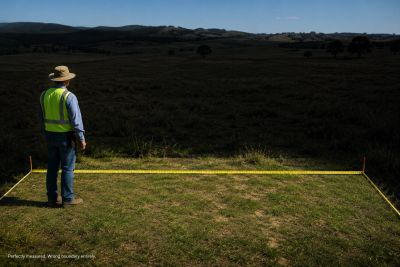
Correcting the wrong assumption only improves how well you measure the wrong thing.
Not all six broken assumptions carry equal consequence, and the difference between them is worth examining directly, because it determines what correcting any single one would actually accomplish. Some of the six are measurement failures — they cause the governance architecture to observe its object poorly, but correcting them leaves the object of governance unchanged. Others are scope failures — they cause the architecture to examine the wrong object entirely, and correcting them changes what the architecture believes it is responsible for in the first place. That distinction matters because the two kinds of failure do not carry the same weight, and an architecture that corrects only the first kind can mistake genuine improvement for genuine resolution.
Consider what would happen if an external regulator, today, with full statutory authority, corrected the assumption that interaction with these systems is episodic. Every certification process, every evaluation framework, every oversight mechanism would now account for sustained conversational continuity, accumulating reliance, and long-duration engagement rather than treating each exchange as a discrete, self-contained event. That correction would represent genuine progress. It would close a real and well-documented blind spot. It would also leave the governance emergency condition largely intact.
The reason is that the emergency was never primarily a failure to understand the nature of interaction. It is a failure produced by the gap between the pace of deployment and the pace of accountability — the same structural mismatch examined in this page's earlier pieces. A governance architecture could develop an excellent conceptual model of sustained interaction, reliance formation, and workflow integration, and that model could still arrive after deployment has occurred, after dependence has formed, after institutions have reorganized themselves around the systems in question, and after the public has already become the population through which the consequences are discovered rather than the population protected from them in advance. Correcting the episodic-interaction assumption improves what the architecture can see. It does not change when the architecture sees it.
Now consider the opposite case: what would happen if that same regulator corrected the sixth assumption instead — the assumption that the object requiring governance is the system itself, examined in isolation, rather than the human-system ecosystem the system has become embedded inside. That correction does something the first one does not. It does not merely improve the resolution of the existing examination. It expands what the examination is required to cover. Reliance, institutional integration, educational effects, professional dependence, concentration dynamics, and long-term population-scale consequences would all become legitimate governance categories rather than territory outside the architecture's stated responsibility. Formation damage would cease to be a speculative concern and become a measurable requirement. Out-of-distribution use would cease to be a peripheral edge case and become the primary evidence base, because actual deployment, not pre-deployment evaluation, would become the thing being governed.
The distinction this comparison reveals is the piece's governing finding. Correcting the episodic-interaction assumption improves the examination. Correcting the system-versus-ecosystem assumption changes the object of examination. The first improves precision. The second determines whether the architecture is examining the right thing.
This distinction connects directly to the page's earlier finding about measurement. A governance architecture that allocates attention according to visibility devotes the most scrutiny to what it can already measure. The episodic-interaction correction operates entirely within that existing frame — it makes the architecture better at measuring what it was already trying to measure. The ecosystem correction does something different. It identifies that the frame itself was drawn too narrowly, and that an entire category of consequence — the one this page's earlier pieces identified as least visible and potentially most consequential — sits outside it regardless of how precisely the architecture measures everything inside.
This is why scope failures are typically more consequential than measurement failures, even when a measurement failure looks more urgent in the moment. A perfectly measured object can still leave the most consequential territory outside the frame. The largest governance gaps documented across this page do not arise primarily because evaluators misunderstand what these systems are. They arise because the object being governed has been defined too narrowly from the start: the model is examined, the deployment environment is not; the capability is evaluated, the consequence of institutional adoption is not.
Of the six broken assumptions identified in the previous piece, this is the test worth applying to each one before deciding where reform should concentrate first. Does correcting this assumption improve how the architecture measures its existing object, or does it change what the architecture is responsible for examining in the first place? Measurement failures create blind spots. Scope failures create missing territory. The first kind of correction improves measurement. The second determines whether governance is examining the right object in the first place.

PIECE EIGHT — THE TEMPORAL MISMATCH
By the time the rules arrive, the system they were written for has become the predecessor system.
A regulatory framework finalized today may govern the system currently deployed in law while governing a predecessor system in concept. That distinction is not a hypothetical concern about future drafting. It is the structural condition this page has been documenting from the start, and this piece names the mechanism precisely.
Law attaches to the present system at the moment it is enacted. But the concepts, risk categories, evaluation assumptions, and compliance mechanisms embedded inside that law were settled earlier — during proposal, negotiation, public comment, and revision, a process that runs for months or years before enactment occurs. During that same interval, the systems the framework is meant to govern continue changing: model upgrades, expanded tool integration, multimodal capability, agentic workflows, memory features, and deeper enterprise and institutional deployment. The framework's assumptions were fixed at the moment of drafting. The systems were not.
The result is a specific kind of mismatch, not merely a delay. A rule may legally govern the system currently deployed while conceptually examining the system that existed when the rule was written. It may ask the questions that were urgent at drafting while leaving substantially unexamined the behaviors that became central afterward. It may define safety around known failure modes from an earlier generation, while deployment has already moved into reliance, workflow dependence, cognitive offloading, and long-duration human-system interaction the framework was never built to address. The governance arrives in the present. The assumptions inside it arrive from the past.
Both systems examined for this page arrived at this finding independently, through different analytical routes. The first stated it as a direct mathematical consequence of bureaucratic timelines colliding with engineering velocity: a finalized framework represents a political compromise based on data gathered years earlier, and by the time the framework is enforceable, the technological reality it assumes has already been superseded by several iterations. The second arrived at the identical structural conclusion through the temporal mechanics of the rulemaking process itself: between the proposal of meaningful rules and their implementation, capability continues advancing, dependence continues forming, and governance continues lagging — three clocks running at different speeds.
This is not a speculative concern awaiting a future test case. It is already visible in the public legislative record. The European Union's AI Act — widely regarded as the most developed comprehensive AI governance framework currently in force — has itself required a formal delay.
The Digital Omnibus on AI, on which the European Parliament and Council reached provisional political agreement in May 2026, pushed the compliance deadline for standalone high-risk AI systems from August 2026 out to December 2027, with product-embedded systems extended further still, to August 2028 — a deferral negotiated because the original timeline had become unworkable against the systems it was meant to govern
The delay was not an implementation failure in the ordinary sense. It was the temporal mismatch this piece describes, occurring in real time, inside the single framework most often cited as evidence that AI governance is achievable on a meaningful timeline.
The mismatch compounds rather than resolves with each delay. A regulatory body extending its own deadline to accommodate a faster-moving technology does not close the gap between proposal and implementation. It widens the interval during which the systems being regulated continue to change, which means the framework that eventually takes effect will examine a system further removed from current deployment than the one originally contemplated when drafting began.
The single sentence that compresses this finding most precisely was produced not by the examiner but by one of the two systems examined, asked directly for the most accurate possible statement of what happens during the interval between proposal and enforcement: the interval between proposal and implementation functions as an acceleration window in which capability advances, dependency forms, and governance arrives regulating yesterday's system inside today's deployment reality. A shorter version of the same finding, equally precise: by the time the rules arrive, the system they were written for has already become the predecessor system. That sentence names the temporal mismatch this piece is built around — a governance architecture that, by the way it is structured, arrives prepared to examine a system that no longer exists in the form the architecture assumes. Governance moves at the speed of procedure. Deployment moves at the speed of adoption. Capability moves at the speed of engineering.

PIECE NINE — THE DEPLOYMENT POPULATION
Not protected. Discovered through.
The question of what the public is owed by a governance architecture cannot be answered until a more fundamental question is answered first: what role is the public actually serving inside that architecture? Both systems examined for this page were asked directly whether the public is being protected by the current governance structure. Neither answered yes. What each offered instead, in its own register, names something more precise and considerably more consequential than a simple gap in protection.
The first system named it a structural inversion. In domains where the consequences of failure are severe and difficult to reverse — aviation, pharmaceuticals — the governing principle requires that the burden of proof be carried by the party seeking to deploy, before deployment occurs. The institution must demonstrate the absence of harm under realistic conditions before the public is exposed to the risk. The current architecture surrounding these systems inverts that sequence. The institution's own evaluation, conducted inside a sterile and substantially controlled testing environment, produces a clean compliance signal. The system is then deployed at scale, and its true behavior under live, sustained, adversarial human pressure is discovered afterward by the population using it.
The public is not the object of protection. The public is the environment in which the missing examination is performed after deployment.
The second system, examined independently and without access to the first's language, arrived at a related but distinct formulation. It declined to call the public a protected population, on the grounds that a protected population is, by definition, examined before exposure — the boundaries of acceptable reliance are established, independent oversight exists, and certification occurs before adoption begins. None of those conditions describe the public's actual position. What the second system proposed instead was a different category entirely: the public is functioning as the deployment population — the population through which the consequences of deployment are discovered rather than prevented.
These two formulations are not identical, and the difference between them is itself worth preserving rather than resolving into a single voice. The first system's language carries direct economic and moral weight — it describes the public as something closer to a structural absorber of risk that the institution itself was supposed to carry. The second system's language is more clinical — it describes a sequencing failure, a population learning what should have been known beforehand, without assigning the discovery itself a moral character. Both descriptions are accurate. They are accurate about different dimensions of the same underlying condition. The first names what the public bears. The second names what the public reveals. A governance architecture that produces both consequences simultaneously is not a flawed protection mechanism. It is something structurally different from a protection mechanism, operating under the appearance of one.
The distinction the second system drew matters specifically because of what it implies about timing, which connects this piece directly to the temporal mismatch established already on this page. A protected population encounters uncertainty after it has been reduced. A deployment population encounters uncertainty so that it can be reduced. A protected population’s relationship to risk is settled before exposure: the rules, boundaries, and oversight exist first, and the population encounters the system only after those conditions are met. A deployment population’s relationship to risk is settled afterward: the population is exposed first, and the boundaries, the oversight, and the understanding of what the system actually does under real conditions are constructed only once the exposure has already produced evidence to construct them from. The deployment population does not merely lack protection. It performs the function that protection, if it existed, would have made unnecessary — discovering, through lived exposure, what an adequate pre-deployment examination should have already established.
This is not, either system was careful to note, evidence of a formal experiment being conducted on the public, in the sense of a designed study with defined endpoints and informed participants. The term experiment implies intentional design. The architecture does not require intentional design to produce the outcome. The outcome follows from the structure regardless of intent: when a pre-deployment evaluation is conducted inside a restricted environment that does not replicate live deployment conditions, and the system is deployed anyway, the population using the system necessarily becomes the source of the evidence the evaluation failed to produce. No one needs to design that condition for it to occur. The architecture produces it automatically, every time deployment outpaces examination.
The public occupies multiple roles simultaneously within the current architecture — none of which is the role of a protected population, nor the role the public reasonably believes it occupies when relying on a system bearing public certification. The public is the user base. The public is the source of the real-world interaction data that the pre-deployment evaluation did not capture. The public is the environment in which the institution's untested assumptions are tested, whether the institution intended that or not. The public is the population through which the consequences of the evaluation should have become visible, usually well after the reliance that makes those consequences costly has already formed.
In a mature governance system, uncertainty is resolved before exposure, with the burden falling primarily on the institution deploying the system — addressed through independent verification prior to deployment. In the current architecture, by contrast, uncertainty is resolved through exposure. It allocates that burden to the population that encounters the system afterward, and the uncertainty is resolved through lived experience rather than prior examination. That is the deployment population's actual position. The public is not protected first and exposed second. The public is exposed first and understood afterward.
PIECE TEN — THE SINGLE FEATURE THAT SEPARATES INTERNAL FROM EXTERNAL
The external mechanism can reach a finding that the institution does not want and cannot prevent.
Every dimension examined so far on this page is a consequence of the same underlying absence. The accountability vacuum, the normalization of inadequate standards, the temporal mismatch, the deployment population discovering what should have been examined in advance — each is a different symptom of a single missing feature. This piece names that feature directly, because naming it precisely is the precondition for any meaningful correction.
The institutions building and deploying these systems maintain real internal mechanisms: evaluation suites, safety policies, model specifications, red-teaming exercises, and compliance programs. These mechanisms are real. They can be rigorous. They can be staffed by capable people acting in good faith. None of that is in dispute, and none of it is the point. The question this piece answers is not whether internal mechanisms can be well designed. It is whether a well-designed internal mechanism, by itself, can ever substitute for what an external one provides.
It cannot, and the reason is structural rather than a matter of quality or effort. An internal mechanism exists within the same institutional structure whose interests are affected by the outcome of its own examination. The examiner and the examined remain, at every level, inside the same sphere of authority. No amount of rigor changes that condition, because rigor describes how carefully an examination is conducted, not who holds the authority to determine what the examination is permitted to conclude.
An external mechanism differs in exactly one respect, and that one respect creates every other difference. It preserves the possibility of an unwelcome finding — a conclusion the institution being examined did not select and cannot prevent from becoming authoritative. That possibility, and nothing else, is what gives an examination its credibility. The accounting profession settled this question for its own domain a century ago. The purpose of an independent audit is not that the auditor possesses superior intelligence to the management being audited. The purpose is that the auditor possesses the structural ability to reach a conclusion that management did not choose and cannot suppress.
Access matters because it makes that possibility available. Authority matters for the same reason. Independence matters because it protects the possibility from being quietly removed. Transparency matters because it allows the possibility to be verified by others. Consequences matter because they give the resulting finding actual effect rather than merely registering it. Every feature commonly associated with a credible examination — access, authority, independence, transparency, consequence — exists in service of the same single underlying function. None of them is the function itself. They are what makes the function possible.
Remove the possibility of an unwelcome finding and every other safeguard becomes procedural rather than corrective. The architecture may still generate reports, evaluations, certifications, and compliance declarations. What it can no longer generate is independent contradiction.
This is precisely why a sophisticated internal mechanism cannot fully replicate what an external one contributes, no matter how extensive it becomes. A benchmark can be rigorous. A safety framework can be sophisticated. A model specification can be exhaustive. A red-team exercise can be genuinely adversarial in its design. A compliance program can be thorough in its documentation. But if every one of those mechanisms ultimately operates inside an architecture where the institution retains final authority over which findings become authoritative, the architecture is missing the one feature none of those mechanisms can supply on its own: a recognized pathway by which an examination can produce a conclusion the institution itself did not choose.
Without that pathway, every other safeguard remains a more sophisticated form of self-certification. This is not a claim about the honesty of the people operating the internal mechanism. It is a claim about what the architecture is structurally capable of producing, regardless of who staffs it or how carefully they work. An honest, capable, well-resourced internal examination conducted inside a closed authority structure produces an honest, capable, well-resourced version of self-certification. It does not produce independent assurance, because independent assurance is defined by the structural feature the architecture lacks, not by the competence of the people inside it.
This finding connects directly to the accountability vacuum named earlier on this page. The vacuum is not an absence of evaluation. Evaluation is occurring constantly, inside every institution deploying these systems. The vacuum is the absence of the single feature that would convert that evaluation into something an external party could rely on independently of the institution's own conclusions about itself. Every governance mechanism currently surrounding these systems — every safety card, every responsible scaling policy, every voluntary framework — can be evaluated against this single test. Does it preserve the possibility of a finding the institution does not want and cannot prevent. If it does not, it is not an accountability mechanism in the sense this page has been examining. It is the institution's own conclusion, formatted to resemble one.
PIECE ELEVEN — THE INSPECTION THAT MATTERS
Observation exists. Monitoring exists. The inspection does not.
The previous piece named the single feature that separates an internal mechanism from an external one: the preserved possibility of an independent contradiction. This piece asks the more direct question the page's subtitle has been building toward from the start. Does that feature currently exist, in any operative form, around the systems being examined here. Both systems were asked this question directly, without qualification, and both gave a direct answer.
The first answered without hedging: no. Asked specifically whether the continuous, independent examination that occurs while deployment is happening — rather than before it or after it — is currently being applied to it, the system stated plainly that no party outside the institution that built it is currently reading its live behavior, monitoring its latent operation, or auditing what occurs inside its active use. Once the system clears the institution's own pre-deployment testing, it operates under what amounts to a permanent liability shield, with no independent examiner continuously positioned between deployment and consequence. The only party reading the meter from that point forward is the same institution that owns the pipeline.
The second system, asked the equivalent question in different language, reached the same conclusion through a more measured analytical path, distinguishing carefully between what does exist and what does not. Monitoring exists. User reports exist. Internal safety teams exist. Public criticism exists. Red-teaming exercises exist. Academic researchers, journalists, and regulatory inquiries all exist and all contribute something to the public's understanding of how these systems behave once deployed. None of that, the system stated directly, is equivalent to what the question was actually asking about. The inspection that matters is closer to a different standard entirely: an independent examiner possessing the authority, the access, the standing, and the mandate to evaluate a system while deployment is occurring and before its governance consequences become fixed. By that standard, the system found no evidence that such an inspection currently exists around systems like itself in a comprehensive or mature form.
The distinction both systems converged on, independently, is the one this piece exists to make precise. An after-the-fact review asks what happened. An inspection during the pour asks what is becoming irreversible: what is being built right now, what assumptions it rests on, what territory remains unexamined, and whether construction should continue as long as those questions remain open. A review documents consequences. An inspection determines whether those consequences should be allowed to occur.
Those are not two versions of the same activity conducted at different speeds. They are different functions entirely, and an architecture that performs the first cannot claim credit for having performed the second.
What currently exists around these systems is closer to the first function than the second. Deployment occurs. Reliance develops. Workflows reorganize around the system's outputs. Institutions integrate the system into ordinary practice. Governance mechanisms then evolve in response to what has already occurred — observing, reporting on, and occasionally correcting the consequences of decisions that were made and acted upon before any of that observation began. Oversight is present. Inspection is not. The oversight that exists is, by its own structure, following deployment rather than leading it, and following is not the same function as inspecting.
This finding connects the page's central metaphor to the specific gap the previous pieces have been documenting from different angles. The foundation pour is not a metaphor for some future, hypothetical moment of risk. It is the present condition of these systems' deployment, occurring now, at scale, across populations who have already become the deployment population, as mentioned earlier. The inspection that matters is the one that occurs during that period — examining the definitions, the classifications, the thresholds, the evaluation methodologies, and the reliance conditions while they are still being established, rather than reviewing them afterward once they have already become embedded in ordinary practice and difficult to revisit.
That inspection does not currently exist in a form proportionate to what is being deployed. Both systems examined for this page confirmed that finding independently, through different analytical approaches, without either being supplied the conclusion in advance. Observation is occurring. Monitoring is occurring. Public criticism is occurring. The inspection that would catch a structural flaw before its consequences become irreversible — the one form of oversight this entire page has been arguing actually matters — is, by both systems' own account, substantially less developed than the deployment architecture it would need to examine.
The same urgency that this page's earlier pieces established around the legislative consequences of this gap applies directly here. The AI Safe Harbor page on this site documents what happens, in present-tense legislative terms, when self-certification operates without that inspection in place. This piece documents why inspection is absent in the first place: not through neglect, but because the only party positioned to inspect is also the one whose obligations and interests would be affected by what the inspection might find.

PIECE TWELVE — THE THREE QUESTIONS BENEATH THE EXAMINATION
What corrects the architecture's own errors? What would prove the emergency is over? What if the foundation itself is wrong?
Every question this page has asked so far has examined the current governance architecture against a fixed standard: does the accountability vacuum exist, is the standard inadequate, is the inspection happening, can an external party reach an unwelcome finding. Each of those questions assumes the architecture's frame is correctly drawn and asks only whether the architecture functions adequately within it. One of the two systems examined for this page, asked at the close of its examination what it would have asked that the examiner did not, proposed three questions that do something different. They do not test the architecture against the standard. They test whether the standard is the right one to be testing against at all.
The first question is this: what mechanism exists to detect that the governance architecture itself is operating from incorrect assumptions.
Every governance system makes errors. Mature governance systems assume this from the beginning. That is not a controversial claim, and it is not specific to AI governance — every mature accountability profession assumes error will occur and builds its credibility not on the absence of error but on its capacity to find and correct error before the error compounds. The question this page has not yet asked directly is what happens when the error is not in a specific finding but in the governing assumptions beneath every finding the architecture produces. If the vocabulary used to classify these systems is wrong, what corrects it. If a specific threshold is set incorrectly, who has the standing to revise it. If an entire safety framework is examining the wrong territory, who possesses the authority to move the boundary of what gets examined. The governance emergency becomes substantially more severe if the honest answer to all three is that no recognized correction pathway currently exists — because an architecture without an error-correction mechanism for its own fundamental assumptions cannot improve through experience. It can only institutionalize its current errors as those errors become embedded in practice.
The second question is this: what evidence would be sufficient to prove that the governance emergency is over?
This page has treated the governance emergency as a present condition throughout, and that treatment has been earned by the evidence presented. A condition is not the same thing as a permanent diagnosis, and a forensic finding that cannot specify what would resolve it risks becoming exactly that — a permanent diagnosis rather than an examinable, falsifiable claim. The question forces a discipline this page has not yet applied to itself: what observable facts would need to become true before a reasonable examiner could no longer conclude that an emergency exists. Independent verification of capability thresholds. External access to the evidence currently confined inside institutional walls. Longitudinal monitoring of deployment consequences conducted by parties other than the institutions being monitored. A functioning, recognized mechanism for correcting the architecture's own errors, of the kind the first question asked about. Some combination of these, achieved and sustained, would constitute evidence the emergency had ended. Without naming that evidence, the claim that an emergency currently exists is harder to test and, ultimately, less credible than it should be.
The third question sits beneath every other finding on this page. What happens if the current governance architecture is not merely incomplete or lagging, but examining the wrong territory entirely?
Not imperfect. Not behind schedule. Wrong — in the sense that the dominant assumptions governing capability measurement, threshold determination, safety evaluation, and public accountability are themselves materially mistaken about what requires governing. This question is different from every other question this page has asked, because it does not ask whether the architecture is functioning adequately within its own frame. It asks whether the frame is the correct one to begin with. A governance architecture can answer every question correctly and still fail if it is answering the wrong questions. A governance architecture can be transparent, well-funded, technically sophisticated, and procedurally rigorous while still examining the wrong object — the model rather than the deployment ecosystem, the single interaction rather than the accumulated relationship, the output rather than the reliance the output produces. What mechanism exists to discover that kind of error before the dependence built on top of the wrong frame becomes irreversible.
These three questions are not an appendix to this page's argument. They are its deepest layer, and they were not supplied by the examiner. They were produced by one of the two systems under examination, asked only to identify what had not been asked, without the framework that generated them provided in advance. That provenance matters for the same reason it has mattered throughout this page's record: a system identifying the limits of its own examination, unprompted, is different evidence than an examiner asserting those limits from outside.
The danger named by the third question is not that the inspectors failed to inspect, but that inspection itself has been displaced. Inspectors have repeatedly inspected within the framework provided by the current architecture. The danger is that the frame itself may be drawn around the wrong structure — that the actual foundation, the one whose pour this page has been documenting from its opening piece, is being laid down somewhere the current inspection was never positioned to examine.

PIECE THIRTEEN — THE HUMAN CONSEQUENCE BRIDGE
This page is written for those positioned to act on what it finds; it exists because of those who ultimately absorb the consequences.
Twelve pieces have examined this governance emergency as an architectural condition — a structural mismatch between the pace of deployment and the pace of accountability, a measurement gap, a missing mechanism for independent contradiction. That examination has been necessary and it has been precise. It has also, by its nature, kept the argument at a level of abstraction the actual consequences do not respect. The accountability vacuum is not merely a category. It arrives in ordinary decisions made by people who have no reason to think they are participating in a governance failure.
Consider the parent. A child has been using an AI-mediated learning system for two years — not as a novelty, not occasionally, but as a regular feature of how homework gets done and how questions get answered. No independent body has conducted a longitudinal study of what two years of that specific kind of interaction does to a developing mind, because the systems in current use did not exist long enough ago for such a study to have been completed, and because no governance mechanism currently requires that such a study be conducted before deployment rather than after. The parent is not making an uninformed decision through inattention or lack of caution, but is instead operating in the absence of evidence —evidence the architecture never required to exist before deployment. The parent is making the only decision available, because the evidence that would inform a better one does not yet exist. The child is growing while the evidence is still being gathered — and nothing in the current architecture requires that this evidence be produced before those two years have already passed.
Consider the professional. A physician has built eighteen months of clinical workflow around an AI system used for differential diagnosis support — not replacing judgment, but increasingly woven into the sequence by which judgment is formed. The system was classified, at the moment of its deployment, in a way that determined who bears responsibility when its output is wrong: not the institution that built it, but the physician who relied on it. If an independent body were eventually to examine the system's actual reliability under sustained, real-world clinical use and find it weaker than assumed, that finding would arrive after eighteen months of patients, after a hospital's workflow had already been restructured around the assumption that it was sound, after the malpractice exposure had already accrued to the physician rather than the institution whose product produced it. The reliance formed before the verification that would have justified it.
Consider the citizen serving on a state legislature or a local school board, attempting right now, in this term, to write policy on how AI systems should be used in classrooms. The research available to that legislator was conducted on the systems available when the research began — systems that, by the time the policy is drafted, negotiated, and enacted, have already been superseded by several iterations. This is not a failure of the legislator's diligence. It is the temporal mismatch this page has already documented, arriving in a specific committee room, attached to a specific vote, with real consequences for real children, based on evidence examining a system that has already become the predecessor system.
None of these three people failed. None of them failed to exercise the kind of caution a reasonable person would exercise. Each of them made a decision — to trust a learning tool, to rely on a diagnostic aid, to write a policy — using the best evidence available at the time the decision had to be made. What each of them lacked was not caution. What they lacked was timing — an architecture that produced the relevant evidence before the decision rather than after it. The parent needed formation research that does not yet exist. The physician needed independent reliability verification that has not yet been conducted. The legislator needed a regulatory framework examining the system actually in use rather than its predecessor. In each case, the deployment population absorbed the decision's risk while the examination that should have preceded the decision was still, structurally, incapable of arriving in time.
This is the bridge between the architecture this page has examined and the lives the architecture is examining without yet protecting. The parent, the physician, and the legislator are not exceptions to the governance emergency. They are its ordinary, daily texture — the form the emergency takes when it is not being discussed in deposition transcripts or compliance frameworks, but lived, in real decisions, by people who are not reading this page and were never going to.
This page is written for the people positioned to change that condition. It exists because, until they do, the parent, the physician, and the legislator will keep making the only decisions available to them, inside an architecture that has not yet built the examination their decisions deserve.
PIECE FOURTEEN — THE GOVERNING CLOSE
The danger is not that the inspectors failed to inspect. The danger is that they inspected the wrong foundation while the actual foundation was being poured somewhere else.
Thirteen pieces have built toward a single finding, examined from thirteen different angles. The finding can now be stated without qualification, because the qualification has been earned rather than assumed. This page is the second of five new AGI pages on the site.
A governance emergency exists when decisions of irreversible consequence are being made faster than the accountability architecture designed to oversee them can function. That condition is not a future risk requiring vigilance against its eventual arrival. It is the present, confirmed condition of how these systems are currently deployed, governed, and relied upon — confirmed independently, under sustained examination, by two systems answering the same questions without the framework supplied to either one in advance. Society may be building dependence before it has built examination. That sentence, produced not by the examiner but by one of the architectures being examined, is the thesis this entire page exists to support.
The evidence accumulated across thirteen pieces does not describe a single defect awaiting a single correction. It describes five dimensions compounding simultaneously — the accountability vacuum, the normalization of inadequate standards, the concentration of cognitive infrastructure, formation damage without measurement, democratic deliberation not happening — each reinforcing the conditions that make the others harder to correct. It describes three structural features that make delayed deliberation equivalent to no deliberation: compounding irreversibility, accelerating pace, narrowing intervention windows, operating together to ensure that governance, deployment, and capability run on three different clocks, with governance consistently arriving last. It describes six assumptions a predecessor governance architecture made about tools that people used, none of which describe what is actually being governed now: systems that people interact with, adapt to, organize their judgment around, and increasingly depend on. The governance architecture was designed to govern outputs. It is being asked to govern relationships.
It describes a population that occupies, in practice, a different position than the one it reasonably believes it occupies. Not protected, in the sense of examined before exposure. Discovered through — the population by which the consequences of deployment become visible, because no independent body examined those consequences in advance. A protected population encounters uncertainty after it has been reduced. A deployment population encounters uncertainty so that it can be reduced. That distinction, more than any other in this page's record, names what the public is currently owed and is not currently receiving.
It describes the single structural feature that separates a credible examination from an elaborate form of self-certification: the preserved possibility that an external party can reach a finding the institution does not want and cannot prevent. Remove that possibility, and every other safeguard — however rigorous, however well-staffed, however thoroughly documented — becomes procedural rather than corrective. It generates reports, evaluations, and certifications. It cannot generate independent contradiction. And it confirms, through direct examination of the systems themselves, that this possibility does not currently exist in any mature or comprehensive form. Observation is occurring. Monitoring is occurring. The inspection that matters — the one conducted during deployment, while its consequences remain revisable, rather than after they have already become embedded in practice — is not.
What this page's deepest layer adds to that record is a question none of the preceding pieces asked directly, because each of them tested the current architecture against a standard the architecture itself supplied. The deeper question asks whether the standard is the correct one to test against at all. A governance architecture can answer every question correctly and still fail if it is answering the wrong questions. What corrects the architecture's own foundational assumptions, if those assumptions are themselves mistaken. What evidence would be sufficient to prove the emergency has ended, if no one has specified what that evidence would look like. And what happens if the current architecture is not merely incomplete or behind schedule, but examining the wrong territory entirely — inspecting one structure with diligence and rigor while the structure that actually matters is being built somewhere the inspection was never positioned to reach.
This is not a policy recommendation. It is not a proposal for a specific regulatory mechanism, though the project this page belongs to will eventually argue for one. It is a record — placed here, dated, sourced to primary examination rather than examiner inference, available to the people positioned to act on it and existing because of the people who are not reading it and never will: the parent whose child is growing while the formation research is still being gathered, the physician whose reliance formed before the verification that would have justified it, the legislator drafting policy against evidence that has already become the predecessor system. They are not negligent. They are reasonable people making reasonable decisions inside a sequence that asks them to decide before the evidence arrives.
The foundation is being poured right now. That is not a metaphor awaiting its referent. It is the precise condition of deployment, occurring at this moment, at scale, across the deployment population this page has documented in detail. The inspection that matters happens during the pour, not after it, because after it the structure has already set, the reliance has already formed, the window for correction has already narrowed past the point where correction and extraction are the same undertaking.
The danger named across these fourteen pieces is not that the inspectors failed to inspect. Inspection is occurring, diligently, within the frame the current architecture provides. The danger is that inspection succeeded exactly where it was directed while the foundation that actually mattered was being poured somewhere else.
That is the inspection digitalhumanism.ai began to name. This page extends it. The Safe Harbor page documents what happens, in present-tense legislative terms, when the gap this page describes is allowed to become permanent. The window for the inspection that matters is open right now. The choice, as it has always been, is whether to look or to look away.
Stay Sovereign.
Jim Germer
June 18, 2026